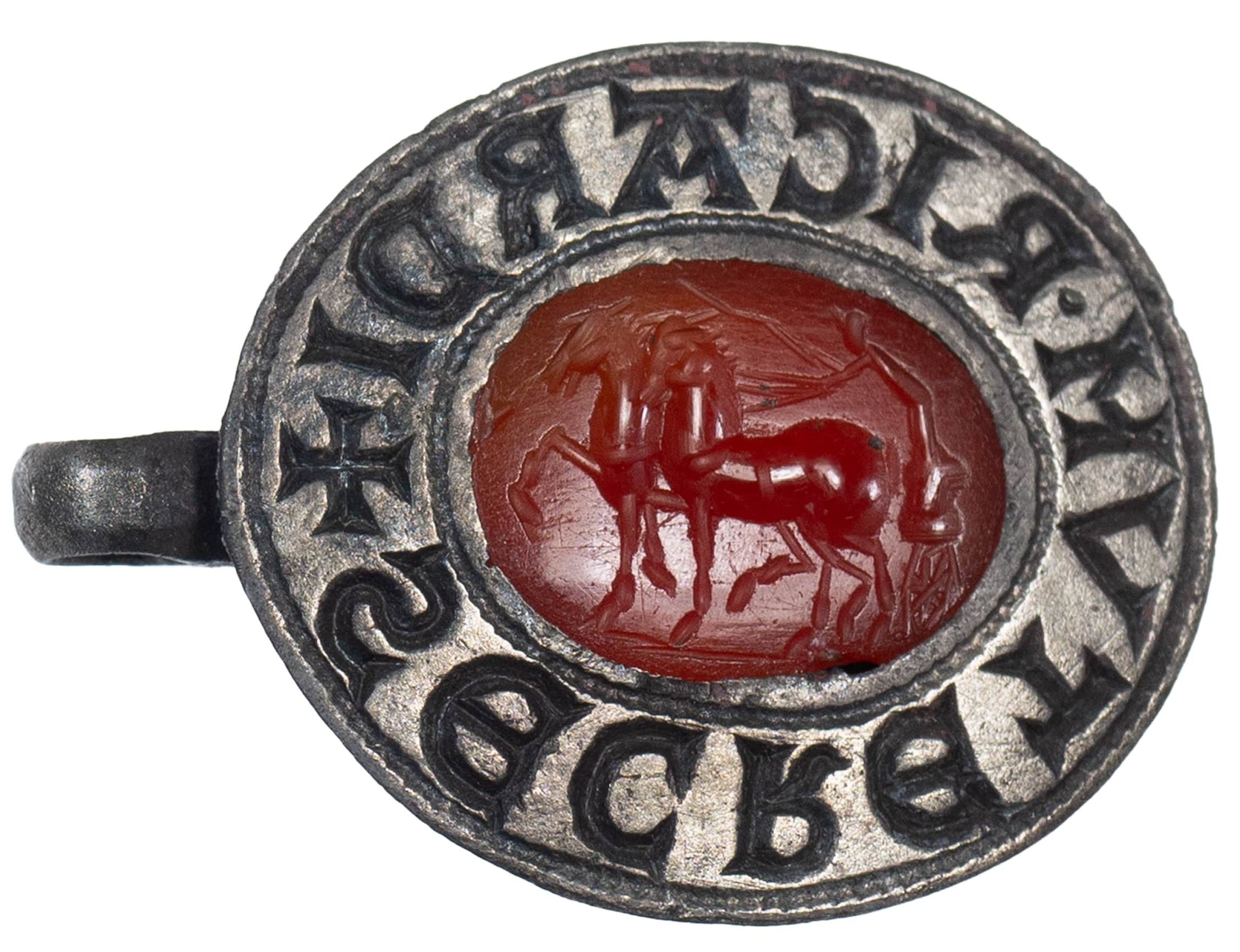
A chance metal-detecting discovery in southeastern England has brought to light an object that quietly bridges two distant worlds of European history. In rural Essex, a rare medieval silver seal has been found bearing a finely engraved Roman-era gemstone depicting a racing chariot — an image originally carved more than a thousand years before the seal itself was made.
A Roman Biga Reused in the Middle Ages
At the heart of the seal is a deep red carnelian intaglio engraved with a biga — a two-horse chariot commonly associated with speed, victory, and public spectacle in Roman culture. The carving shows two horses moving at a controlled trot, pulling a compact chariot driven by a charioteer holding the reins and a long whip.
Art-historical comparison places the gemstone in the late 1st century BC or early 1st century AD, a period closely associated with early imperial Rome. Despite its classical origin, the stone was later reset into a silver mount and repurposed as a seal during the 13th to 14th centuries, when ancient Roman gems were highly prized among medieval elites.
“Richard’s Private Seal”
The silver bezel surrounding the gemstone bears a Latin inscription engraved in reverse, designed to read correctly when impressed in wax: “+SECRETVM . RICARDI.” While often translated literally as “Richard’s secret,” the phrase is better understood as “Richard’s private seal.”
Such seals were not intended for official administrative documents. Instead, they functioned as personal or counter-seals, used to authenticate private correspondence or discreet transactions. Examples incorporating reused Roman gemstones are known from the period, but pieces featuring early, high-quality intaglios like this one are comparatively rare.
Why Roman Gems Still Mattered in the Middle Ages
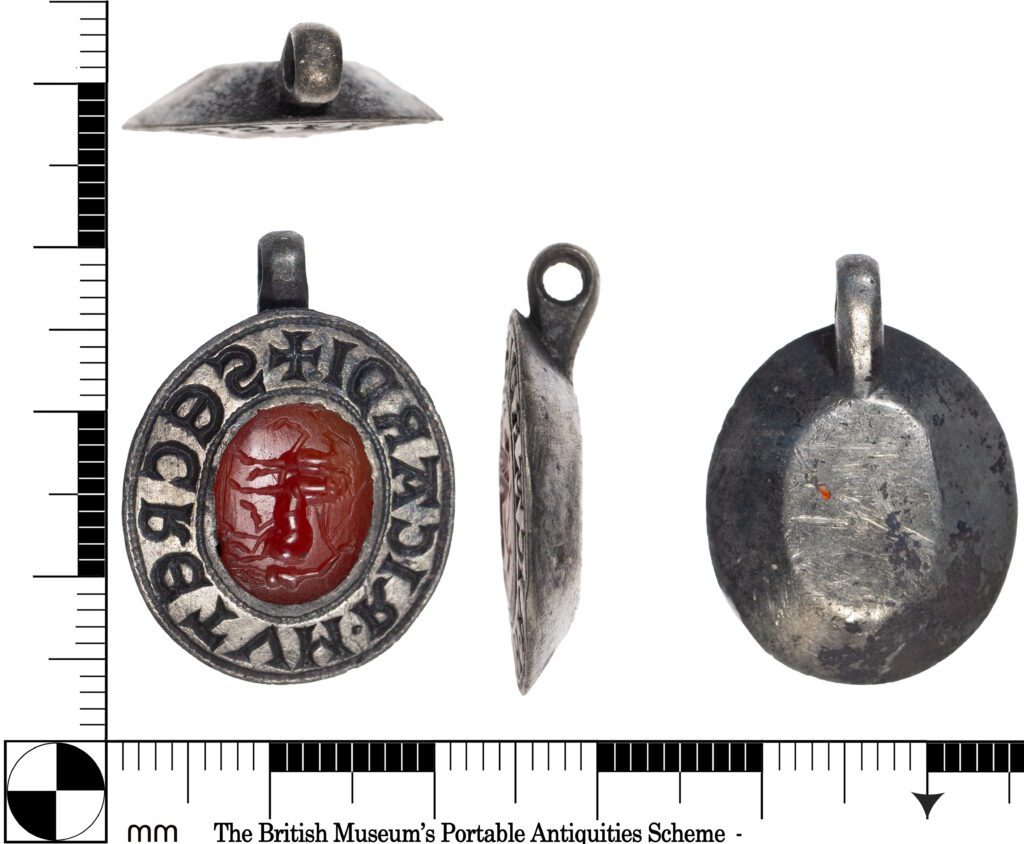
Medieval seals set with Roman intaglios vary widely in quality and origin. Later Roman stones, often dating to the 2nd–4th centuries AD, were frequently discovered accidentally during agricultural work and reused with little concern for craftsmanship. Earlier intaglios, however — especially those from the Augustan period — were deliberately sought after.
This biga intaglio belongs to the latter category. Its refined execution suggests it was consciously selected for its artistic merit and its association with classical authority. For a medieval owner, such a gemstone conveyed education, status, and a symbolic link to Rome’s imperial past.
From Field Discovery to Public Heritage
The seal was discovered in September near Gosfield by a metal detectorist. Under British law, it has been officially declared treasure and will now be professionally valued before being offered to a local museum. Should no institution acquire it, ownership may legally revert to the finder.
Archaeologists and curators note that objects combining Roman material culture with medieval reuse provide especially valuable insight into how the past was interpreted, preserved, and repurposed long after the fall of the Roman Empire.
One Object, Two Historical Worlds
This seal is more than a finely crafted accessory. It is a compact historical document — one that shows how Roman imagery endured, not as a relic, but as a living symbol woven into medieval identity and authority. The chariot once associated with Roman racing arenas ultimately became a personal emblem of power and authenticity in medieval England.
Cover Image Credit: Colchester and Ipswich Museum Services