
A compact iron weapon recovered from farmland in northeastern Poland is offering an unusually direct physical link to late medieval warfare. Archaeologists have confirmed that the object—a rare kiścień, or medieval flail—dates to the same era as the famous Battle of Grunwald, one of the most consequential military confrontations in European history.
A Weapon Rarely Preserved in the Archaeological Record
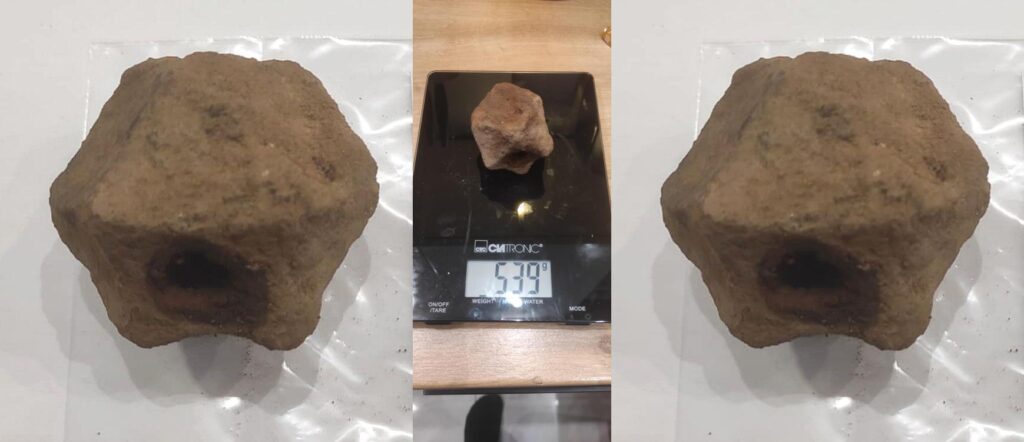
The flail was discovered near the village of Gietrzwałd in Poland’s Warmian-Masurian region during a legally approved field survey carried out by experienced amateur detectorists. Specialists examining the find identified it as a kiścień, a flail-type weapon used widely between the 11th and 15th centuries across Central and Eastern Europe.
What makes the discovery exceptional is not only its condition but also its rarity. According to regional experts, this is just the fourth archaeological example of a kiścień ever documented in the area. Despite frequent references in medieval chronicles and visual depictions, such weapons are seldom recovered because many were made with organic components—wooden handles, leather straps, or ropes—that rarely survive in the soil.
How the Kiścień Was Used in Medieval Combat
Unlike swords or spears, the kiścień was designed for close-quarters fighting against armored opponents. A weighted striking head, attached to a short flexible connector, allowed the weapon to deliver powerful, unpredictable blows capable of bypassing shields or striking vulnerable points in armor. Both infantry and mounted soldiers employed flails, particularly in regions where battlefield encounters often turned into dense mêlées.
While modern popular culture tends to exaggerate medieval violence, historians emphasize that weapons like this reflect tactical pragmatism rather than brutality. The kiścień represents a response to evolving armor technology and the practical realities faced by soldiers on crowded medieval battlefields.
Found in the Shadow of a Defining European Battle
The location of the discovery adds a further layer of historical resonance. The artifact was unearthed only a short distance from the site of the Battle of Grunwald, fought on 15 July 1410. In that decisive clash, the allied forces of the Kingdom of Poland and the Grand Duchy of Lithuania defeated the Teutonic Order, permanently altering the political balance of northeastern Europe.
Although archaeologists caution against directly associating the weapon with a specific soldier or moment from the battle, its chronological and geographical proximity strengthens the material connection between surviving artifacts and written historical accounts of the conflict.
Museum Verification and Scholarly Assessment
Following its recovery, the flail was reported to heritage authorities and examined by specialists affiliated with the regional Grunwald battlefield museum and the Warmia and Mazury museum network. Detailed photographic analysis and structural assessment confirmed the object’s authenticity and medieval date. Museum officials note that their own collections include only a single comparable example, underscoring how rarely such weapons enter the archaeological record.
Further conservation work is planned to assess the artifact’s construction techniques, weight, and possible origin. Researchers hope to determine whether it was locally produced or influenced by broader regional trade networks that shaped medieval arms manufacturing.
Detectorists and the Protection of Shared Heritage
The find also highlights the increasingly important role of responsible detectorist groups in Polish archaeology. When conducted legally and in cooperation with museums, such surveys can help recover artifacts that might otherwise remain undiscovered or be lost to the illicit antiquities market. Scholars stress that proper reporting ensures objects like this kiścień can be studied, preserved, and interpreted within their full historical context.
A Small Object With Large Historical Meaning
Although modest in size, the flail adds a tangible dimension to our understanding of medieval warfare in Eastern Europe. Each rare weapon recovered from the ground helps bridge the gap between historical texts and lived experience, offering insight into how soldiers fought, adapted, and survived during one of the continent’s most turbulent periods. Near Grunwald, where history reshaped an entire region, this single artifact quietly reinforces the enduring power of material evidence.
Cover Image Credit: This image is an AI-generated illustrative reconstruction inspired by 15th-century artwork. It provides educational and historical information about the structure and documented use of a medieval flail weapon, rather than depicting a real event or promoting modern-day weapon use.