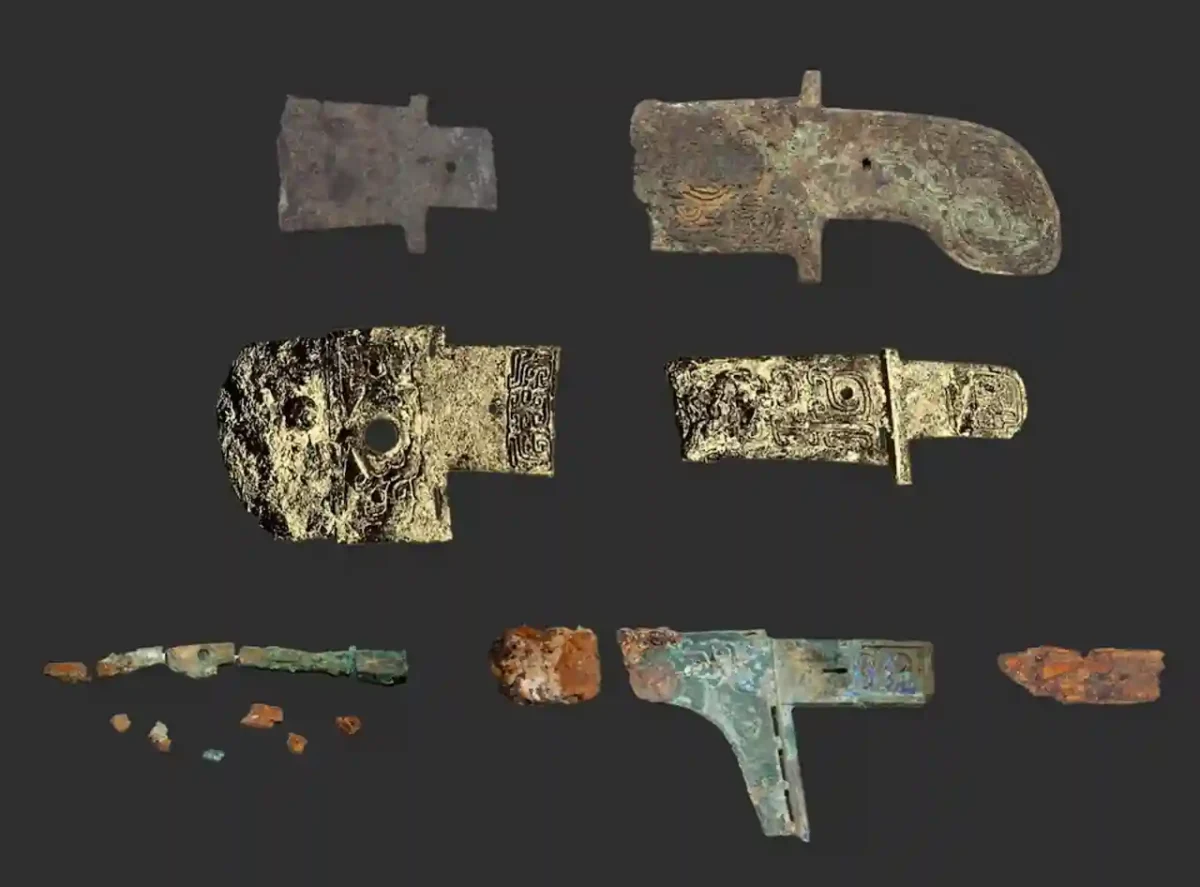
A strange iron object buried for more than three millennia at the ritual complex of Sanxingdui has now been confirmed to come from outer space.
Researchers in China have identified the elongated, axe-like artifact as meteoritic iron, making it the oldest and first confirmed example of such material in southern China. The study, published in Archaeological Research in Asia, offers rare insight into how Bronze Age societies engaged with materials literally fallen from the sky.
A Ritual Object from One of China’s Most Mysterious Sites
Sanxingdui, located in Sichuan province, is already known for reshaping our understanding of ancient Chinese civilization. Dating roughly between 2800 and 600 BCE, the site reached its peak during the Shang period and has yielded thousands of extraordinary ritual objects — including towering bronze trees, masks, and finely cast figures.
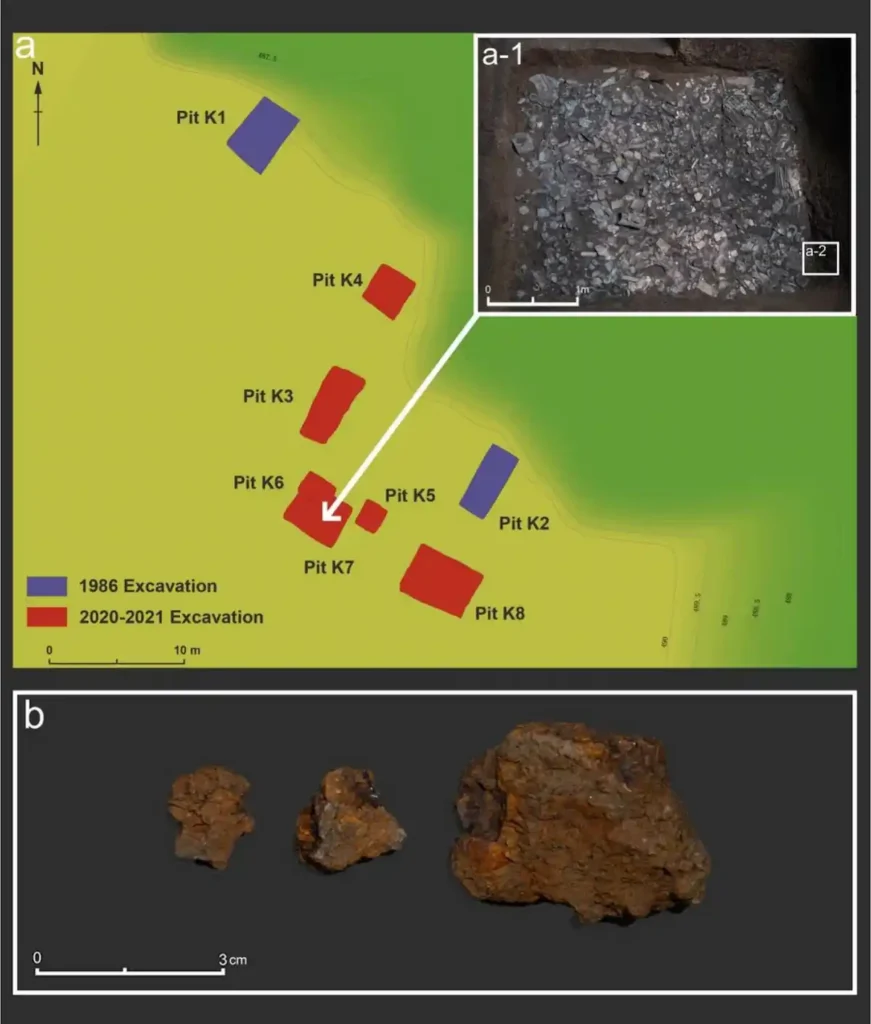
The newly analyzed iron artifact was recovered from Pit No. 7, one of eight sacrificial pits at the site. Unlike typical grave goods, it was found embedded vertically into the wall of the pit, suggesting a deliberate and possibly symbolic placement.
Its fragile condition forced archaeologists to remove it together with surrounding soil, preserving its integrity. During early conservation work, several small fragments detached — and those fragments would prove crucial.
Chemical Clues Point Beyond Earth
Initial tests using portable X-ray fluorescence revealed something unusual.
The object consisted of more than 90% iron, but also contained approximately 7.4% nickel — a signature that immediately raised suspicion. Iron produced through ancient smelting rarely contains such elevated nickel levels, especially in early Bronze Age contexts.
Given that iron metallurgy had not yet developed in China at the time, researchers began to consider a different origin.
To confirm their hypothesis, scientists conducted detailed metallographic and SEM-EDS analyses on one of the fragments.
The results were decisive.
A Microstructure Formed in Space
Under electron microscopy, the metal displayed a structure composed of uniform ferrite grains, with no signs of deformation. This type of microstructure is characteristic of metallic meteorites, which cool extremely slowly over millions of years in space.
Even more telling was the distribution of nickel.
Chemical mapping showed that nickel — averaging around 20% concentration — was perfectly homogeneous throughout the material. Achieving such uniformity would have been virtually impossible using any known metallurgical techniques of the Shang period.
Researchers emphasized that the diffusion behavior of iron and nickel makes this level of consistency unattainable through early smelting technologies. In other words, the object was not made — it was reshaped from a naturally occurring extraterrestrial metal.
A Rare Southern Example
Meteoric iron artifacts are not entirely unknown in China, but they are exceptionally rare.
To date, only about thirteen examples have been identified across the country, most of them concentrated in northern regions such as Henan, Hebei, and Beijing. These are typically associated with elite burials and often appear as bimetallic objects, where meteoritic iron was inserted into bronze tools or weapons.
The Sanxingdui artifact is different.
It is monometallic, made entirely of meteoritic iron, and stands out as the largest known example in China. Its unusually high nickel content — around 20%, well above the typical average — further distinguishes it from previously known finds.
Its closest parallels are found not in the Central Plains, but in distant Xinjiang, suggesting regional diversity in early metal use rather than a unified technological tradition.
Tool, Ritual Object — or Both?
The function of the artifact remains uncertain.
Unlike northern examples tied to burial contexts, the Sanxingdui object comes from a clearly ritual environment. Yet there are intriguing hints that it may have served a practical purpose before deposition.
Many bronze objects from Sanxingdui show post-casting cut marks, indicating they were modified using tools harder than bronze itself. Meteoric iron, significantly more durable, would have been ideal for such tasks.
The possibility that this object functioned as a cutting or shaping tool cannot be ruled out — though researchers caution that further evidence is needed.
A Material from the Sky
Beyond its technical implications, the discovery carries symbolic weight.
For ancient societies, meteoritic iron was not just rare — it was extraordinary. A material that literally fell from the heavens may have held deep ritual or cosmological significance.
The deliberate placement of this object within a sacrificial pit suggests that it was more than a tool. It may have been perceived as a sacred substance, bridging the earthly and the celestial.
Filling a Critical Gap in Early Metallurgy
The confirmation of meteoritic origin does more than solve a mystery — it fills a major gap in the archaeological record of southwestern China.
As the earliest Bronze Age meteoritic iron artifact identified in the region, the Sanxingdui piece expands our understanding of early metal use, long before iron smelting became widespread.
At the same time, questions remain unanswered. The exact type of meteorite from which the iron originated is still unknown, and further analysis is limited by the artifact’s fragile condition.
Future high-resolution techniques may help refine its classification — and perhaps reveal more about how ancient people selected, shaped, and valued materials from beyond Earth.
Haichao Li, Zishu Yang, Yuniu Li, Jiahui Liu, Yu Lei, Honglin Ran, The earliest meteoritic iron artefact of the Chinese Bronze Age discovered at Sanxingdui, Southwest China. Archaeological Research in Asia, Volume 46, June 2026, 100692. doi.org/10.1016/j.ara.2026.100692
Cover Image: Meteoric iron artifacts discovered across China. Credit: H. Li et al., 2026