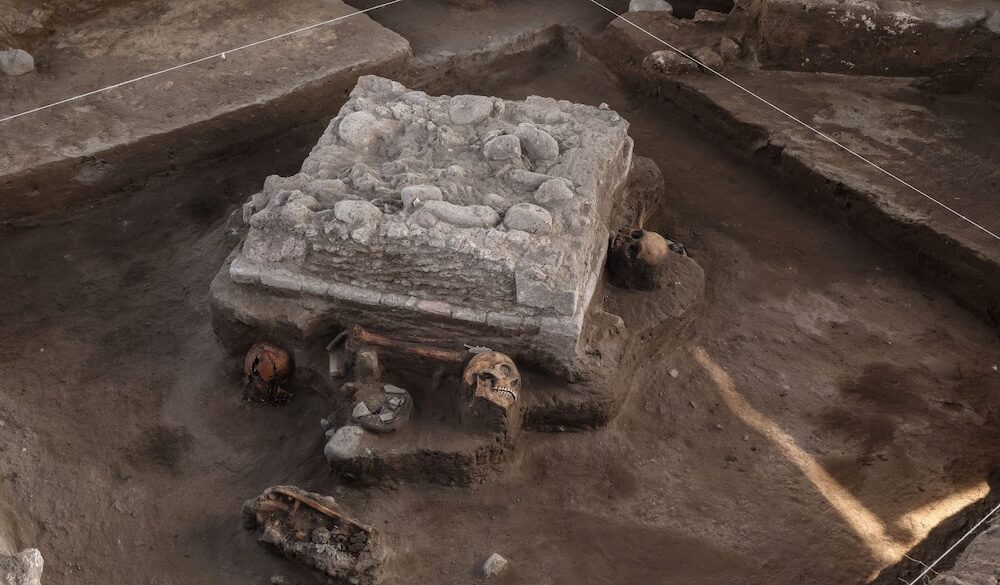
Archaeologists working near the ancient city of Tula in central Mexico have uncovered a Toltec ceremonial altar surrounded by human remains and ritual offerings, shedding new light on the religious life and urban layout of one of Mesoamerica’s most influential civilizations.
The discovery emerged during salvage excavations linked to the construction of the Mexico City–Querétaro passenger railway, a project that has unexpectedly revealed new layers of Toltec history. The work is being carried out under the supervision of Mexico’s National Institute of Anthropology and History (INAH).
Discovery Expands the Boundaries of Ancient Tula
The altar was found just outside the protected limits of the Tula Archaeological Zone in Hidalgo, near an area known as Tula Chico. Dating to the Tollan phase (AD 900–1150), when Tula functioned as the Toltec capital, the structure offers new evidence that the city extended beyond its previously mapped core.
Located roughly 300 meters outside the main zone, the find suggests that elite or ceremonial spaces may have existed on the city’s outskirts, challenging long-standing assumptions about Tula’s spatial organization.
A Ceremonial Platform Built for Ritual, Not Access
Identified as a momoztli, a type of ceremonial altar, the structure measures approximately one meter on each side. It was constructed using andesite blocks, basalt, and river stones, carefully arranged to form at least three low tiers.
Notably, the altar lacks stairways or access points—an architectural detail that points to a restricted ritual function, rather than a space designed for public interaction.
Human Remains Suggest Ritual Deposition
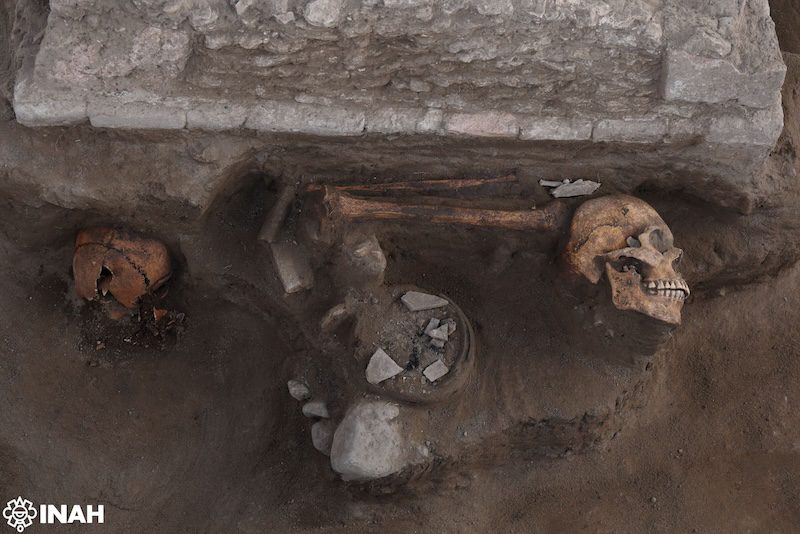
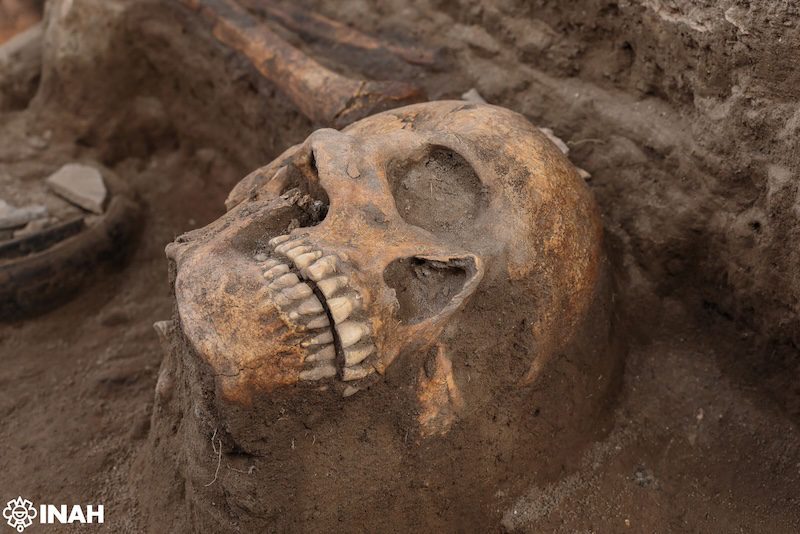
The most striking aspect of the discovery is the presence of human remains deliberately placed around the altar. Archaeologists documented four skulls and several long bones, likely femurs, positioned along three sides of the structure.
One skull was found still connected to part of the vertebral column, a detail that could provide critical evidence for ritual decapitation practices. If cut marks are confirmed, they may indicate the use of obsidian or flint blades, tools commonly associated with ceremonial activity in ancient Mesoamerica.
Researchers believe additional remains may be uncovered as excavation continues, potentially completing a four-sided arrangement.
Offerings Reveal a Blend of Ritual and Daily Life
Alongside the human remains, archaeologists uncovered a range of artifacts connected to both ceremonial and domestic activity. These include ceramic vessels, obsidian fragments and blades, bone tools, shell remains, spindle whorls, and awls.
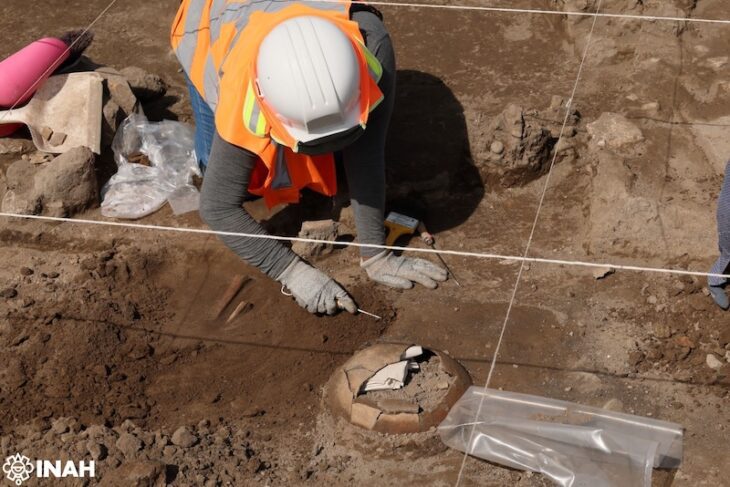
One notable find—a black ceramic bowl containing another vessel—suggests intentional deposition practices, possibly linked to ritual offerings or symbolic acts.
Together, these materials indicate that the space functioned not only as a ritual center but also as part of a broader lived environment tied to elite groups.
Evidence of an Elite Courtyard Complex
Further excavation revealed traces of walls and compacted floor surfaces, suggesting the altar once stood at the center of a courtyard. This layout supports the interpretation that the structure formed part of a larger architectural complex, possibly including elite residences or ceremonial buildings.
Archaeologists note that Tula’s outer zones have long been associated with higher-status populations, reinforcing the idea of a socially stratified city with clearly defined spatial divisions.
Reconsidering the Structure of the Toltec Capital
The discovery contributes to a growing body of evidence that Tula was not limited to its monumental core. Instead, the city appears to have included extended ceremonial and residential zones, reflecting a more complex and layered urban landscape.
Tula, which rose to prominence after the decline of Teotihuacan, later became known in Aztec tradition as Tollan, a symbolic center of power, knowledge, and legitimacy.
Salvage Archaeology Reveals Hidden Histories
All recovered materials are currently undergoing detailed analysis. Human remains will be examined to determine age, sex, health conditions, and cause of death, while ceramic artifacts are being processed for classification and conservation.
At the same time, archaeologists are using drone mapping and digital modeling techniques to document the site with high precision before further intervention.
Authorities are now evaluating whether to preserve the altar in place or relocate it for protection.
A Discovery That Reshapes the Edges of Tula
Beyond its immediate findings, the discovery highlights the importance of infrastructure-linked archaeology in Mexico, where modern development often intersects with ancient landscapes.
What began as a routine salvage operation has revealed a ceremonial space that may significantly alter how archaeologists understand the reach, structure, and ritual life of the Toltec capital.
As excavations continue, the altar and its offerings are expected to provide deeper insight into how power, belief, and social hierarchy were expressed beyond the monumental heart of Tula.