
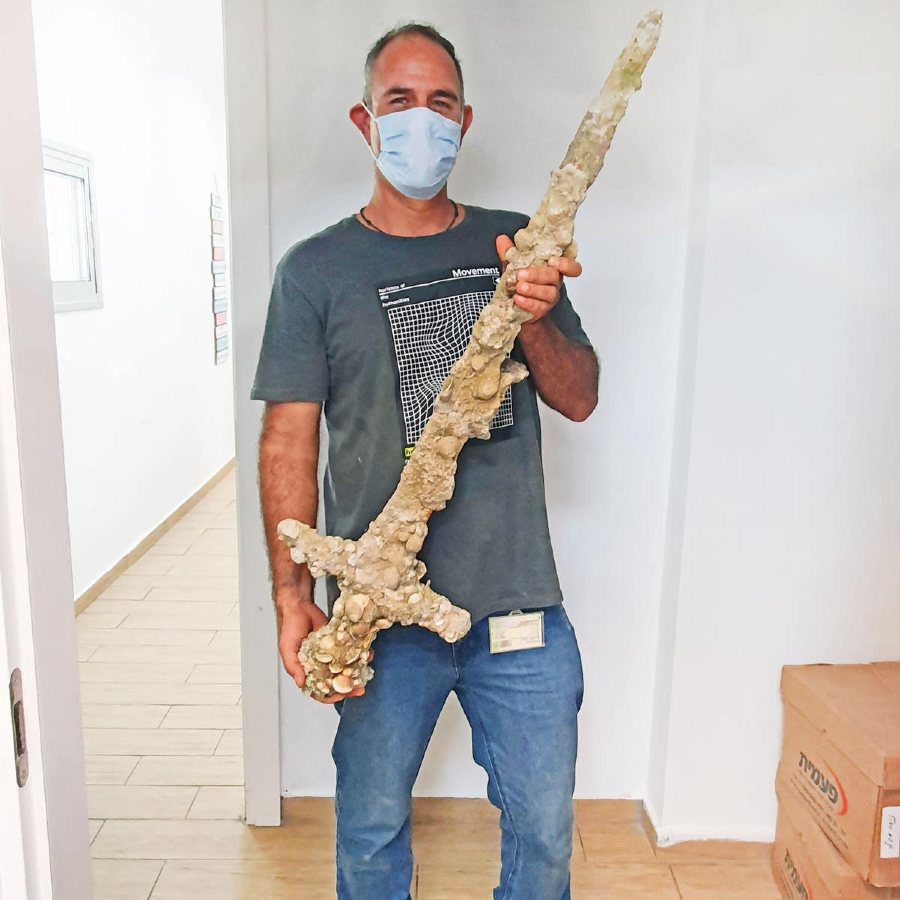
Five years after uncovering a barnacle-covered Crusader sword off the coast of Israel, diver Shlomi Katzin has returned to nearly the same location—and found another.
The new find is already drawing attention from archaeologists, not just for its rarity, but for what it suggests about medieval activity along the region’s shoreline.
A Chance Encounter Turns Into a Pattern
Back in 2021, Katzin made headlines after spotting a sword partially buried in sand on the seabed. Encrusted with shells and marine growth, the weapon appeared almost sculptural—its outline unmistakable despite centuries underwater.
Now, in a striking repeat, Katzin has recovered a second sword from the same general area.
This time, the discovery came under unusual circumstances. While swimming near a site known for historic shipwrecks, Katzin noticed individuals using metal detectors. Suspecting possible looting, he approached the group—only to spot the sword protruding vertically from the sand nearby.
It was a moment of coincidence that quickly turned into a controlled archaeological recovery.
Scientific Analysis Without Touching the Artifact
The newly discovered sword, believed to date to the 12th century, was transferred to the Israel Antiquities Authority (IAA) and researchers at the University of Haifa’s Department of Maritime Civilizations.
Instead of immediately cleaning or physically examining the object—actions that could risk damaging the fragile remains—researchers opted for a more advanced approach.
Using a CT scanner at a nearby hospital, they were able to visualize the internal structure of the sword without removing the thick marine encrustations.
The results were revealing.
Much of the iron blade had deteriorated over time, leaving only partial internal remains. However, the scans provided enough data to determine that the sword was likely not produced in the Levant. Instead, its characteristics point to European manufacture.
A Link to Crusader Campaigns
This detail is critical.
Combined with the earlier sword found in 2021, the evidence suggests both weapons were carried by European Crusaders operating along the eastern Mediterranean coast during the medieval period.
Between the 10th and 13th centuries, multiple Crusades were launched by European powers attempting to seize control of the Holy Land. While these campaigns ultimately failed, they left behind a material footprint—one that is only now beginning to emerge more clearly through underwater archaeology.
The presence of two swords in such close proximity raises the possibility that the site may have once functioned as a maritime anchorage or staging point used by Crusader forces.
Rare Finds With Broader Implications
According to Professor Debbie Zwickel of the University of Haifa, who facilitated the recovery process, such discoveries remain exceptionally uncommon.
“This is an extremely rare find that sheds light on the Crusader presence along the country’s coast,” she noted.
Only a limited number of Crusader-period swords have been documented in Israel to date, making each new discovery particularly valuable for reconstructing the historical landscape.
Beyond the weapons themselves, these finds offer insights into the daily realities of medieval warfare—how soldiers moved, where they anchored, and how material culture traveled across regions.
More Than Coincidence
What makes this discovery especially compelling is not just the sword itself, but the pattern it suggests.
Two nearly identical finds, recovered by the same diver within a few years and in the same general area, point to a broader archaeological context that may still be hidden beneath the seabed.
For now, the Mediterranean continues to guard its secrets. But with each discovery, the picture becomes sharper—revealing not isolated artifacts, but fragments of a much larger historical narrative waiting to be pieced together.
Cover Image: Yoav Bornstein, University of Haifa