
For years, Petra’s was described as practical, efficient, mostly gravity-driven. That picture just shifted.
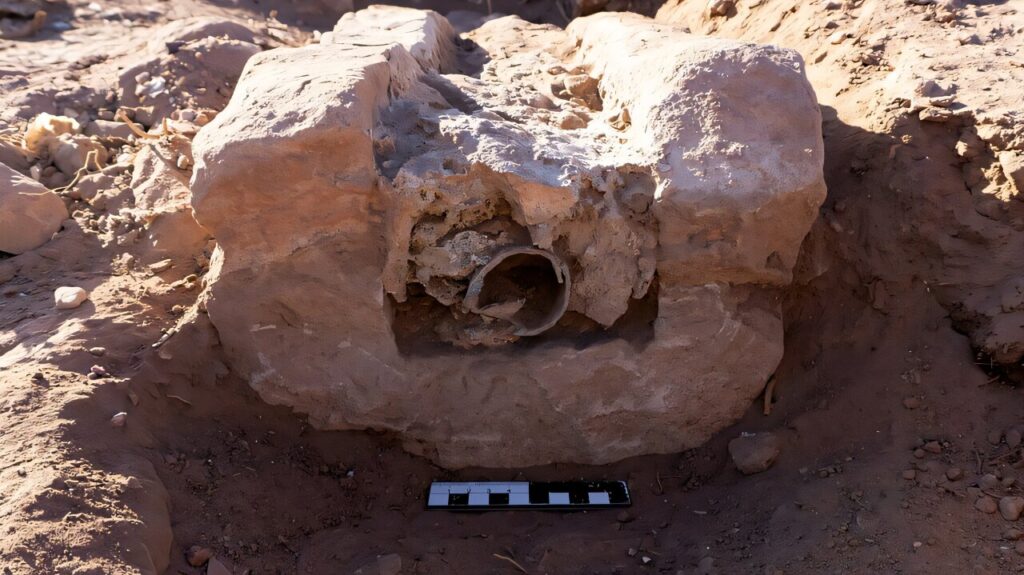
On the slopes of Jabal al-Madhbah, archaeologists have identified a 116-meter pressurized lead pipeline preserved in situ — a feature rarely documented in open-air aqueduct corridors in the eastern Mediterranean. The find sits within a 2,500-square-meter survey zone and belongs to the ‘Ain Braq water network.
More importantly, it shows that this was not a single-phase system.
An Early Experiment with Pressure
The earliest installation used welded lead pipes designed to withstand hydraulic pressure. This was not standard Nabataean practice. Terracotta was far more common.
Lead, however, allowed something different. Using an inverted siphon principle, water could drop steeply and then rise again — essential in Petra’s broken, uneven terrain. It suggests planning at a higher level than previously assumed.
Lead was expensive. It required imported material, fuel for smelting, skilled labor, and maintenance knowledge. Installing it along an exposed slope was a statement as much as a solution.
At some point, the pipeline was sealed.
A Practical Replacement
In a later phase, engineers replaced the pressurized system with open channels and terracotta pipes laid over a constructed stone base. Water was directed into a small distribution box with two outlets, from which it could be divided toward different parts of the city.
The shift appears deliberate. Terracotta was cheaper, easier to repair, and locally manageable. It reflects adjustment — not failure.
Az Zantur and Monumental Petra
The lead conduit likely pushed water uphill toward the reservoir on Az Zantur, a ridge overlooking the city center. From there, gravity could take over.
The timing aligns with Petra’s peak growth during the reign of Aretas IV, when major structures such as the Great Temple and the Garden and Pool Complex were expanding. These projects required reliable water flow — not just for daily use, but for effect.
In a desert capital, visible water carried political meaning.
More Than a Single Line
The survey documented nine conduits in this limited sector, along with a large reservoir closed by a substantial dam, two cisterns, seven basins, and several runoff channels carved into the rock.
The dam itself stands out. Its stepped façade and irregular profile differ from other known Petra dams. The design may have helped distribute hydraulic pressure within the reservoir. It may also have shaped seasonal runoff into controlled cascades. In Petra, engineering and display often intersected.
What emerges is not a simple aqueduct, but a layered system that changed over time.
The newly documented lead pipeline does not just add a technical detail. It complicates the story. Nabataean water management was more experimental — and more adaptable — than previously thought.
Urban Development of Ancient Petra Project
Jungmann, N. (2025). Rediscovering the ‘Ain Braq aqueduct: new insights into Petra’s urban water management. Levant: The Journal of the Council for British Research in the Levant, 1–19. doi:10.1080/00758914.2025.2592501
Cover Image Credit: The Urn Tomb, Petra, Jordan – Wikipedia Commons