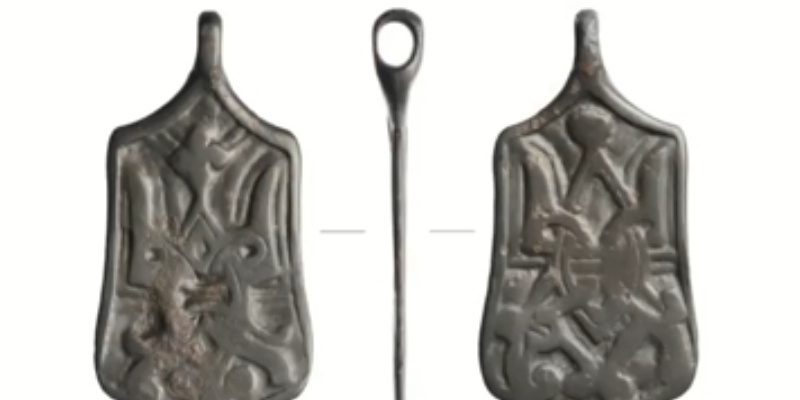
A small pendant unearthed in northern Russia is offering unusually concrete evidence of how power functioned in the earliest phase of the Rus’ state.
Archaeologists excavating in Old Ladoga have discovered a rare 10th–11th century heraldic pendant bearing the trident emblem of the Rurikid dynasty. Scholars believe the object did not serve as simple adornment. Instead, it likely functioned as an official identification marker — a credential carried by a princely envoy or high-ranking administrator acting on behalf of a ruling prince.
The discovery was presented at the 40th academic conference “Novgorod and the Novgorod Land: History and Archaeology,” hosted by the Novgorod State Museum-Reserve. The research was delivered by Marianna Pavlova of the Institute for the History of Material Culture, part of the Russian Academy of Sciences.
A Ceremonial Emblem of Authority
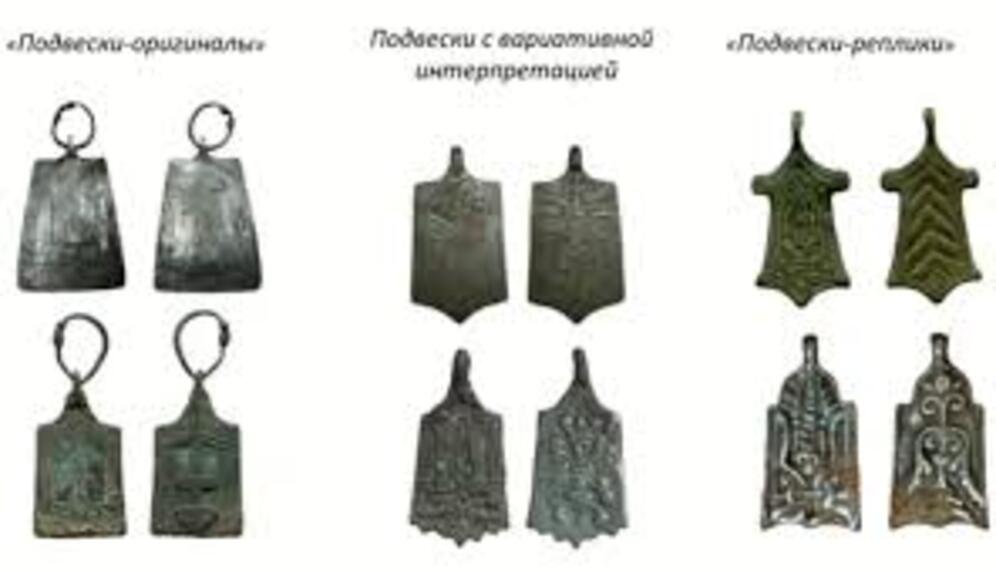
The pendant displays the Rurikid trident, or tryzub, on both sides — a dynastic symbol strongly associated with the princes of Kievan Rus’, including Vladimir the Great and Yaroslav the Wise. Only eight pendants bearing this exact heraldic design are known to archaeologists, placing the Ladoga example among a remarkably small and exclusive group.
Researchers classify such pendants into two categories. The earliest type, dating to the 10th–11th centuries, functioned as official insignia authorizing princely representatives. Later examples from the 12th–13th centuries appear to be decorative replicas inspired by the original administrative symbols.
The newly discovered piece belongs to the earlier, official group.
Despite visible corrosion, its details remain legible. On one side, the central prong of the trident ends in a rhombus-shaped finial set above an oval base supported by a triangular stem, flanked by three small spheres. The reverse features a similar design, though crowned with a spherical finial rather than a rhombus.
Pavlova described the trident as rendered in a distinctly “ceremonial” form — emphasizing symbolic authority over ornamentation. Wear patterns and smoothed relief suggest prolonged and active use, implying that the pendant accompanied its owner during official duties rather than being stored or displayed.
A Metallurgical Puzzle
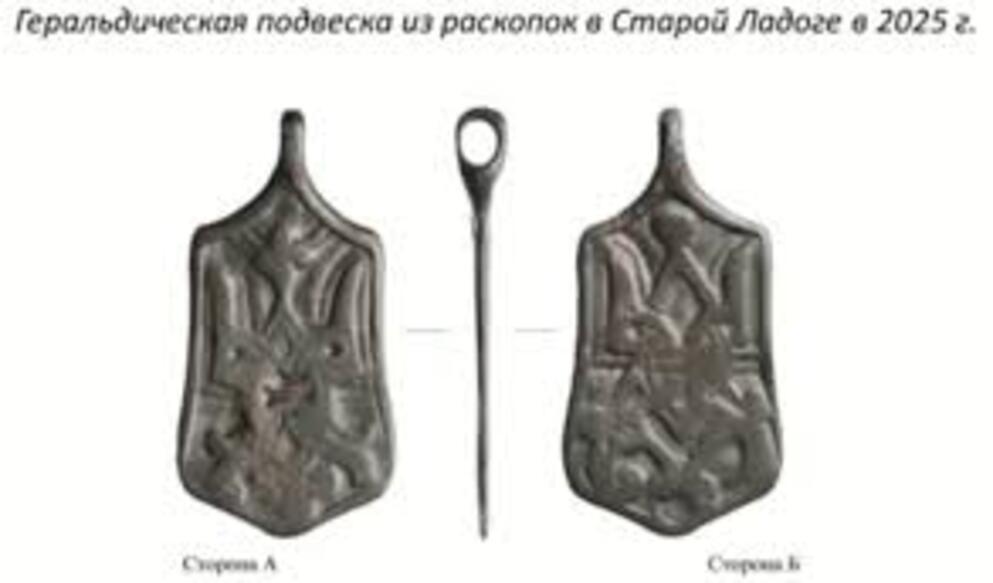
Scientific analysis revealed an unexpected complexity in the object’s composition.
The outer surface contains roughly 49% lead, 24% tin, and 23% copper, with minor traces of silver, arsenic, and zinc. Beneath this surface layer, however, corrosion exposed a markedly different composition: approximately 82% copper, with only small amounts of tin and lead.
This contrast has sparked debate. One interpretation suggests the pendant was originally cast from a copper alloy and later coated with a tin-lead layer to create a silvery appearance — a finish that would enhance its prestige and visibility. Another scholar proposed that the unusual distribution of metals might instead result from tin migrating toward the surface during the casting process, rather than deliberate plating.
Either way, the craftsmanship reflects technical sophistication and intentional visual messaging.
A Direct Link to Novgorod
One of the most compelling aspects of the find is its near-identical match to a pendant discovered in Veliky Novgorod in 1956. The two objects share identical dimensions and form, strongly indicating they were cast from the same mold.
Interestingly, the Novgorod pendant preserves sharper detailing on one side, while the Ladoga example retains clearer features on the other. This variation suggests differences in casting quality or finishing techniques, rather than design changes.
The implication is significant: standardized insignia were being produced and distributed within a coordinated administrative framework.
Old Ladoga: A Northern Power Base
Old Ladoga occupies a pivotal place in early Rus’ history. Often described in medieval chronicles as an early seat of power associated with Rurik — the semi-legendary founder of the Rurikid line — the settlement stood at a strategic point along the famed trade route “from the Varangians to the Greeks.”
From this location, trade networks linked Scandinavia, the Baltic region, the Volga basin, and Byzantium. Archaeological evidence — including fortifications, elite residences, imported goods, and production workshops — indicates a permanent and organized political center rather than a temporary trading outpost.
Increasingly, scholars argue that Ladoga functioned as an experimental ground for early governance. Mechanisms of taxation, territorial control, and military organization may have taken shape here before being transferred to later urban centers such as Novgorod and Kyiv.
The presence of standardized authority markers, like the Rurikid trident pendant, reinforces the idea of structured administration under princely oversight.
Why It Matters
This pendant is more than a rare artifact. It represents a physical manifestation of early medieval governance — a symbol that communicated legitimacy, hierarchy, and delegated power.
Each new discovery from Old Ladoga refines our understanding of how the Rus’ state emerged, consolidated authority, and visually encoded political identity. The Ladoga pendant suggests that by the 10th century, princely administration was already operating with formal insignia, controlled production, and clearly recognizable symbols of rule.
A small object, yes. But one that speaks directly to the origins of dynastic power in Eastern Europe.
As research continues, Old Ladoga once again demonstrates why it remains central to debates about the birth of the Rus’ polity and the administrative strategies of the Rurikid rulers who shaped its early trajectory.
Cover Image Credit: 53News.ru