Beneath the floors of an ancient domestic complex near Tula, archaeologists have found a burial world tied to the age of Teotihuacan. The discovery includes human remains, shell ornaments, shaft tomb-like graves, and 47 miniature ceramic vessels placed beside the dead.
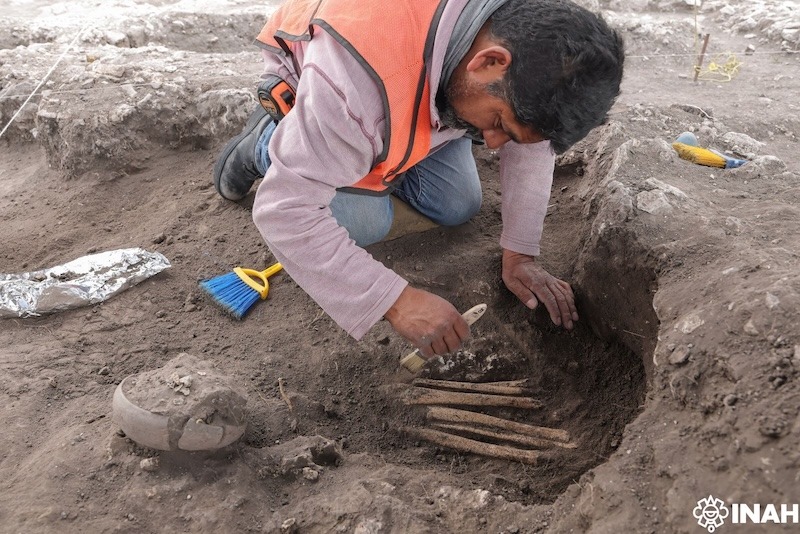
The excavation, carried out near the community of Ignacio Zaragoza in Mexico, is part of a rescue archaeology project linked to the Mexico City–Querétaro passenger train. Since September 2025, a team from Mexico’s National Institute of Anthropology and History has been working across a 2,400-square-meter area that falls within the planned railway route.
What began with scattered ceramics on the surface soon led to something far more substantial. Test pits revealed wall foundations, and further excavation exposed the remains of a pre-Hispanic residential complex. Within that domestic space, archaeologists found more than a dozen individual and collective burials.
The site is now offering a rare look at how people in this region lived, buried their dead, and maintained ritual practices during one of the most powerful periods in Teotihuacan’s history.
Burials Found Inside Ancient Rooms
The residential complex at Ignacio Zaragoza appears to have been made up of small domestic units connected by patios. Some patios were central, while others were located along the sides of the structures. The rooms were arranged along north-south and east-west axes, giving archaeologists a clearer view of how the settlement was organized.
The site was disturbed over many centuries. Long-term farming removed stones from earlier buildings, leaving only the lowest traces of walls. Even so, the floors and underlying rock preserved something more intimate than architecture: the burial spaces of the people who once lived there.
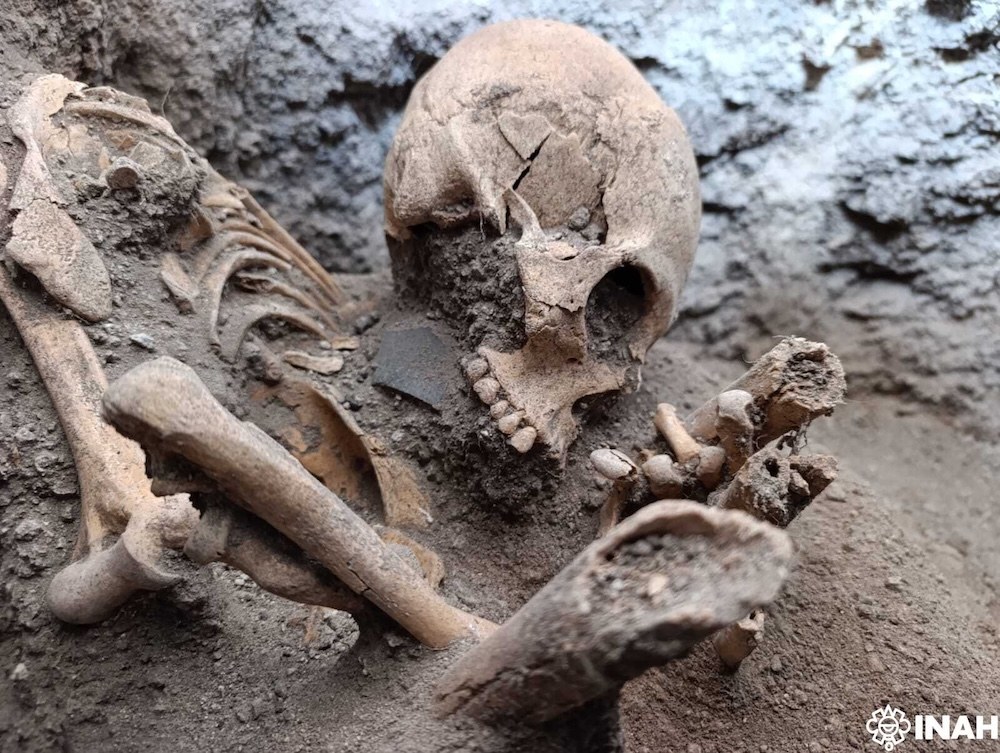
Inside the rooms, archaeologists identified both cist burials near the surface and tombs resembling shaft tombs, excavated into the hard tepetate layer beneath the domestic complex. This detail is important. The graves were not found in a distant cemetery, but within or directly below residential spaces.
For the excavation team, that relationship between house and burial may help explain how families or local groups understood ancestry, memory, and ritual obligation.
Eight Individuals and 47 Miniature Vessels
One room produced two of the most striking tombs. According to the excavation team, one was located toward the northern side of the room and another toward the south.
The northern tomb had two chambers running east-west. The southern tomb contained a single chamber facing east. Measurements recorded by the team show that the northern tomb’s shaft reached 1.69 meters deep, while the southern circular shaft reached 1.80 meters deep.
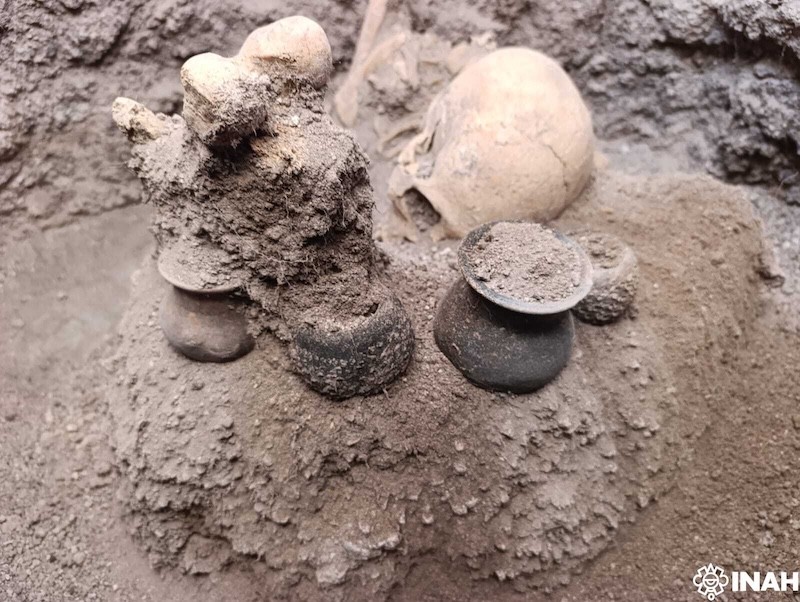
Inside the northern tomb, archaeologists recovered the remains of eight individuals, most of them adults. Six were placed in a seated position. Near their feet, the team found a ceramic offering made up of 47 miniature vessels.
The arrangement suggests a burial practice that was repeated over time. Some remains had been disturbed, and archaeologists believe the tomb may have been reopened when later individuals were placed inside. In that process, earlier funerary bundles may have been moved aside to make room for new burials.
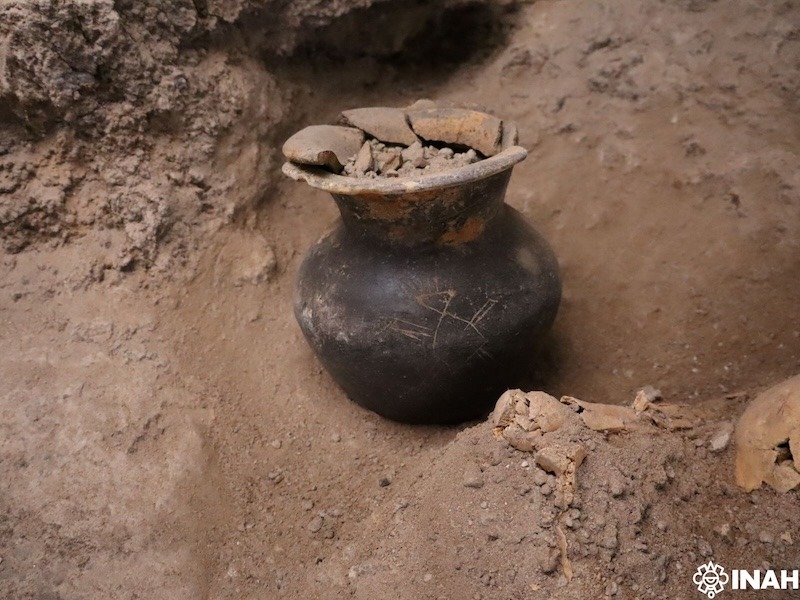
The tomb also contained personal ornaments. One individual was associated with a small shell object, possibly part of a mother-of-pearl pendant, as well as a small plaque made from the same material. In another tomb, incised vessels were removed with surrounding soil so that they could be studied through micro-excavation.
A Settlement from the Height of Teotihuacan
Most of the material from Ignacio Zaragoza has been linked to the Tlamimilolpan and Xolalpan phases, dating roughly from 225 to 550 CE. This places the main occupation of the site within the Teotihuacan period, when the great city’s influence extended across large parts of Mesoamerica.
The site also saw later activity. Archaeologists identified Coyotlatelco and Mexica ceramics from the Late Postclassic period, dated between 900 and 1521 CE. That later reoccupation shows that the area remained meaningful long after the original Classic-period settlement had faded.
But the Teotihuacan-era remains are the central point of the discovery. The combination of residential architecture, collective burials, seated individuals, shell ornaments, and miniature vessels suggests a community with structured funerary customs and a strong relationship between domestic space and ritual life.
The finds do not simply add another dot to the map of ancient Mexico. They bring attention to smaller communities that existed within the wider orbit of Teotihuacan, far from its monumental avenues and pyramids.
Tula’s Wider Archaeological Landscape
The excavation team cautions that Ignacio Zaragoza should not be viewed as an isolated site. The northern area of Tula contains several Classic-period settlements, including Chingú, considered a regional center connected with Teotihuacan expansion.
Other nearby sites, including El Tesoro, Acoculco, El Llano, and La Malinche, also form part of this broader archaeological landscape. At Acoculco, archaeologists have previously identified tombs linked to Zapotec and Teotihuacan traditions, as well as extended and flexed burials.
Another detail may connect the region to Teotihuacan in a practical way. Archaeologist Jonathan Velázquez Palacios notes that the area was exploited as a source of raw material in pre-Hispanic times, especially lime. Lime would have been essential for the stucco used on buildings at Teotihuacan, located about 90 kilometers away.
That connection gives the Ignacio Zaragoza discovery a wider significance. The site may help researchers understand not only burial customs, but also how communities around Tula participated in regional networks during Teotihuacan’s rise.
The 47 miniature vessels are the most visually striking find, but the deeper story lies in the setting. These objects were placed inside a domestic world where rooms, patios, graves, and memory seem to have overlapped. More than 1,500 years later, the floors of that settlement are beginning to show how people beyond Teotihuacan’s great urban center lived with their dead close by.