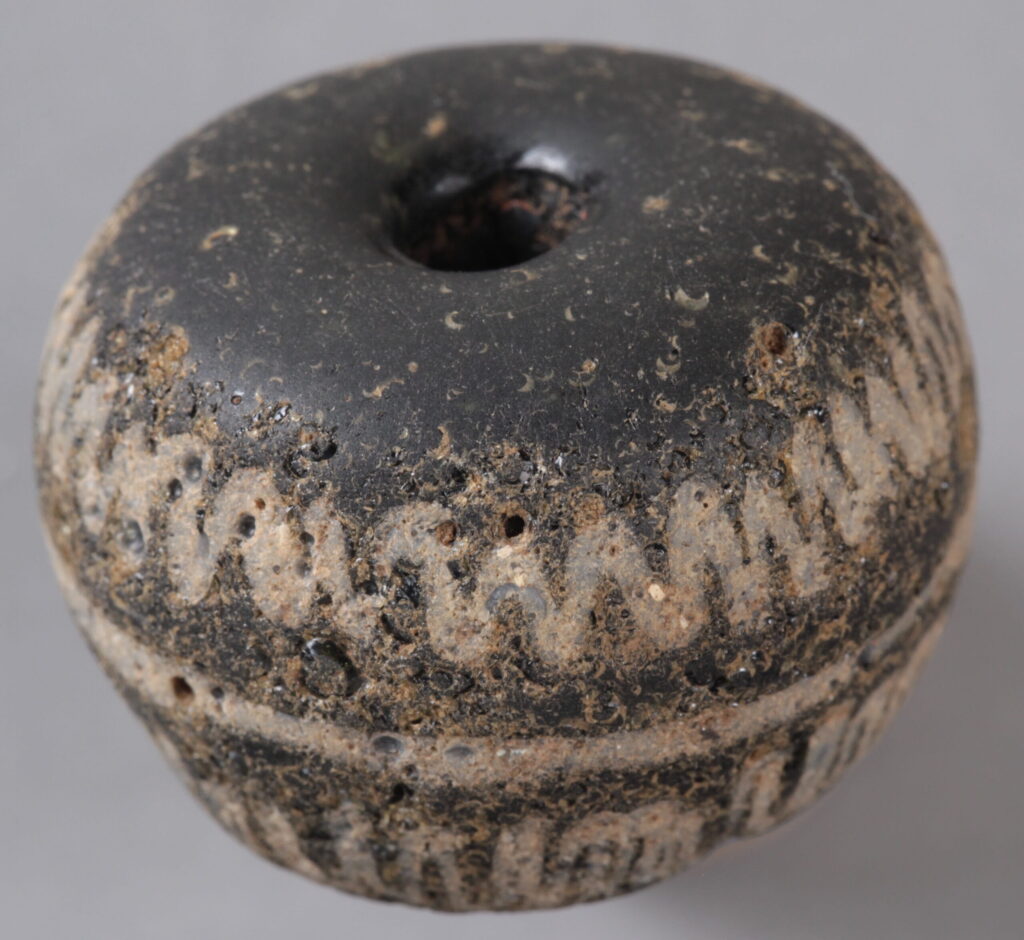
A large, dark glass bead decorated with pale wave-like bands has become the most striking find from a 1,600-year-old settlement uncovered at a gravel extraction site in Saxony, Germany.
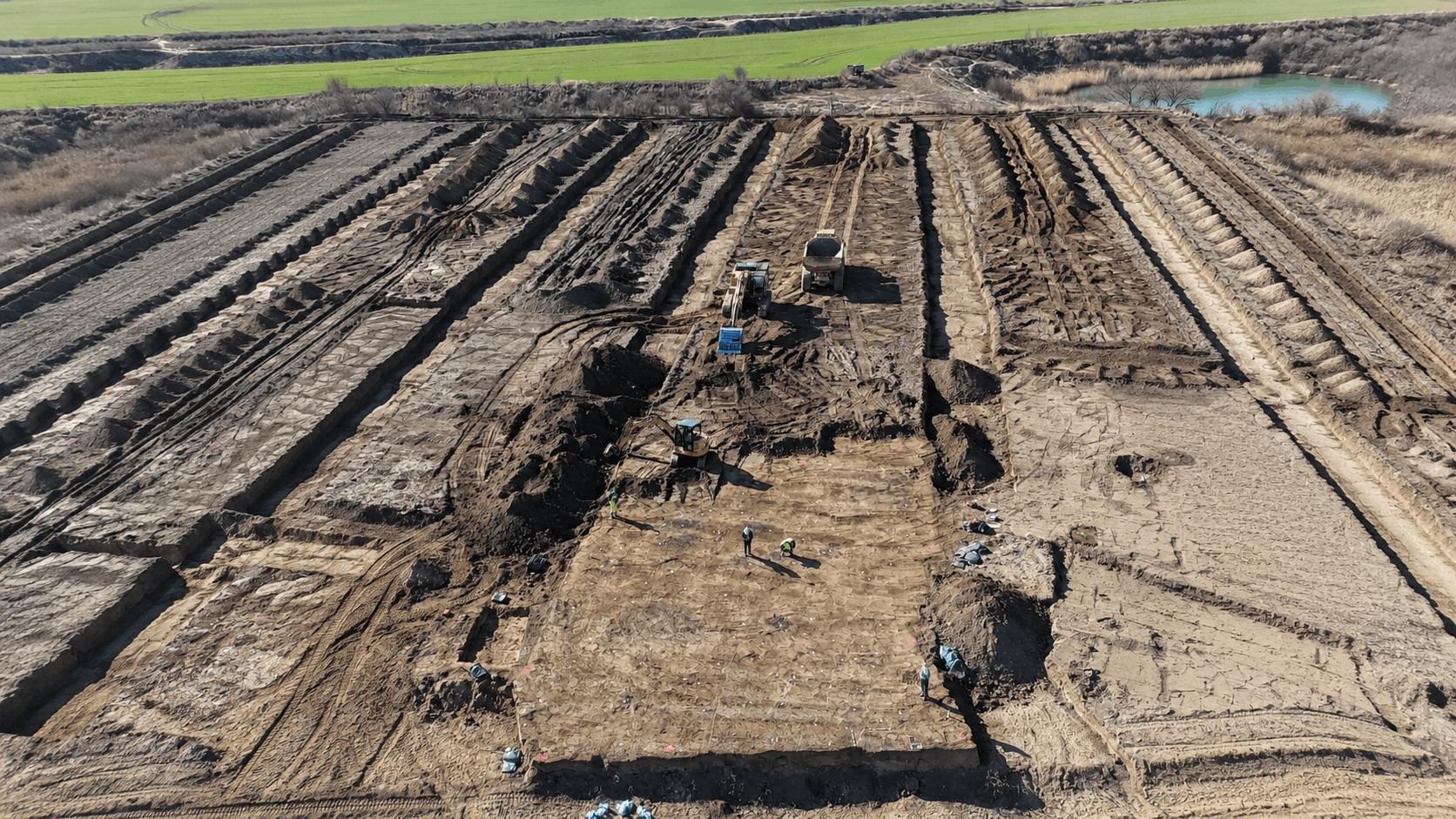
The discovery was made near Belgern-Schildau, where archaeologists from the State Office for Archaeology of Saxony examined the area before the planned expansion of an open-pit gravel mine. The site lies in a landscape known to have been occupied for thousands of years, but any surviving archaeological remains would have been destroyed once extraction work began.
What emerged from the soil was not a single object or isolated burial, but the remains of a small rural settlement dating from the 3rd to 5th centuries A.D., a period between the late Roman Imperial era and the early Migration Period. The traces point to a community that lived, stored grain, kept animals and produced textiles on site.
A village preserved in postholes, pits and burned clay
Archaeologists identified at least four multi-aisled longhouses built with post-and-beam construction. Some of these buildings measured up to 20 meters in length and about five meters in width. They appear to have served both as homes and stables, reflecting a practical rural layout in which people and livestock were closely connected.
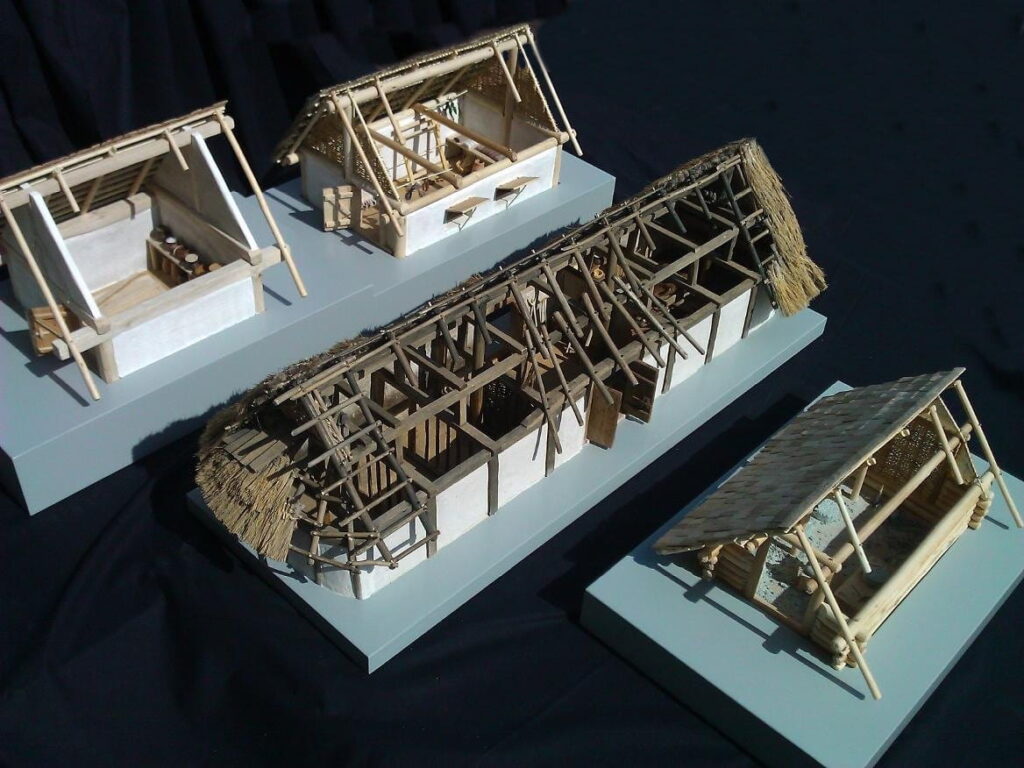
Three smaller pit houses were also documented. These structures, partly dug into the ground, had floor areas of roughly seven to twelve square meters. They likely functioned as farm buildings, workshops or storage spaces.
The remains are modest at first glance: postholes, pits, pottery fragments and traces of building material. Yet together they reveal the footprint of a self-sufficient village that existed far from the major centers of the Roman world, at a time when communities across central Europe were adapting to shifting political and social conditions.
Loom weights point to textile production
One of the pit houses produced clear evidence of textile work. Archaeologists recovered 30 flat, round clay loom weights, objects used to tension vertical warp threads on a loom. The presence of so many weights in one structure strongly suggests that woven fabrics were being produced inside the settlement.
During the Roman Imperial period, textiles in this region were commonly made from sheep’s wool. A clay spindle whorl found at the site adds another part of the production chain, since such objects were used to spin raw wool into thread on a weighted spindle.
This makes the settlement more than a cluster of farm buildings. It shows a small community managing several essential parts of daily life in one place: housing, animal keeping, food storage and textile production.
The strange dark glass bead
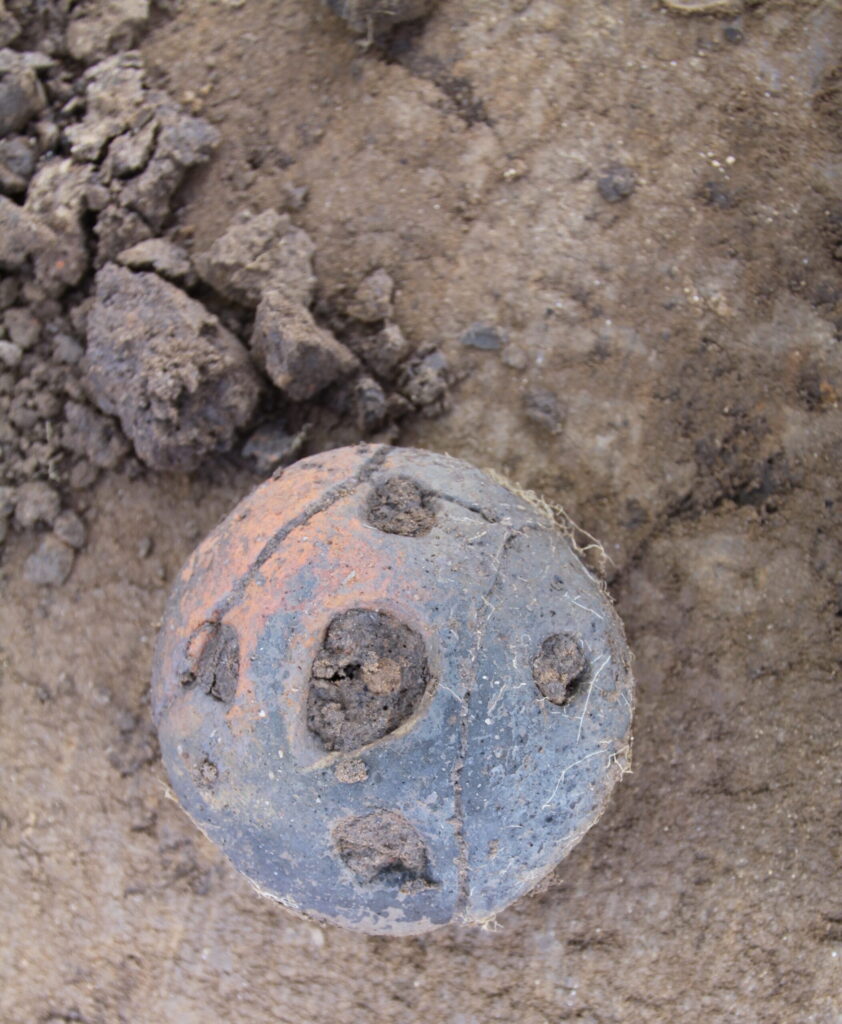
Among the mostly everyday finds, the dark glass bead stands apart. It is large, opaque and decorated with light-colored wave bands. Beads of this kind are more often found as ornaments in women’s graves, where they formed part of personal adornment.
Its discovery in a settlement pit is therefore unusual. Archaeologists note that the shape and decoration of this bead type remained in use for a long time, but they are especially common in the 4th and 5th centuries A.D.
Because it was not found in a grave, its role is less certain. It may have been lost, discarded or repurposed. One possibility is that the bead was used as a spindle whorl, linking it to the textile activity already documented at the site. That interpretation remains cautious, but it gives the object a more intriguing place in the story of the village.
Fire may have marked the settlement’s final phase
Other traces suggest that the settlement may have ended violently or abruptly. Burned clay indicates that the walls of some structures were coated with clay and later exposed to fire. Burned grain shows that food was being stored inside the buildings when the fire occurred.
The evidence does not yet prove exactly what happened. It may have been an accidental fire, a destructive event or part of the settlement’s abandonment. Further analysis of plant remains, charcoal and other recovered materials may help clarify the sequence.
Radiocarbon dating will now be used to refine the chronology of the settlement and its final phase. For archaeologists, the site offers a rare chance to examine everyday rural life in central Germany during a period often known more through burials and scattered artifacts than through complete settlement traces.
The dark glass bead remains the most memorable object from the excavation. But its real importance lies in what surrounds it: longhouses, pit houses, loom weights, grain and burned walls. Together, they bring into view a small community that lived beneath what is now a gravel extraction landscape, until its traces were almost erased.