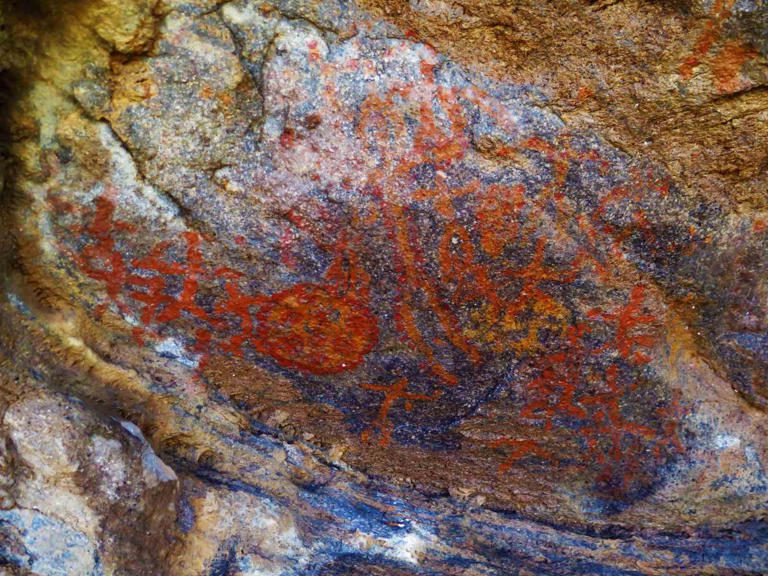
Eight thousand years ago, long before the Hittites ruled the Anatolian plateau, small communities living in what is now central Turkey began carving and painting symbols on rock. Their red ochre figures—human shapes, animals, and abstract signs—still cling to the walls of a stone shelter near the town of Develi in Kayseri, offering a rare glimpse into the dawn of belief and symbolic thought in Anatolia.
Archaeologists investigating the area recently identified a group of prehistoric engravings and pigment traces on volcanic rock formations. Early analysis suggests the artwork dates back to the Late Neolithic or Early Chalcolithic period, roughly 6,000 BCE—a time when early farmers and herders were transforming both the land and their own understanding of the world.
“These images are not random decorations,” the researchers noted. “They are deliberate marks of meaning—evidence that people were trying to explain their relationship with nature, animals, and unseen forces.”
The Oldest Symbolic Language of Anatolia
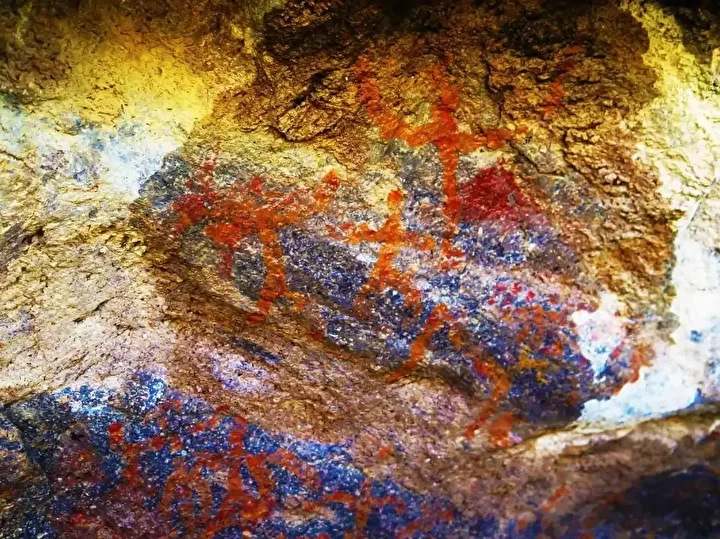
The engravings were created using red and yellow mineral pigments applied to the rock face, sometimes combined with carved outlines. Some figures appear to represent groups of people or ritual scenes; others, circular or radiating forms that might symbolize the sun or cycles of life. While interpretation remains cautious, the patterns show a clear sense of structure, suggesting early attempts at visual storytelling.
Rock art of this kind has been recorded in parts of southeastern and eastern Anatolia, such as Hakkari and Niğde, but findings in the central plateau are exceedingly rare. The Develi site bridges that geographic and cultural gap, showing that Neolithic symbolism was not confined to one part of ancient Anatolia—it was part of a broader spiritual landscape.
A Silent Message from Prehistory
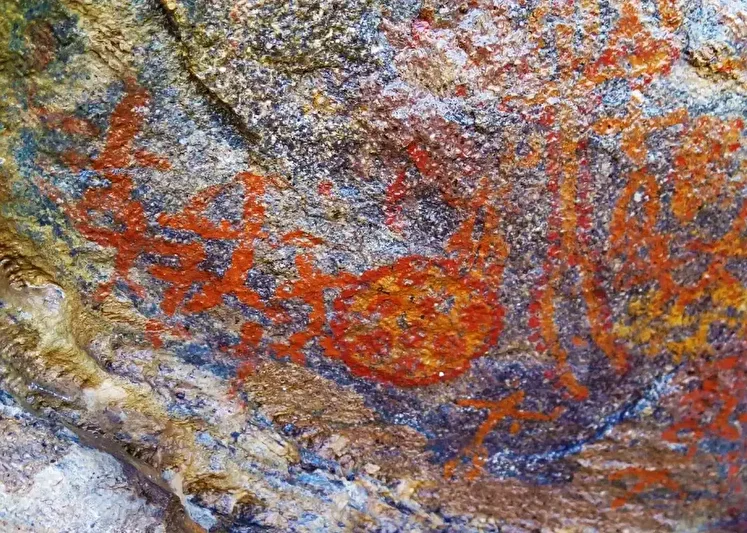
Situated along ancient steppe routes and near perennial water sources, the rock shelter may once have served as a gathering point for rituals or seasonal observances. The survival of pigment on the rock, despite millennia of erosion, is itself extraordinary—an echo of a people who left no written record, only images.
For archaeologists, each mark carved or painted into the stone represents an early form of thought, a bridge between daily survival and metaphysical awareness. These scenes, now faint under centuries of mineral deposits, may be among the earliest artistic and spiritual expressions ever created in Central Anatolia.
“They speak to us across eight thousand years,” one of the field researchers remarked, “reminding us that long before temples or empires, belief already had a language—and it was carved into stone.”
Cover Image: Traces of red ochre figures painted on a rock surface in Develi, Central Anatolia — part of an 8,000-year-old symbolic composition predating the Hittites. Credit: IHA