
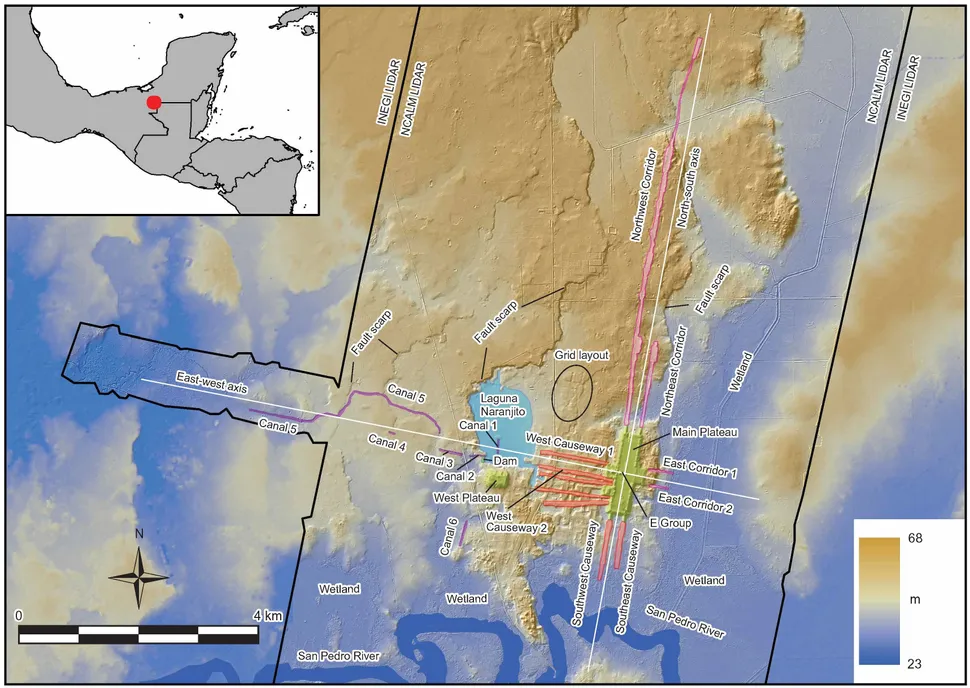
Archaeologists say a 3,000-year-old ceremonial complex in southeastern Mexico may have been designed as a cosmogram—a vast representation of how early Maya communities perceived the universe. The site, known as Aguada Fénix, spans nearly 9 by 7.5 kilometers (5.6 by 4.7 miles), making it one of the largest and oldest monumental constructions in Mesoamerica.
The findings were detailed in a new study published in Science Advances and reported by Owen Jarus for Live Science.
The World’s Oldest Maya Monumental Architecture
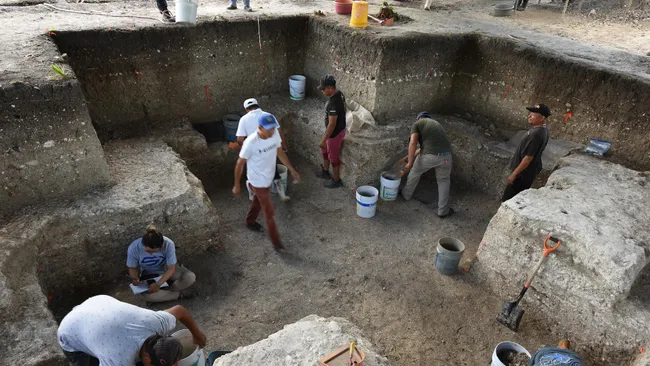
Located in Tabasco, near the border with Guatemala, Aguada Fénix dates back to around 1050 BCE, predating the Maya writing system and dynastic rule by several centuries. Excavations and lidar mapping between 2020 and 2024 revealed that its enormous platform and surrounding structures were built to align with the rising sun and celestial axes.
According to Professor Takeshi Inomata of the University of Arizona, who led the research, the site reflects an early vision of cosmic order:
“The people who used Aguada Fénix probably thought the universe was ordered according to north-south and east-west axes,” Inomata told Live Science. “The east-west axis was tied to the movement of the sun and likely related to the passage of time.”
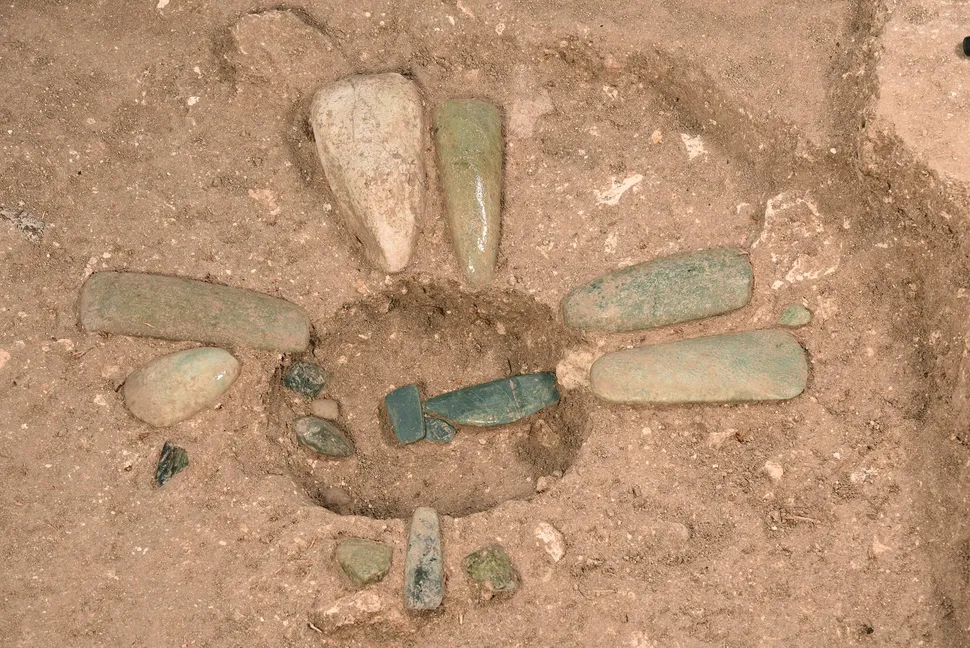
At the center of the complex lies an E-group—a cluster of small ceremonial platforms that may have served as astronomical observation points. Archaeologists uncovered greenstone ornaments shaped like animals and humans, ceramic vessels, and pigments—objects likely used in ritual offerings.
A Monument Built Without Kings
Unlike later Maya cities such as Tikal or Copán, Aguada Fénix shows no evidence of centralized authority or social hierarchy. The absence of royal tombs, palaces, or elite dwellings suggests that its construction was a communal effort involving thousands of people.
The researchers propose that large-scale gatherings at the site may have served social and ritual purposes similar to Stonehenge in Neolithic Britain—occasions for feasting, trade, and shared cultural identity.
“This monumentality was built collectively rather than under the direction of powerful rulers,” said James Aimers, an anthropologist at SUNY Geneseo, who commented on the findings. “It fits with new interpretations that stress cooperation over hierarchy in early Mesoamerican societies.”
A Cosmic Design in Earth and Stone
The study describes Aguada Fénix as a network of canals, causeways, and dams forming a pattern of intersecting crosses—mirroring cosmological maps found in later Maya and Aztec traditions. Although the canals were too large to serve irrigation purposes, they symbolically linked water, earth, and sky in a unified sacred landscape.
Arlen Chase, an anthropologist at the University of Houston, and David Stuart, a Maya scholar at the University of Texas at Austin, both praised the team’s interpretation, noting that the buried offerings and cross-shaped alignments reinforce the idea of a cosmic layout.
The researchers estimate that over 1,000 people participated in building the site, likely guided by ritual specialists skilled in astronomy and calendrical calculations.
The alignment of Aguada Fénix with sunrise positions associated with the 260-day sacred calendar—a cycle that became central to both Maya and Aztec cosmology—suggests that the builders saw space and time as deeply intertwined.
A Glimpse into a Pre-Hierarchical World
Abandoned around 700 BCE, the site remains unfinished—some canals were never completed, hinting at changing social or environmental conditions. Yet its scale and geometry capture a unique historical moment when collective belief, not royal power, mobilized communities to shape their world according to the stars.
As Inomata and his colleagues argue, Aguada Fénix offers one of the earliest material expressions of Mesoamerican cosmology—a monumental map of the universe carved into the earth itself.
Cover Image: A jade pendant carved in a cosmogram-like design found in southeastern Mexico. Such objects reflect the ancient Maya’s symbolic understanding of the universe. Credit: Takeshi Inomata