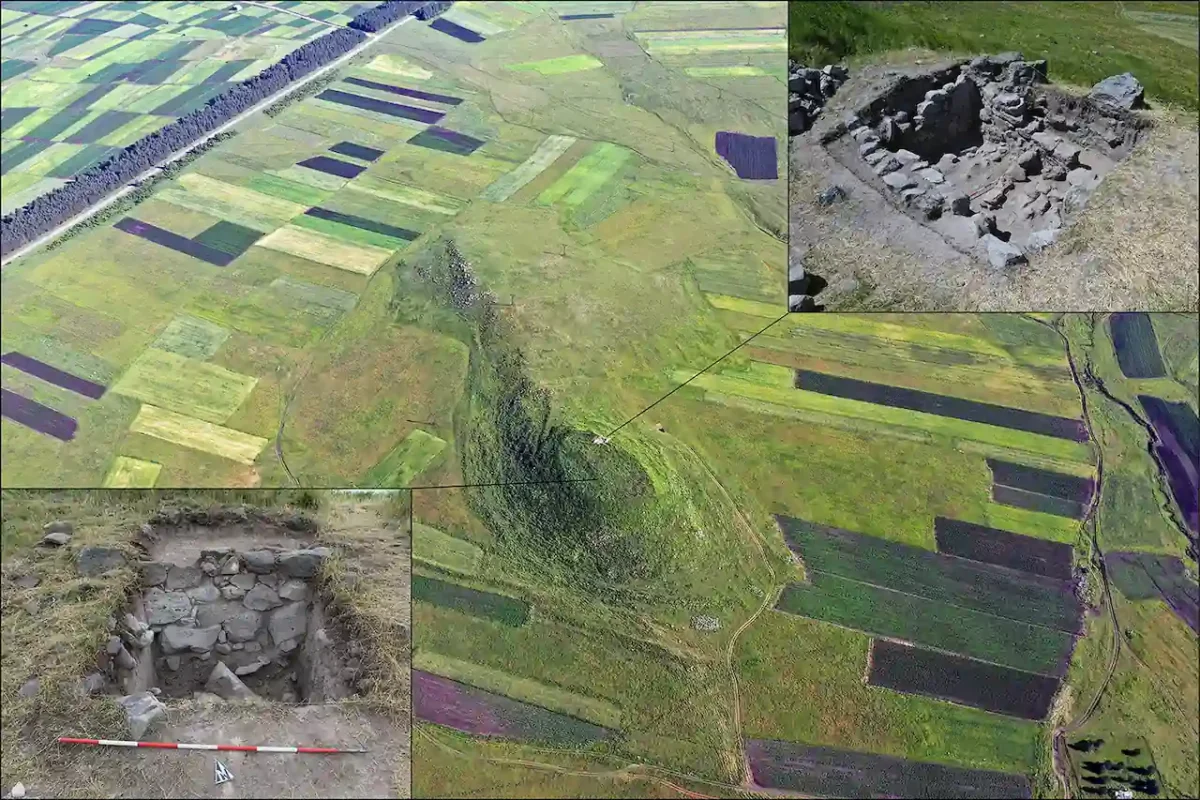
A finely decorated bronze sun disk and rare painted clay plaques discovered on Georgia’s Javakheti Plateau are shedding new light on a little-explored highland region of the South Caucasus.
At first glance, the high volcanic plateau of Javakheti, in southern Georgia, appears inhospitable. Long winters, sparse vegetation, and elevations rising above 2,000 meters define a landscape where sustained settlement seems unlikely.
Yet recent discoveries suggest a different reality.
A bronze sun disk points to hidden ritual landscapes
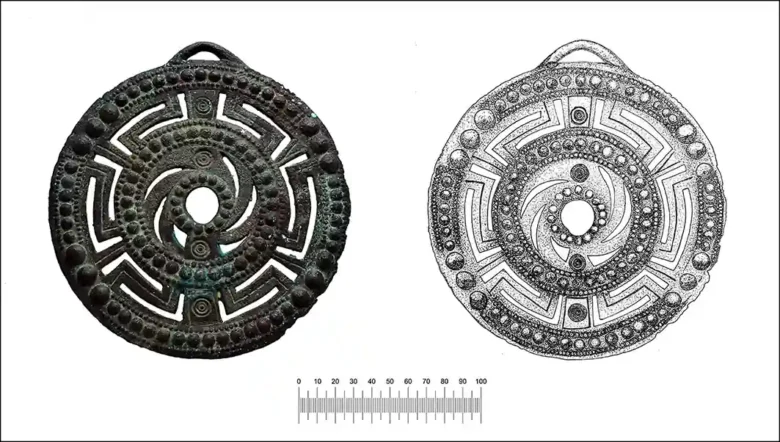
Before systematic excavations even began at Baraleti Natsargora, archaeologists recovered a finely crafted bronze sun disk from the surface. Now housed in the Akhalkalaki Museum, the object features concentric bands of raised bosses, angular motifs, and regularly spaced perforations.
Artifacts of this kind are rarely decorative alone. In southern Georgia, comparable examples have been linked to solar symbolism and funerary display, often associated with female burials. That connection raises an important possibility: the disk may originate from a nearby, still-undiscovered burial context.
If so, the plateau may preserve not just settlements, but entire ritual landscapes that remain largely invisible.
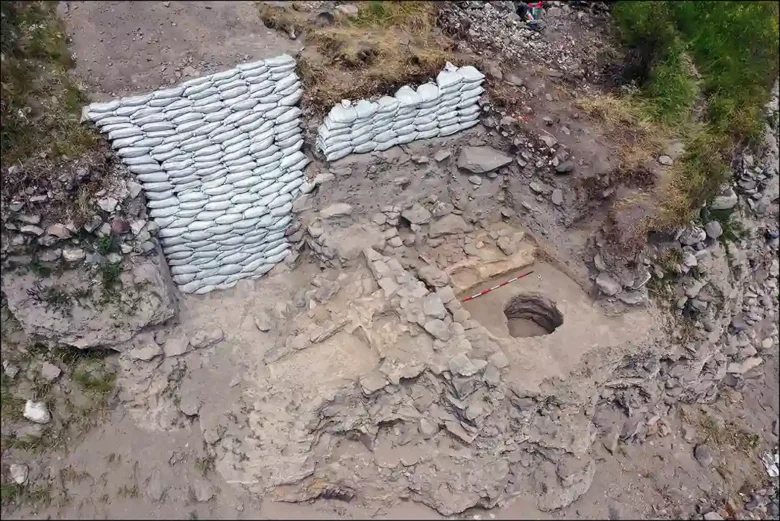
When excavations began in 2023–2024, the site’s name proved telling. “Natsargora” translates as “hill of ashes,” and the stratigraphy confirmed it. Multiple burned layers, defensive walls, and domestic structures revealed a long sequence of occupation stretching from the Early Bronze Age to the Iron Age.
The pattern is not one of simple habitation. It is a cycle of occupation, destruction, and return; suggesting that the site retained significance across generations despite repeated disruption.
Painted clay plaques reveal symbolic life inside settlements
A second major discovery emerged at Meghreki Fortress, where excavations exposed an unusually long occupational sequence beginning in the Kura-Araxes period (c. 3500–2500 BCE) and continuing through the Iron Age into the medieval era.
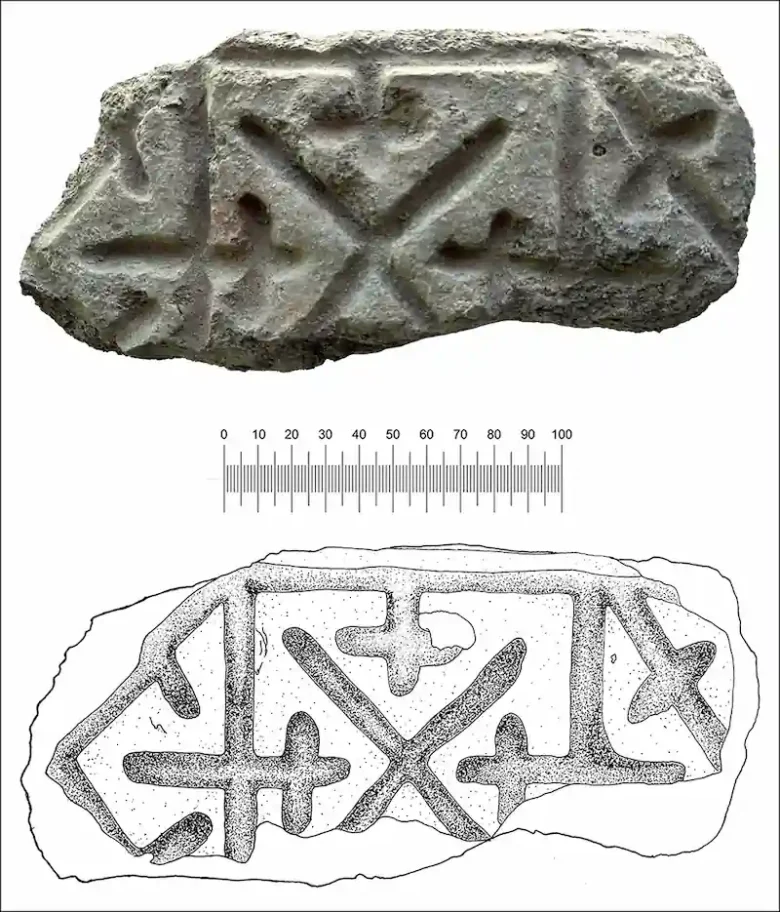
Among the most striking finds are painted clay plaques embedded within clay-built installations, possibly ovens or raised platforms, inside residential structures dated to the Late Iron Age or Achaemenid period.
These plaques carry incised geometric designs and traces of red, white, and dark blue pigments—a rare combination in the South Caucasus.
Parallels exist at sites such as Digasheni and Amiranis Gora, where similar elements have been interpreted as markers of ritualized domestic space or elevated status. At Meghreki, however, their number and context suggest a broader and more deeply rooted tradition.
Here, the boundary between everyday domestic life and symbolic expression appears increasingly blurred.
Rethinking fortifications in a highland frontier
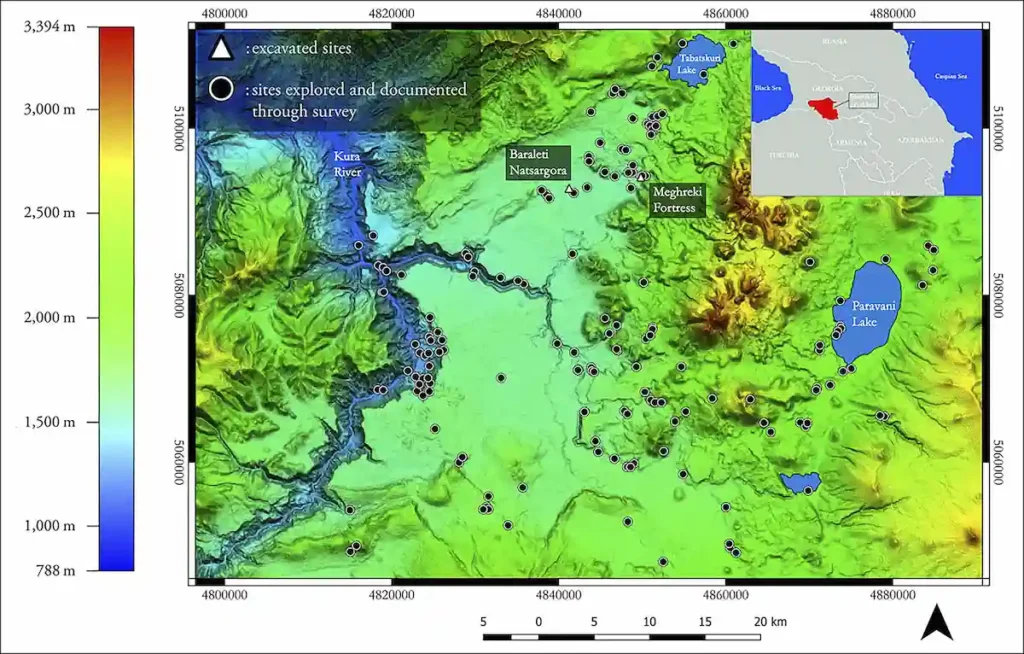
Across the Javakheti Plateau, researchers have documented 168 archaeological sites, including fortifications, settlements, and necropolises. Many are built using large, unmortared stone blocks, often described as cyclopean architecture.
Yet their function may not be as straightforward as once assumed.
Rather than permanent defensive strongholds, some of these structures appear to have served as temporary refuges, used by mobile pastoral groups during seasonal movement or periods of instability. This interpretation suggests a more flexible and adaptive settlement system, shaped by both environmental constraints and social dynamics.
Sites such as Abulis Gora and Saro-1 show repeated phases of occupation beginning in the Bronze Age, while nearby necropolises indicate long-term cultural continuity tied to the landscape.
A connected highland, not a marginal one
These discoveries are part of the ongoing Samtskhe-Javakheti Project, a collaboration between Georgian and Italian researchers launched in 2017. Over eight field seasons, the team has combined survey, excavation, GIS mapping, and remote sensing to produce the first systematic archaeological framework for the region.
The emerging picture challenges long-standing assumptions.
Javakheti was not a remote and isolated periphery. It functioned as a dynamic frontier, linking the highlands of the South Caucasus with surrounding lowland regions. Communities here developed strategies of mobility, maintained symbolic traditions, and repeatedly returned to meaningful locations within a demanding environment.
A landscape still revealing its past
Future research will expand excavations, refine ceramic chronologies, and apply radiocarbon dating to better anchor occupation phases. Paleoenvironmental studies and mobility models are also planned to reconstruct how communities moved across the plateau and interacted with neighboring regions.
Dan R, Chilingarashvili T, Vitolo P, et al. Layers of stone and ash: new perspectives from the Samtskhe-Javakheti archaeological project. Antiquity. Published online 2026:1-8. doi:10.15184/aqy.2026.10331
Cover Image: Aerial view of Baraleti showing the excavation areas. Credit: Samtskhe-Javakheti Project