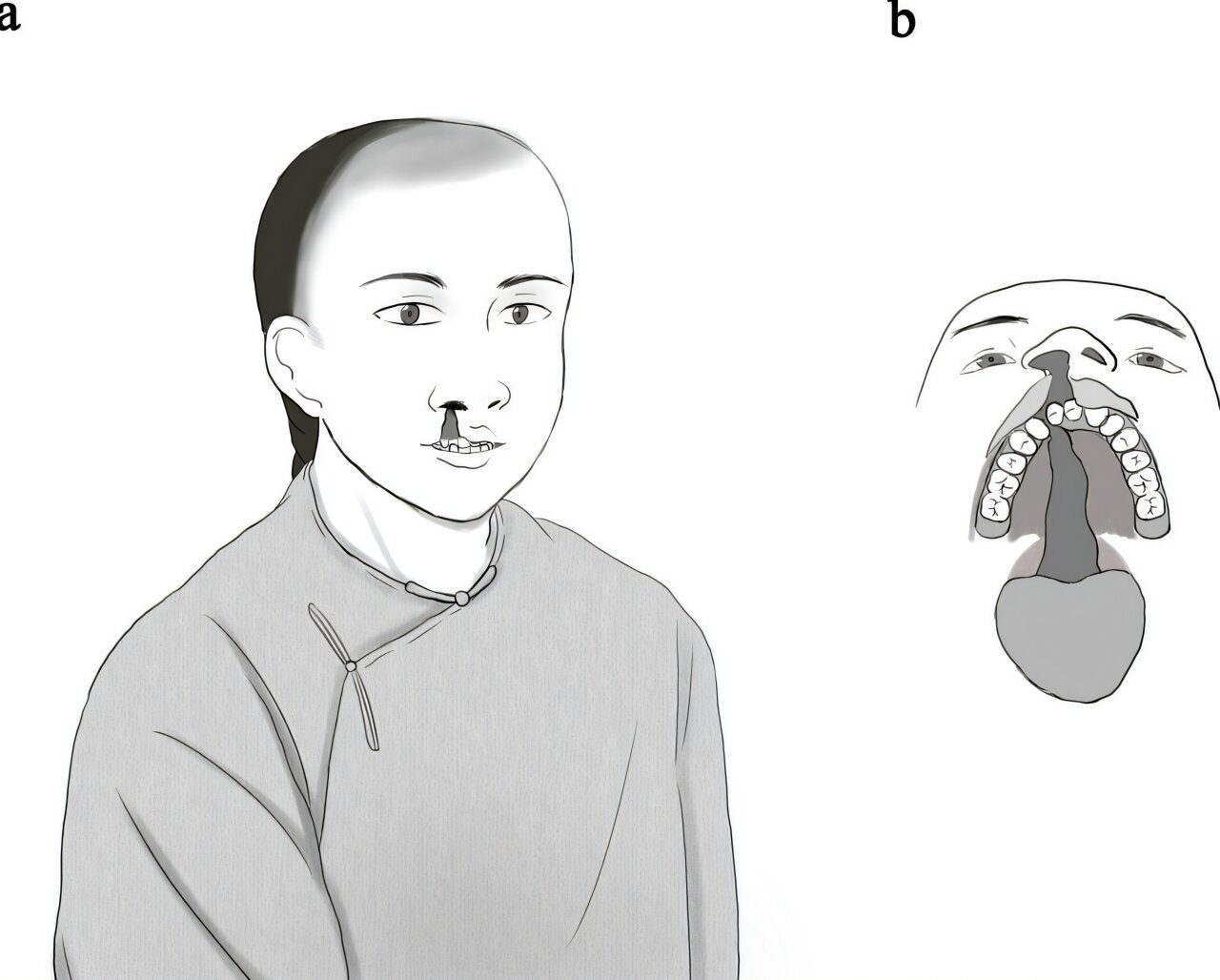
The first archaeological case of a cleft lip in China has been identified in a Qing Dynasty burial, revealing that a teenager born with a visible facial condition was not pushed aside, but cared for and accepted within his community.
The discovery, published in the International Journal of Osteoarchaeology, comes from the Wenchi Cemetery in Shanxi Province. Led by Xiaofan Sun, the research offers rare physical evidence that challenges long-held assumptions about how past societies treated individuals with congenital differences.
A Life That Defies Expectations
The individual, identified as M234-2, was a young male aged around 16 to 18 at the time of death. He lived during the late 18th to early 19th century, in the Jiaqing era of the Qing Dynasty.
In many historical contexts, individuals born with conditions like Orofacial cleft faced stigma, neglect, or worse. Survival alone could be uncertain.
But this case points in another direction.
Skeletal analysis revealed no signs of malnutrition or long-term physiological stress. Despite the challenges associated with feeding and speech, the young man appears to have received consistent and effective care throughout his life.
This was not accidental survival. It suggests sustained support, likely within the household.
Scientific Evidence of a Congenital Condition
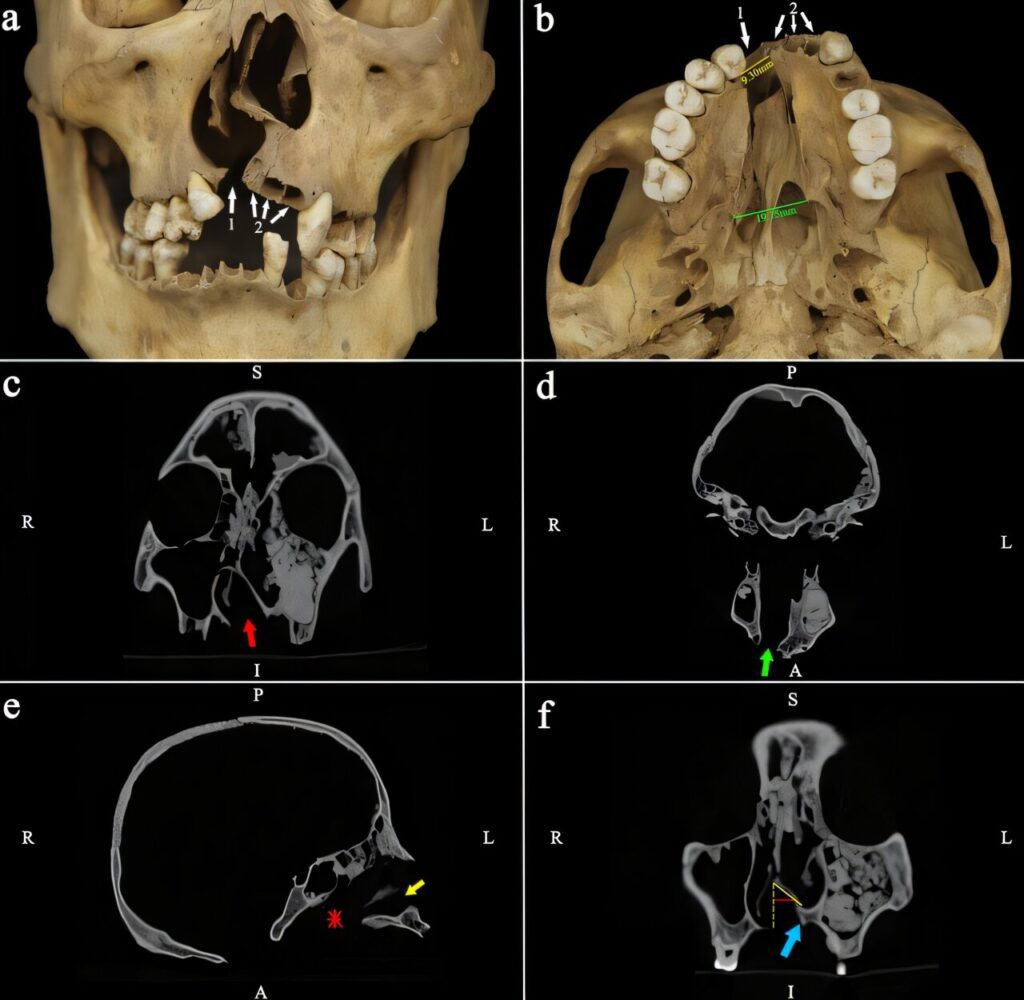
Macroscopic examination and CT scans revealed a combination of craniofacial features, including a deformed palate, a missing upper incisor, and a pronounced deviation of the nasal septum.
After ruling out trauma and infection, researchers concluded that these traits resulted from a congenital orofacial cleft—a developmental condition in which facial structures fail to fully fuse before birth.
Such conditions can be life-threatening in infancy without proper feeding adaptations. The absence of nutritional stress markers in this individual’s remains strongly indicates early and continuous caregiving.
Burial, Family, and Social Belonging
The burial context adds another layer to the story.
The young man was interred in a brick tomb alongside an adult female, accompanied by ceramics, metal objects, and coins. These elements reflect standard funerary practices of a lower-to-middle socioeconomic community—neither elite nor impoverished.
Importantly, there is no indication of marginalization.
According to Dr. Sun, paired burials in this context often reflect the Confucian ideal of family continuity. The woman buried with him is therefore most likely his wife.
If so, this detail carries real weight. It suggests that the young man was not only accepted, but also formed recognized social and familial bonds.
Rethinking Disability in the Past
Historical interpretations of physical anomalies varied widely across cultures. In China, some texts associated cleft conditions with symbolic explanations, including links to animals such as rabbits. Yet such beliefs did not always translate into exclusion.
The Wenchi cemetery provides a rare glimpse into everyday life beyond written records.
Here, the evidence points to a community where care was practical, sustained, and local. Not dependent on wealth. Not driven by institutions. But rooted in family and social ties.
From infancy to burial, the young man appears to have lived within the normal social fabric of his community.
A Single Case, A Broader Insight
Researchers caution against broad generalizations. This is one individual, one site.
Still, its implications are difficult to ignore.
In a past often assumed to be harsher and less accommodating, this case suggests something more nuanced. It shows that even in ordinary communities, individuals with visible differences could be supported—not set apart.
And in the quiet details of a burial, a different kind of history comes into focus.
Sun et al, An Archaeological Case of Cleft Lip and Palate in Late Imperial China (1796–1820 ce) and Its Social Implications, International Journal of Osteoarchaeology (2026). DOI: 10.1002/oa.70095.
Cover Image: Reconstruction of M234-2, a Qing Dynasty teen with a cleft lip. Credit: Sun et al., 2026