
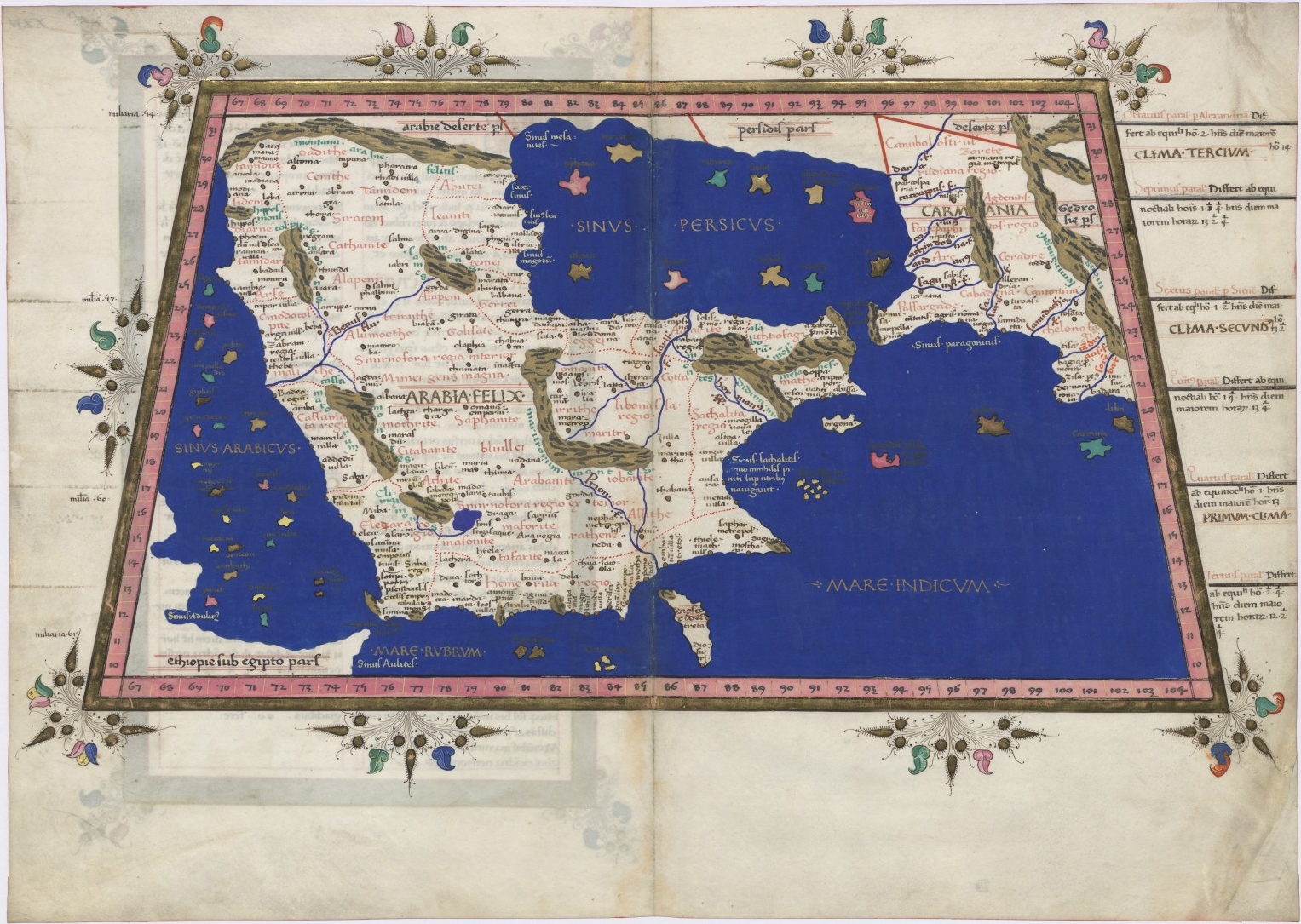
A mysterious lake shown in the cartographic tradition of ancient Arabia is drawing fresh attention, not as a confirmed scientific discovery, but as one of those old map problems that still refuses to disappear.
Claudius Ptolemy, the 2nd-century Alexandrian geographer known for his influential work Geography, shaped how later mapmakers imagined the ancient world. His place names, coordinates, and regional descriptions were copied, corrected, and reinterpreted for centuries. Among the curious details in this tradition is an inland lake placed somewhere in Arabia, a feature that has long raised questions for readers looking at the peninsula through modern maps.
Syrian-born writer and independent researcher Monis Bukhari has revisited this puzzle in a popular blog essay. His argument is careful but provocative: the feature sometimes interpreted as the “Lake of the Arabs” may not belong in central Arabia. It may instead reflect an ancient memory of Yemen’s interior valleys, especially the great drainage systems around Hadramut and the old South Arabian world.
An old map, a new question
Ptolemy’s geography was not based on modern surveying. His information came from earlier writings, trade routes, inherited place names, and reports that had passed through many hands before reaching the mapmaking tradition.
That is why every lake, river, or mountain on a Ptolemaic map must be treated with caution. It is not automatically proof of a real landscape feature in the exact place where it appears.
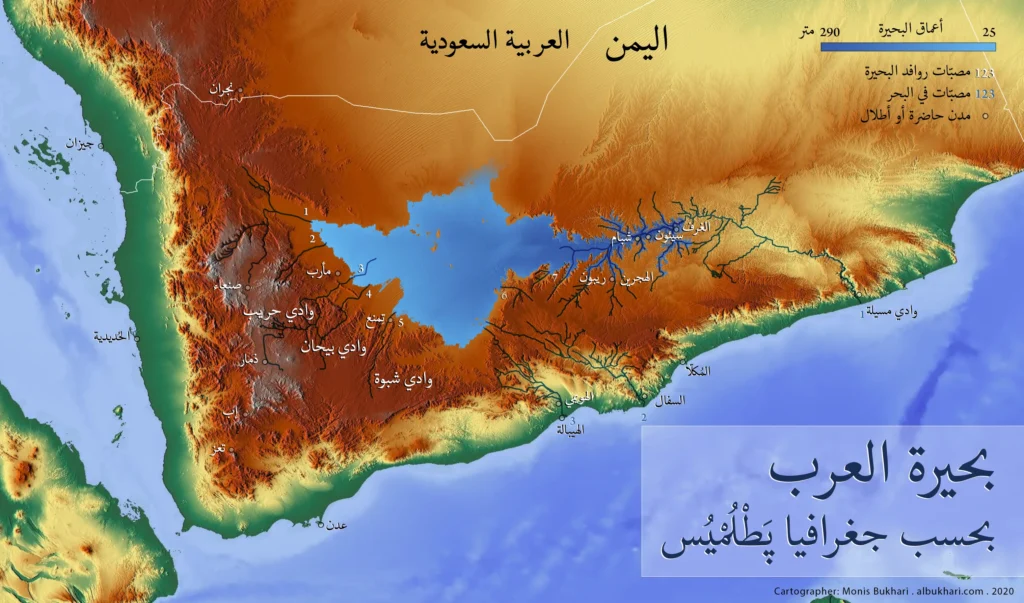
Still, such details are rarely meaningless. Errors on old maps can preserve distorted traces of real information. A lake may represent a seasonal basin. A river may echo a major wadi system. A misplaced inland feature may come from reports carried by merchants, sailors, or local informants before being fixed into a geographic model.
Bukhari’s proposal becomes interesting at this point. Yemen’s dry valleys still carry the imprint of earlier water movement, and ancient South Arabia was never simply an empty desert margin. Kingdoms such as Saba, Qataban, Hadramawt, and Himyar depended heavily on water management. The Marib Dam remains the best-known reminder of how deeply water shaped agriculture, settlement, and political power in the region.
A hypothesis, not a discovery
For now, the claim remains a historical-geographical hypothesis. There is no excavated lakebed in Yemen directly tied to Ptolemy’s map, no dated shoreline, and no published sediment study proving that the “Lake of the Arabs” was a vast ancient lake in the Yemeni interior.
That does not make the question worthless. It means the idea has to be tested with geology, paleoenvironmental data, and archaeology.
Bukhari’s blog essay should therefore be read as an interpretive starting point rather than a final answer. By placing ancient map traditions beside Yemen’s topography and South Arabia’s long history of water engineering, it raises a sharper question: was Ptolemy’s mysterious Arabian lake simply a cartographic mistake, or did it preserve a damaged memory of a wetter landscape now hidden behind dry valleys?
The answer is not yet known. But the question itself is useful. It encourages a different way of looking at ancient Yemen, not only as a land of ruins, incense routes, and desert valleys, but as a region whose civilizations were built around water, seasonal flows, and the difficult art of making life possible in a demanding landscape.
Cover Image: A Ptolemaic map of Arabia showing Arabia Felix and surrounding regions, part of the cartographic tradition that later shaped debates over Ptolemy’s mysterious inland lake. Credit: Wikimedia Commons / Public Domain.