
A new comparative study suggests that the famous Vulture Stone at Göbekli Tepe may belong to a wider prehistoric vocabulary of signs, one that later finds possible echoes in the ritual world of Europe’s Trypillia culture.
A stone that still refuses to give one answer
At Göbekli Tepe, some carvings feel less like images than arguments left in stone. Stele 43, better known as the Vulture Stone, is one of them.
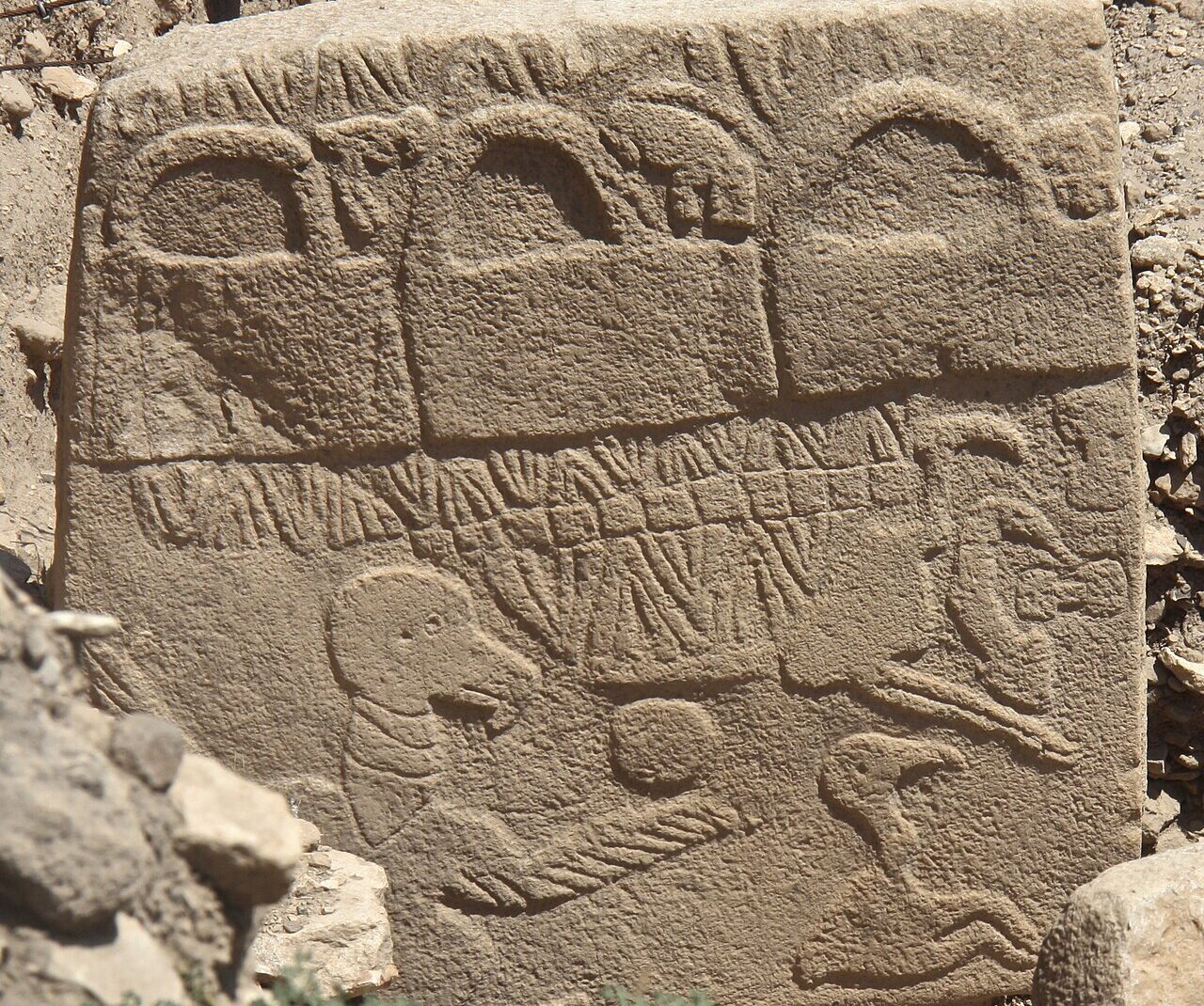
The pillar is crowded with figures: a large bird, smaller birds, snakes, a scorpion, a boar, a waterfowl, abstract signs and a small headless human body. Since its discovery, it has been read through several lenses. For some scholars, it belongs to the world of death ritual and ancestor memory. For others, its imagery may contain astronomical meaning, perhaps even an early way of marking time.
A new study by Oleksandr Zavalii, published in the International Journal of Culture and History, adds another possibility. Rather than treating the Vulture Stone as an isolated monument, the study compares its symbolic program with later ritual imagery from the Trypillia culture, which flourished across parts of modern Ukraine, Moldova and Romania.
The result is not a simple claim that Trypillia borrowed directly from Göbekli Tepe. The distance in time is too great for that. Instead, the study asks whether early farming societies in Anatolia and Eastern Europe may have used related visual ideas to express time, seasonal change, death and sacred space.
The Vulture Stone as a layered image
The study pays close attention to the structure of Stele 43. Its upper section is dominated by birds and signs that Zavalii interprets as potentially celestial. The lower section, with its scorpion, snake, boar and headless human figure, is read as a darker zone linked to the earthly or underworld sphere.
That division matters because the pillar may not be telling a story in the modern sense. It may instead be arranging a worldview. Birds could mark the sky. Snakes could suggest cycles, danger or renewal. The scorpion may sit near a boundary between realms. The headless figure may point to death, transformation or ritual passage.
None of these readings can be treated as final. Göbekli Tepe has no written text to explain itself. Still, the study argues that the carvings are too organized to be dismissed as random imagery. The composition appears to join animals, signs and spatial order into a structured symbolic field.
Time, number and sacred order
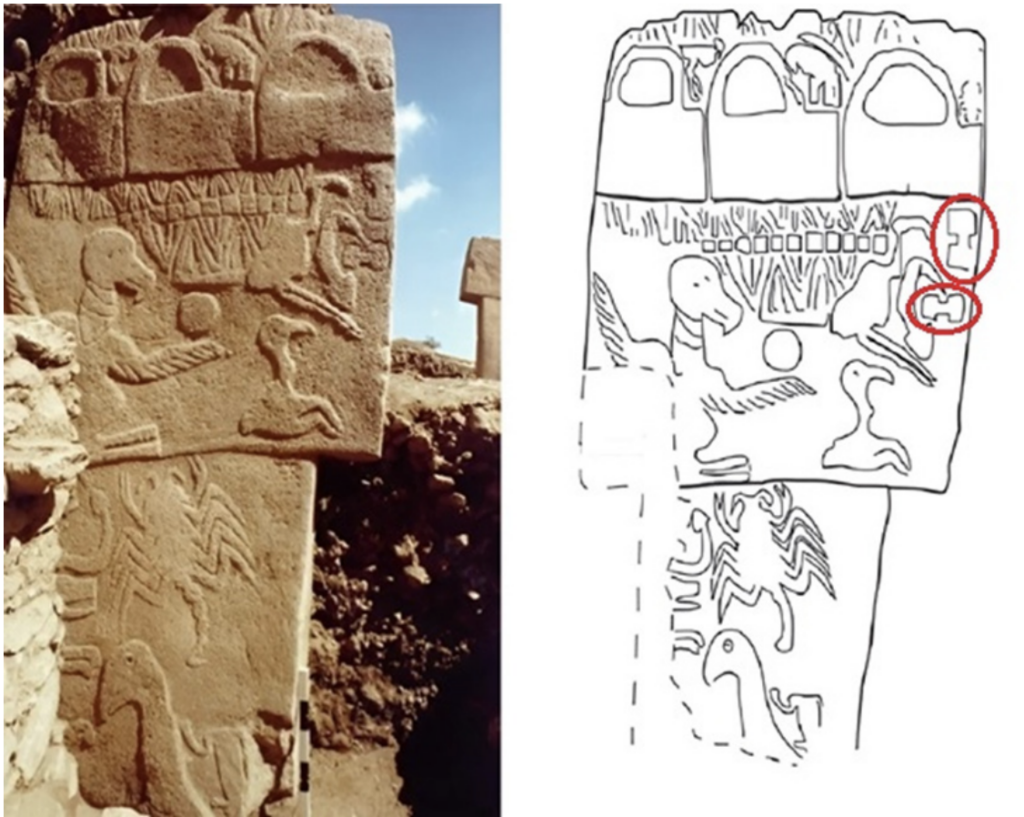
One of the more striking parts of the research concerns numbers. Zavalii draws attention to eleven rectangular elements on the Vulture Stone and compares them with repeated patterns in Göbekli Tepe’s architecture. In this interpretation, the number may have been connected with the organization of the year or intervals between major solar events.
The paper also turns to Stele 33, another pillar from Building D. This monument contains wavy forms interpreted as snakes, along with foxes, birds, spiders and H-shaped signs. Zavalii suggests that the repeated numbers three, eleven and thirteen may reflect solar and lunar concerns. Thirteen, in particular, could point toward lunar reckoning.
Such claims sit within a broader debate. Earlier theories have proposed that Göbekli Tepe’s imagery may encode constellations, calendars or celestial events. Other researchers have urged caution, noting that the site’s buildings were complex, rebuilt over time and difficult to interpret as simple observatories.
The new study does not settle that debate. Its contribution is different. It suggests that astronomical, ritual and funerary readings may not be mutually exclusive. In a Neolithic ritual setting, the movement of the sky, the passage of the dead and the rhythm of the year may have belonged to the same symbolic order.
Why Trypillia enters the picture
The Trypillia culture developed thousands of years after Göbekli Tepe, but it remains one of prehistoric Europe’s most visually rich traditions. Its communities produced decorated ceramics, ritual objects and large settlements, including monumental structures such as the Nebelivka Temple in Ukraine.
Zavalii compares Göbekli Tepe’s H-shaped signs with Trypillian “binocular-shaped” ritual objects. The proposed similarity is not only visual. The study argues that both may have expressed ideas of duality, balance or the division of sacred time.
The comparison also includes circular motifs, solar and lunar imagery, animal symbolism and the spatial organization of ritual buildings. In this reading, Göbekli Tepe and Trypillia are not connected by a proven historical line, but by recurring symbolic strategies used by early agricultural societies.
That distinction is important. Archaeology rarely allows certainty across such long spans of time. What it can show, more carefully, are patterns: repeated forms, similar arrangements, shared concerns and the persistence of certain ritual ideas.
A wider question about early farmers
The deeper issue raised by the study is not whether one symbol “means” one thing. It is whether early farming societies developed durable ways of making invisible forces visible.
Agriculture changed how people lived with time. Seasons mattered. The sun and moon mattered. Death, fertility, renewal and communal ritual became bound to the yearly cycle. In that context, a carved pillar, a temple plan or a ritual vessel could become more than an object. It could become a way of organizing reality.
This may be the most useful way to read the proposed Göbekli Tepe and Trypillia parallels. The Vulture Stone does not need to be reduced to a calendar, a death scene or a mythic image. It may have been all of these at once, held together by a symbolic logic that modern categories struggle to separate.
A monument still open to interpretation
The study’s strongest point is its refusal to close the case too neatly. It does not prove a direct cultural bridge from southeastern Türkiye to prehistoric Europe. It does not make the Vulture Stone a decoded text. What it offers is a broader frame for looking at one of archaeology’s most discussed images.
Göbekli Tepe’s builders carved animals, signs and human forms into stone more than 11,000 years ago. Trypillian communities, much later, shaped ritual objects and sacred spaces with their own visual language. If Zavalii’s comparison is correct, both traditions may preserve fragments of a long prehistoric effort to connect the sky, the year, the dead and the sacred center of community life.
That possibility makes the Vulture Stone even more intriguing. It may not be a single message waiting to be solved. It may be part of a much older symbolic conversation, one that began before writing and survived only in stone, clay and ritual architecture.
Zavalii, O. (2025). Cosmological aspects of the stelae of Göbekli Tepe and their parallels with the religious symbolism of the Trypillia culture. International Journal of Culture and History, 12(1), 1–55. https://doi.org/10.5296/ijch.v12i1.22688
Cover Image Credit: Pillar 43, Enclosure D: the “Vulture Stone”. Sue Fleckney – Public Domain