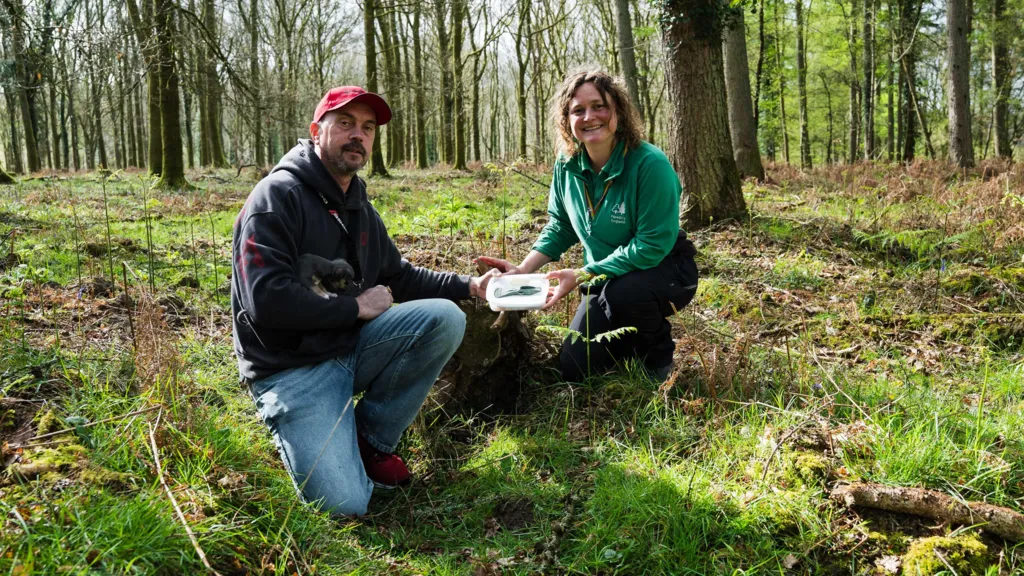
A Bronze Age axe head hidden for more than three millennia has been discovered in England’s Forest of Dean after a dog walker noticed an unusual green flash among the roots of a fallen tree.
John Smith was walking his puppy through woodland near Brierley, Gloucestershire, when the dog ran off and began rooting around the forest floor. As Smith followed, he looked down into the exposed root plate of a fallen tree and saw something wedged in the soil. It was small, green, and unmistakably different from the stones and branches around it.
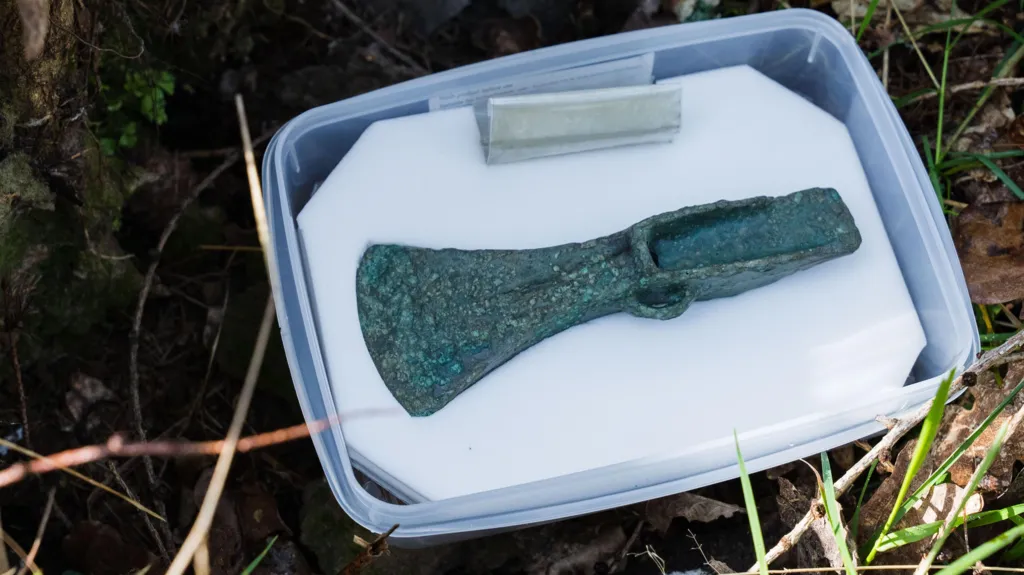
The object, now identified as a Middle Bronze Age palstave axe, is believed to date from around 1400 to 1275 BC, making it approximately 3,400 years old. For a moment, one of Britain’s prehistoric tools had returned to view not through a planned excavation, but through a chance encounter during an ordinary woodland walk.
A green sparkle beneath the roots
Smith later recalled that the artefact caught his eye because of its vivid colour. The copper alloy surface had developed a layer of green corrosion, known as verdigris, after centuries of contact with oxygen, moisture, and minerals in the soil.
“I knew it was old because of the intensity of the green,” Smith said, explaining that he decided to remove it carefully and hand it in so others could enjoy and study it.
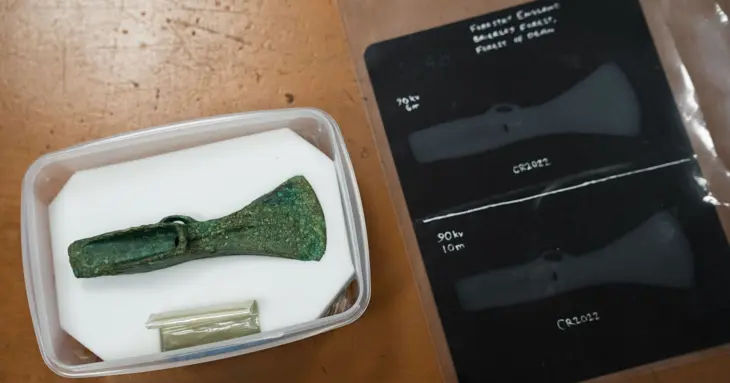
That decision proved important. Instead of remaining an isolated private find, the axe was passed to Forestry England, which manages the woodland, for recording and investigation. It has since been examined by specialists and is now linked to Cotswold Archaeology’s virtual museum, where the object is being documented for public access.
A Middle Bronze Age palstave axe
The artefact is known as a palstave axe, a type of Bronze Age tool designed to be hafted securely onto a wooden handle. Unlike earlier flat axes, palstaves had raised flanges and a stop ridge that helped lock the blade into place. This example also has a side loop, which would have allowed cord to bind the metal head tightly to its handle.
That small feature matters. It shows a stage of toolmaking in which Bronze Age metalworkers were not simply casting useful blades, but refining their designs for durability and control. A loose axe head could make work difficult or dangerous. A looped palstave offered a more stable solution.
Objects conservator Kayleigh Spring explained that the axe was made from a copper alloy, most likely bronze, a mixture of copper and tin. Bronze Age tools like this were cast in moulds. Early moulds could be simple hollowed stones, but by the Middle Bronze Age, two-part moulds made more sophisticated forms possible.
The Forest of Dean axe belongs to that technological world. It is not a crude object. It reflects skilled casting, practical design, and a deep knowledge of how metal, wood, and binding materials worked together.
More than a woodland curiosity
At first glance, the axe might look like a lost tool. It may indeed have been used for woodworking, land clearance, or other tasks connected with everyday life. But Bronze Age axes in Britain often carry a more complex story.
Many have been found as isolated objects, while others appear in hoards or deposits that may have had social, symbolic, or ritual meaning. Without a controlled excavation around the exact findspot, it is impossible to say whether this axe was lost by accident, hidden deliberately, or placed in the ground for reasons that no longer survive in the archaeological record.
That uncertainty gives the discovery much of its power. The axe is both familiar and mysterious. It is a tool shaped for the human hand, yet its final journey into the ground remains unknown.
The Forest of Dean itself adds another layer to the story. Today, the area is known for its woodland, but prehistoric landscapes were never static. Bronze Age communities across Britain were clearing land, managing resources, developing field systems, and reshaping their surroundings. A tool like this belongs to that wider transformation.
Its recovery from the roots of a fallen tree is also a reminder of how much archaeology remains hidden in woodland environments. Dense vegetation, deep leaf litter, and root systems can make prehistoric evidence difficult to detect. Sometimes, it takes erosion, storm damage, animal activity, or pure chance to reveal what lies beneath.
From chance find to public heritage
After the axe was handed in, specialists assessed and conserved it. Soil and corrosion were carefully removed under magnification, and the object was stabilised so it can be safely preserved. It will now be cared for by The Dean Heritage Centre near Soudley.
Leoni Dawson, community ranger for Forestry England, said finds like this help people connect with those who lived and worked in the same landscapes thousands of years earlier.
That connection is what makes the discovery so compelling. The axe was not found in a museum case or under the lights of an excavation trench. It appeared in the half-hidden space where a tree had torn open the ground. A dog ran ahead, a walker looked down, and a small green object revealed a fragment of Britain’s Bronze Age past.
For more than 3,000 years, the palstave lay beneath the forest floor. Now, it has entered the public record as a rare reminder that ancient history is sometimes still waiting just below our feet.
Cover Image: The 3,400-year-old Bronze Age axe head, spotted during a walk in the Forest of Dean, has come to light after thousands of years. Credit: Forestry England / Crown copyright