
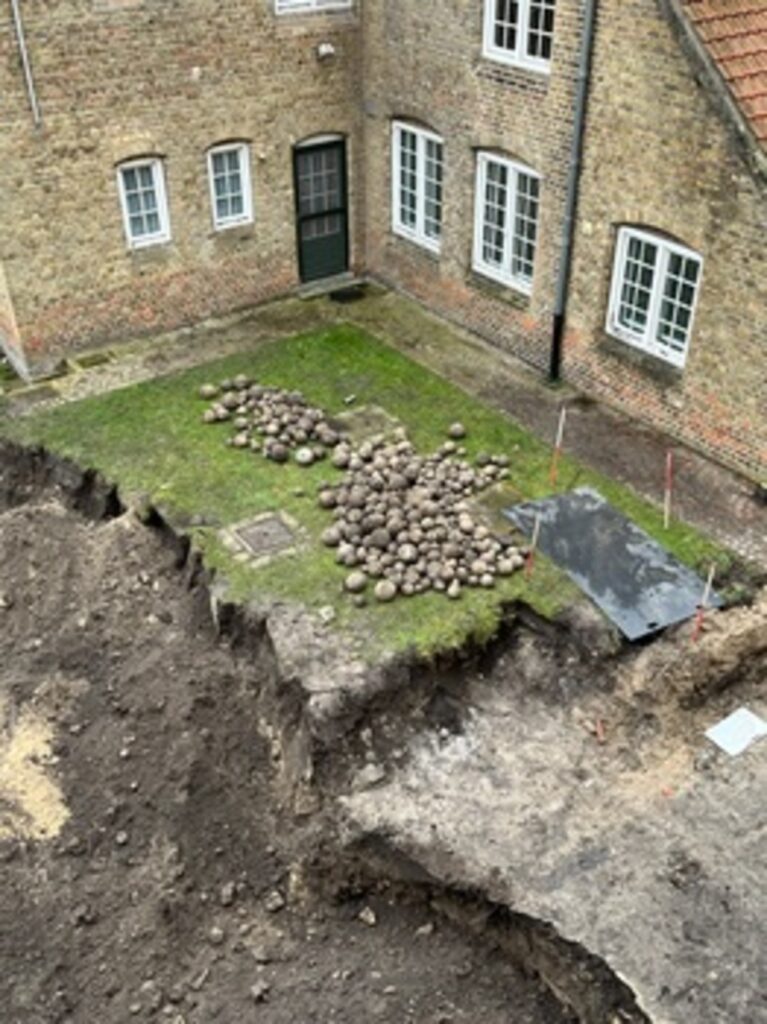
Dozens of medieval cannonballs have been discovered beneath the site of a future Administrative Centre in Nieuwpoort, Belgium, revealing how one modern construction plot preserved traces of defence, civic life and war across several centuries.
Archaeologists working in Nieuwpoort-Stad, between the historic Stadshalle and Willem De Roolaan, uncovered a depot of natural-stone cannonballs, medieval building remains and an unexploded First World War shell. The excavation began in mid-February 2026, after earlier test trenches and trial pits showed that the area held strong archaeological potential.
The site is now nearing the end of its fieldwork phase, but the discoveries already suggest that this part of Nieuwpoort was not an ordinary urban zone. It stood close to the medieval civic heart of the city and near the former southern city wall, a position where administration, daily life and defence likely overlapped.
A medieval stockpile near the city wall
The most striking discovery is the group of cannonballs made from natural stone. Such projectiles were used in Europe between about 1350 and 1600, when warfare was shifting from older siege methods toward gunpowder artillery.
could be used with different weapons, including early cannon and older siege engines. In Nieuwpoort, however, their careful finish and standardized form point strongly toward use with firearms. That detail makes the find more than visually impressive. Standardized ammunition suggests preparation, storage and military planning.
The variation in size may also indicate that the town kept ammunition for more than one weapon type. Rather than a random collection of stones, the depot appears to represent a stored supply of military material in a strategically sensitive part of the city.
Archaeologists have not yet determined why the cannonballs were buried together. Their location offers an important clue. The excavation area lies near the line of Nieuwpoort’s former medieval southern city wall, now associated with Willem De Roolaan. A 1641 map by Antonius Sanderus shows a cannon in the area of the city wall, close to the present excavation zone. The map does not prove a direct link with the newly discovered depot, but it gives researchers a strong historical lead to examine.
Medieval traces beneath Nieuwpoort’s civic centre
The cannonballs were not the only medieval evidence found at the site. Excavators also documented soil features, wall remains and floor levels. These traces are important because they were found near the Stadshalle and belfry, a civic complex that has shaped Nieuwpoort’s urban identity since the thirteenth century.
Although the remains appear to date from after the construction of the belfry, they may help clarify how this part of the city developed over time. Their exact function remains uncertain. They could belong to buildings, yards, working areas or infrastructure connected with the fortified urban landscape.
For archaeologists, these quieter traces may prove essential. Cannonballs immediately draw attention, but walls, floors and soil layers often explain how a medieval town organized its space, adapted to pressure and rebuilt itself through time.
A First World War shell adds another layer
The excavation also brought a more recent danger to the surface. Workers found an unexploded shell from the First World War, prompting the intervention of Belgium’s explosive ordnance disposal service, DOVO, which secured and removed the munition.
The find recalls Nieuwpoort’s role during the 1914–1918 conflict, when the city stood in a front-line region and suffered severe destruction. More than a century later, unexploded ordnance still occasionally emerges from the ground in parts of Belgium heavily affected by the war.
Seen together, the discoveries create a layered portrait of Nieuwpoort. The medieval cannonballs point to a city of walls, artillery and local defence. The First World War shell recalls a later conflict that devastated the same landscape. Between them lies the story of a coastal city repeatedly shaped by threat, damage and reconstruction.
Local officials have emphasized the symbolic value of the finds. Heritage alderman Ann Gheeraert said the discoveries exceeded expectations, from medieval structures to an exceptional cannonball depot and military relics linked to Nieuwpoort’s front-line past. Mayor Kris Vandecasteele noted that the excavation shows how history can remain present only a few meters beneath the modern city.
Once fieldwork ends, specialists will study the cannonballs, architectural traces and soil layers before final conclusions are drawn. Nieuwpoort hopes to lay the first stone of its new Administrative Centre by the end of 2026. Before that future civic building rises, the ground beneath it has offered a clear reminder: the city’s public life has long stood close to defence, resilience and memory.
Cover Image Credit: City of Nieuwpoort