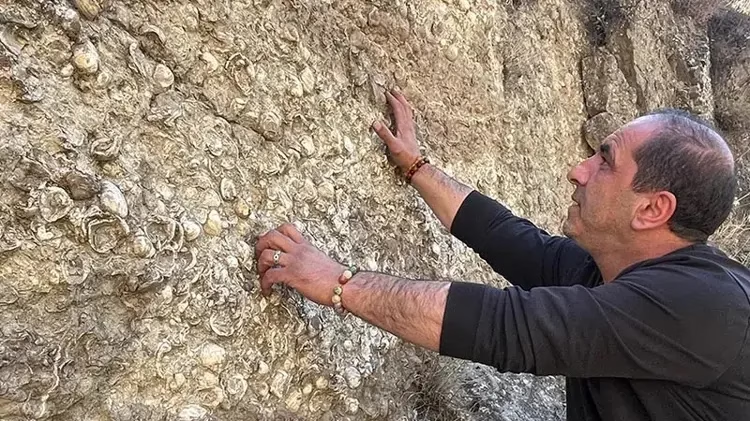
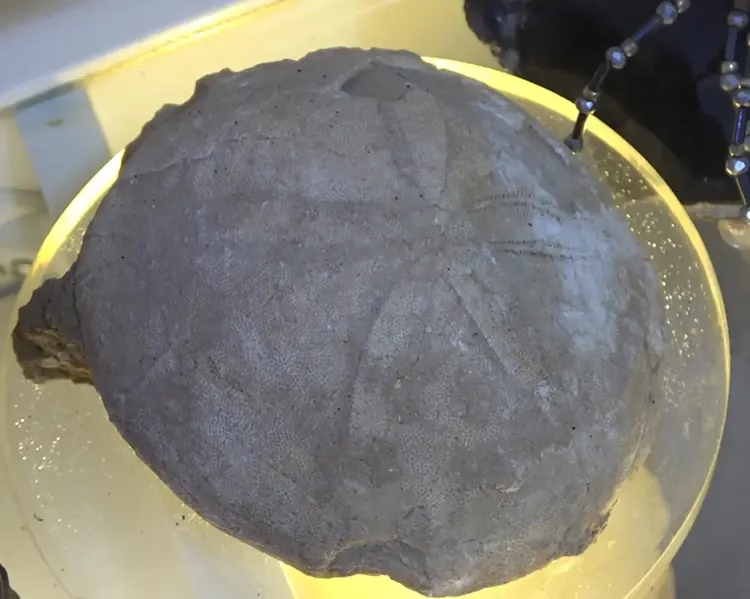
In the highlands of eastern Anatolia, nearly 2,000 meters above sea level, traces of an ancient ocean have surfaced. Researcher Oğuzhan Türk has uncovered a wide range of fossilized marine life — from sea urchins and corals to gastropods and even a possible octopus imprint — in the rugged hills of Erzurum’s Tortum district.
According to Türk, these fossils date back roughly 200 million years, to the Lower and Middle Jurassic periods, when much of modern-day Turkey lay beneath the Tethys Ocean, a vast sea that once separated the ancient continents of Gondwana and Laurasia.
A Hidden Seafloor Beneath the Anatolian Mountains
Guided by the official geological formation map published by the General Directorate of Mineral Research and Exploration (MTA), Türk surveyed a corridor stretching 80 kilometers east–west and 200 kilometers north–south, covering hundreds of rural sites. Over years of fieldwork, he visited nearly 700 villages, documenting stone formations, caves, and fossil-rich outcrops.
“We found marine fossils everywhere — sea urchins, sea cucumbers, gastropods, corals, even something resembling an octopus. The idea that this land was once underwater changes how we see this region,” Türk said.
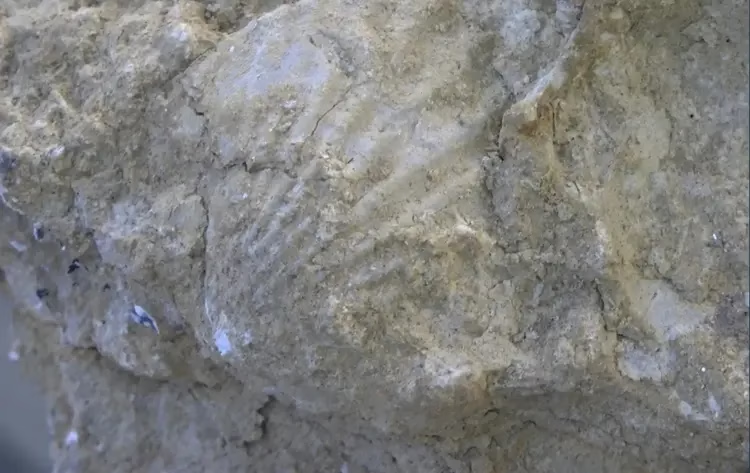
While most fossils were collected for public display in his Yakutiye stone workshop, the potential octopus imprint remains in situ for expert examination. The decision reflects a rare degree of care — soft-bodied fossils are extraordinarily fragile and almost never preserved in standard sedimentary environments.
Scientific Context: When the Sea Covered Anatolia
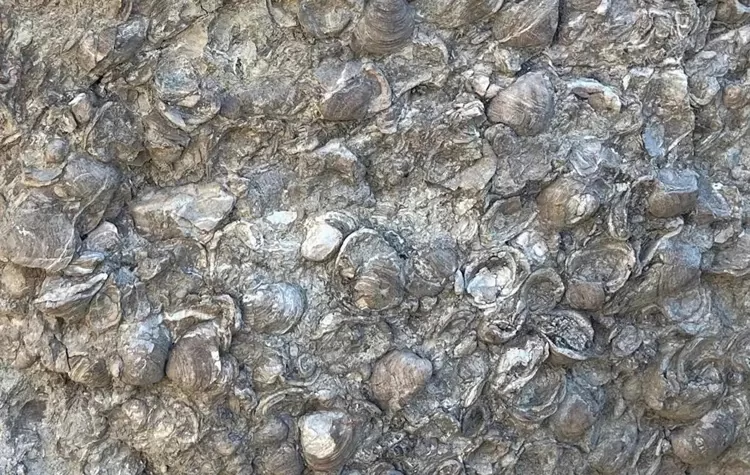
The discovery aligns with paleogeological reconstructions showing that the Tethys Ocean once covered nearly all of Anatolia during the Mesozoic era. Over tens of millions of years, tectonic uplift and continental collision — driven by the northward drift of the African and Arabian plates — raised these seabeds into the mountains we see today.
Fossils from this era help scientists trace the disappearance of the Tethys Ocean, whose closure gave birth to both the Mediterranean Sea and Turkey’s mountainous topography. Comparable marine deposits have been recorded in central and western Anatolia, but findings from the Erzurum highlands are rare, especially at such elevations.
“Every new fossil site in this region gives us another clue about how the Tethys retreated and how the Anatolian plateau emerged,” says geologist Dr. Selin Kara of Istanbul University, who was not involved in the study. “If the octopus imprint proves authentic, it would be an extraordinary case of soft-tissue preservation.”
From Fossil Beds to Cultural Heritage
Türk’s efforts are not confined to scientific curiosity. He aims to promote the fossils as part of Erzurum’s geological and cultural heritage, highlighting the deep-time story of a region often defined by its mountains and harsh climate. His small exhibition in Yakutiye allows visitors to see pieces of the ancient ocean floor — shells, corals, and petrified marine textures — up close.
“People don’t expect to find sea life in these mountains,” Türk says. “But 200 million years ago, this was a thriving ocean. The land remembers, even if we’ve forgotten.”
A New Frontier for Anatolian Paleontology
If confirmed through laboratory analysis, these discoveries could reshape understanding of eastern Anatolia’s paleoenvironment.
Preliminary field evidence suggests that Jurassic marine ecosystems once extended far inland, leaving behind a fossil record now trapped within uplifted limestone and shale.
Researchers emphasize the need for:
- Stratigraphic sampling and radiometric dating to verify fossil layers
- Microscopic and isotopic analyses to confirm marine origin
- Regional correlation with other known Tethyan sequences across Turkey, Iran, and Greece
Such data could eventually integrate Erzurum into the broader Tethyan paleogeographic framework, offering insights into species migration, climate, and ocean chemistry during the Jurassic.