For centuries, the mystery of how the people of Rapa Nui moved their colossal moai statues across the island’s rugged terrain has puzzled archaeologists. Now, new research led by Binghamton University and the University of Arizona offers the clearest answer yet: the statues “walked” — using an ingenious system of ropes, balance, and motion that allowed a handful of people to transport multi-ton monuments upright.
Using a combination of physics simulations, 3D modeling, and real-world experiments, a team led by Professor Carl Lipo of Binghamton University and Professor Terry Hunt of the University of Arizona has demonstrated how the island’s inhabitants achieved one of the most impressive engineering feats in human history.
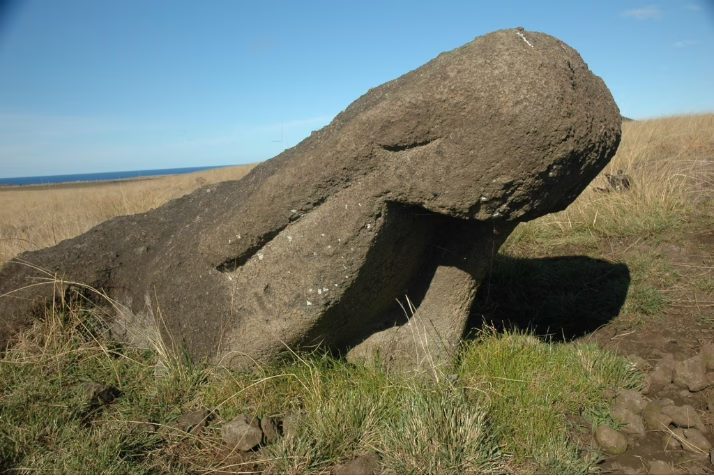
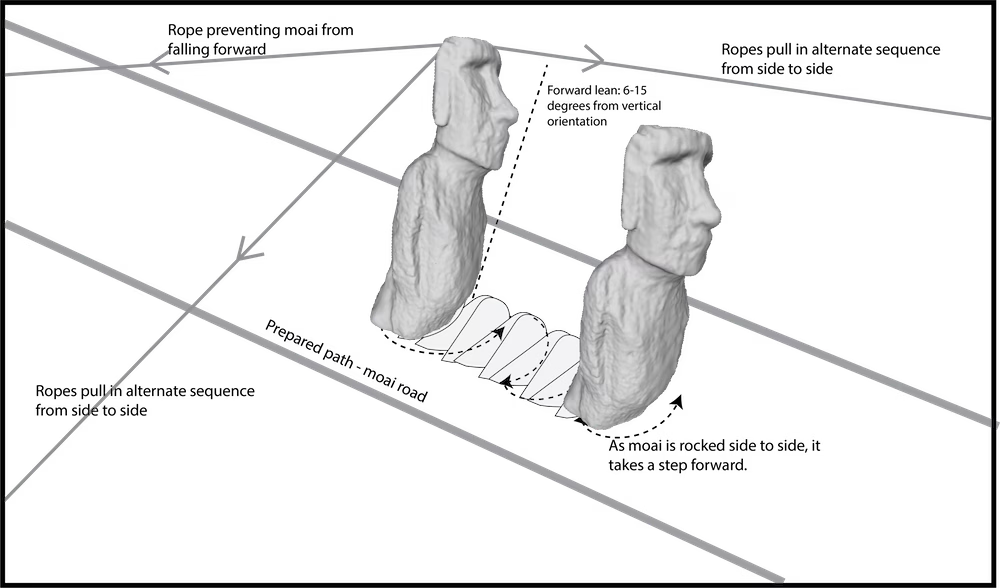
The researchers analyzed nearly 1,000 moai statues, noting distinctive design traits such as D-shaped bases and a subtle forward lean — features that made the figures ideal for a controlled rocking motion. These details, they argue, were not artistic accidents but deliberate engineering solutions.
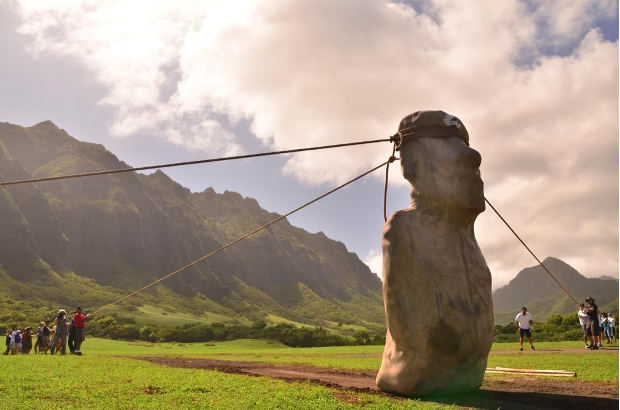
To test the theory, the team built a 4.35-ton replica moai with the same forward-leaning design. Using only ropes and 18 people, they successfully moved the statue 100 meters in just 40 minutes, rocking it side to side in a zig-zag path that mimicked walking.
“Once you get it moving, it isn’t hard at all,” Lipo explained. “It conserves energy, and it moves really quickly. The hard part is getting it rocking in the first place — but once it’s balanced, the physics make perfect sense.”
This experiment refutes older theories suggesting that moai were transported lying flat on wooden sleds. Instead, the evidence now shows that Rapa Nui’s ancient engineers relied on gravity, rhythm, and geometry — not brute strength — to move statues that could weigh more than 80 tons.
Equally telling are the island’s ancient roads, which average 4.5 meters in width and feature a concave cross-section ideal for stabilizing an upright load. According to Lipo, these roads were likely constructed as part of the statue transport process itself.
“Every time they moved a statue, they were building the road beneath it,” he said. “The path was an evolving structure — a product of engineering as much as the moai themselves.”
The results, recently detailed in the team’s study, underline not only the practicality of the “walking” hypothesis but also the intellectual sophistication of Rapa Nui’s ancient society.
“It shows that the Rapa Nui people were incredibly smart,” said Lipo. “They figured out a way to do something extraordinary with limited resources. It’s a celebration of their ingenuity.”
The findings also challenge decades of pseudo-archaeological claims that attributed the island’s monuments to lost civilizations or extraterrestrial aid. Instead, this research reaffirms what science increasingly reveals: that human creativity and physics — not fantasy — explain the wonders of the past.
A research team including Binghamton University archaeologist Carl Lipo has confirmed via 3D modeling and field experiments that the ancient people of Rapa Nui “walked” the iconic moai statues. Image Credit: Carl Lipo.
Carl P. Lipo et al, The walking moai hypothesis: Archaeological evidence, experimental validation, and response to critics, Journal of Archaeological Science (2025). DOI: 10.1016/j.jas.2025.106383