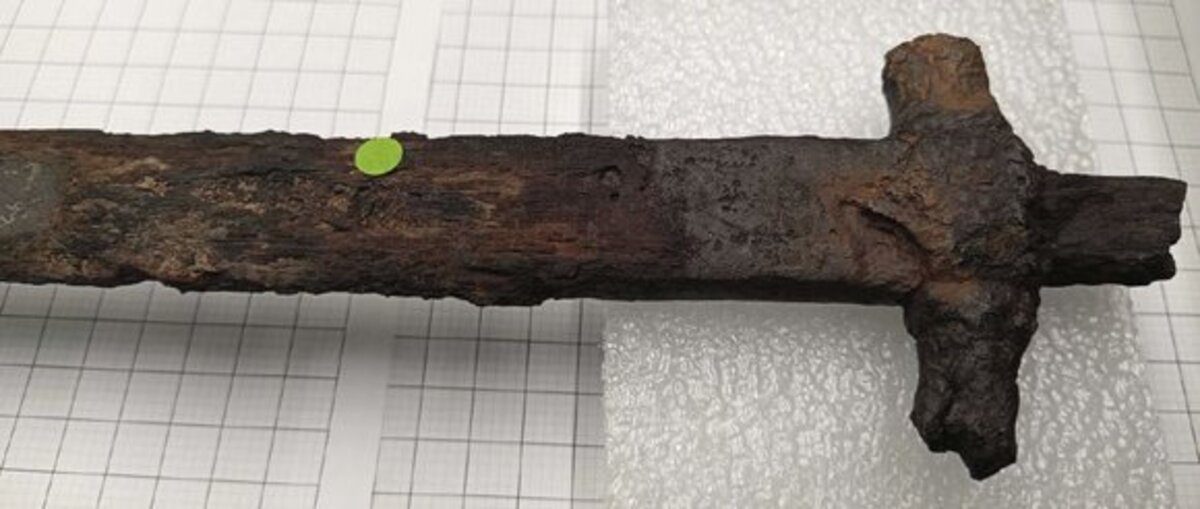
When technology peers into the past, the results can be astonishing. Researchers in Germany have used advanced CT imaging to reveal a hidden inscription inside a heavily corroded Renaissance sword — uncovering the name of a forgotten Solingen swordsmith, Clemes Stam, concealed for more than four centuries.
A Hidden Signature Beneath Centuries of Rust
The discovery comes from an interdisciplinary project at the Friedrich Schiller University Jena and the applied research institute INNOVENT e.V. The sword — or degen — was excavated from the ruins of Collegium Jenense, the original core of Jena University founded in 1558.
Before its destruction during World War II, the Collegium served as both a chapel and burial site for professors and students. Among the artifacts recovered from its crypts were several ceremonial swords placed in burials between the late 1500s and early 1800s. One of them, sealed beneath layers of corrosion, became the focus of a detailed investigation titled “Early Jena University History through the Collegium Quarter.”
Technology That Looks Through Time
Conservator Ivonne Przemuß suspected that the degraded blade might hold more than metal fatigue. Instead of cleaning it mechanically — which could destroy delicate traces — the team turned to high-resolution computed tomography (CT) at INNOVENT’s technology center in Jena.
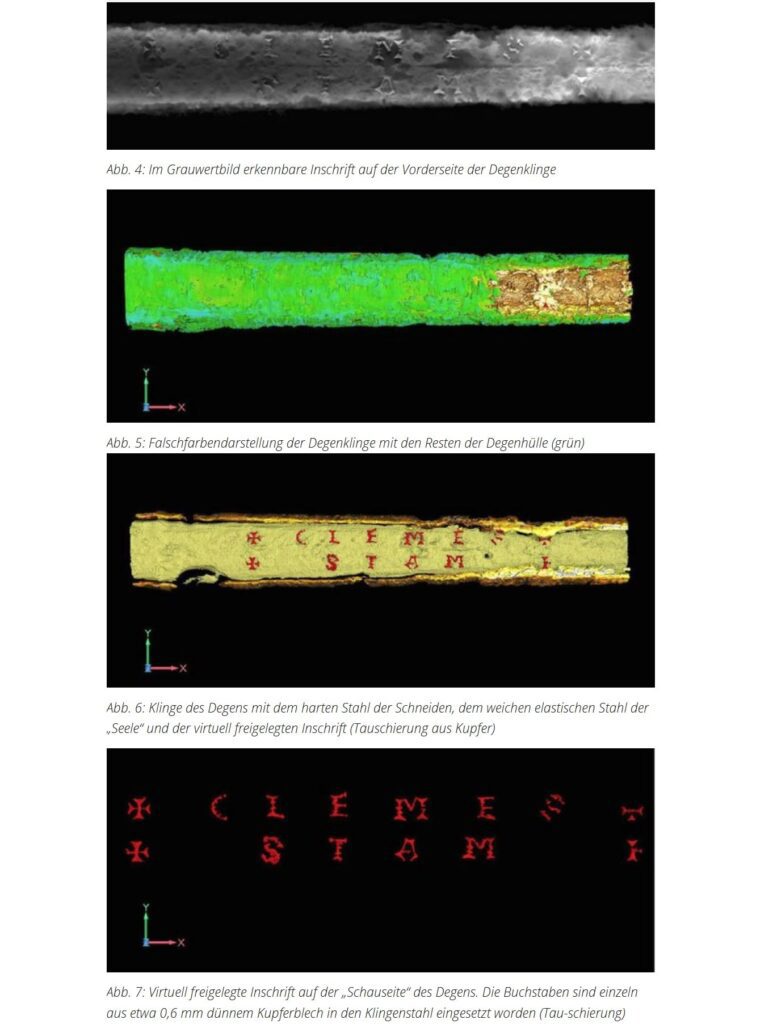
Using an EasyTom 150–160 X-Ray Micro & Nano-CT scanner by RX Solutions, the artifact was digitally reconstructed in three dimensions, achieving a resolution finer than a human hair. The non-invasive scan exposed every density shift within the steel: lamination patterns, corrosion channels, and remnants of a vanished scabbard.
Then, in the virtual model, faint curves appeared. Letters.
What centuries of oxidation had hidden, computation brought to light — the engraved inscription “Clemes Stam.”
Rediscovering a Solingen Swordsmith
Historical records confirm a sword-maker by that name active in Solingen, the German city that supplied blades to noble houses and even the Spanish royal court in the late 16th century. Comparable examples, dated 1580–1620, are preserved today in the German Blade Museum (Deutsches Klingenmuseum).
The Jena sword’s fine structure and metallurgical complexity — alternating steel types forge-welded into the blade — mark it as the work of a master craftsman. Scholars believe it may once have belonged to a university rector or a student of noble descent, a ceremonial weapon symbolizing both status and scholarship.
CT Scanning in Cultural Heritage
The success of this project demonstrates how non-destructive 3D analysis is transforming archaeology and conservation. Instead of cutting, cleaning, or scraping, CT allows experts to explore an artifact’s interior without physical contact — revealing manufacturing techniques, tool marks, and hidden inscriptions invisible to the naked eye.
As project archaeologist Dr. Enrico Paust explained, “CT imaging doesn’t just map surfaces; it lets us read the biography of an object from the inside out.”
The scans also revealed subtle distortions, perhaps traces of ceremonial handling or combat use — details that could never have survived traditional restoration.
From Silent Metal to a Speaking Artifact
The reappearance of Clemes Stam’s name is more than a technical achievement. It is a recovery of identity — the voice of a craftsman echoing from the Renaissance into the digital age.
For the researchers in Jena, the sword bridges two legacies: early modern scholarship and modern scientific inquiry. Each letter engraved by hand in the 16th century now glows in a digital reconstruction, proof that innovation can resurrect what history once silenced.