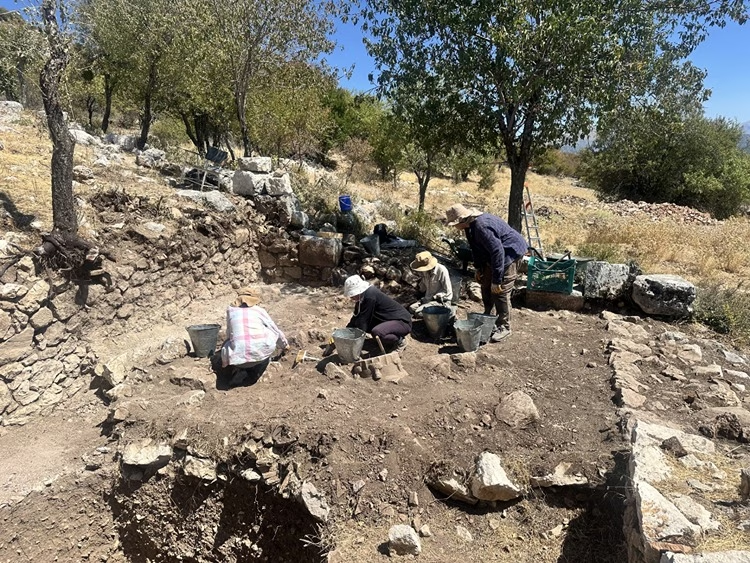
A team led by Prof. Dr. Fikret Özcan has identified a pantry–kitchen suite near the church of Timbriada in Isparta’s Aksu district, with carbonized seeds offering rare clues to diet, economy, and agriculture in Late Antiquity.
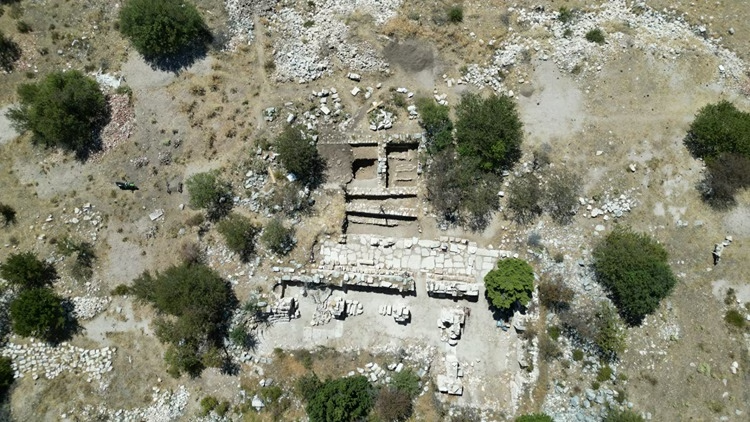
Founded on the slopes of Asartepe and spread across roughly two kilometers, the ancient city of Timbriada in Pisidia has yielded a discovery that moves beyond temples and walls into the routines of daily life. Excavations directed by Prof. Dr. Fikret Özcan of Süleyman Demirel University have exposed adjoining spaces that functioned as a pantry and a cookhouse immediately west of the city’s church.
Sondages in this sector produced carbonized seeds and cereals—modest finds at first glance, but gold dust for archaeologists. Even in damaged condition, the botanical remains speak to how communities adapted to local ecology, what they stored, cooked, and consumed, and how food provisioning was organized around an increasingly important church complex in the Late Antique period.
Özcan notes that the assemblage raises the tantalizing prospect of identifying well-preserved heirloom varieties in future seasons. Beyond enriching the site narrative, such material can inform broader studies of agricultural history and genetic diversity relevant to today’s crops.
Coins, cult, and connectivity
Timbriada was no backwater. From the 2nd century BCE onward the city minted its own coins, reflecting civic identity and economic activity. In the Roman Imperial era, Timbriada participated in the Panhellenion, a league that linked twelve prominent cities—including Athens and Pergamon—into a shared cultural and political framework.
Religion stitched the wider landscape together. In front of Zindan Cave, a sanctuary dedicated to Kybele (Meter) functioned as a major cult center not just for the city but for the region. Local coin types attest to a diverse pantheon—Kybele, Zeus, Dionysos, Hermes, and the Dioscuri—signaling layered beliefs that continued to evolve as the city later appears in records as a bishopric.
Why a pantry and kitchen matter
Domestic and semi-institutional food spaces are often erased by time. Finding both storage and preparation areas in situ, and embedded in a religious precinct, helps clarify how resources were gathered, safeguarded, and redistributed in Late Antiquity. The proximity to the church hints at a community-facing role—from feeding clergy and staff to supporting charity and hospitality.
As work continues under Prof. Özcan’s team, the new sector promises a more granular timeline for Timbriada’s urban life: not just when monuments stood, but what people ate, how they cooked it, and who controlled the stores.