A quiet museum gallery in central France has yielded an academic surprise worthy of a detective novel. Among carefully catalogued artworks at the Museum of Fine Arts of Blois, a single parchment leaf, long believed missing, has re-emerged as part of one of the most important scientific manuscripts in human history.
The page belongs to the celebrated Archimedes Palimpsest, the medieval parchment codex that preserves several foundational works of the ancient mathematician Archimedes. Its rediscovery closes a decades-long gap in the manuscript’s physical record and opens a new chapter in the technological recovery of ancient knowledge.
The identification was made by Victor Gysembergh, a researcher at CNRS, during research unrelated to a systematic manuscript hunt. The rediscovered folio corresponds to a section of On the Sphere and the Cylinder, one of Archimedes’ most influential mathematical treatises.
What had vanished from the codex in the 20th century has, unexpectedly, been sitting in a regional fine arts museum.
A Missing Leaf From One of History’s Most Important Scientific Manuscripts
The Archimedes Palimpsest is a 10th-century Greek manuscript later reused as a religious book. During the Middle Ages, scribes scraped their original ink from the costly parchment and overwrote it with liturgical texts – a practice that created what scholars call a palimpsest.
Beneath later writings survived works by Archimedes, including treatises that reshaped the history of mathematics.
The codex itself is now housed at the Walters Art Museum in the United States, after passing through private collections and a complex legal journey that concluded with French export authorization in 1996.
Yet something was missing.
Scholars comparing early photographs with the manuscript’s modern condition had long noted the absence of folio 123. For years, its fate remained unknown.
Century-Old Photographs Provide the Key
Authentication of the Blois folio relied on an extraordinary visual archive. Between 1906 and 1908, the Danish philologist Johan Ludvig Heiberg photographed the manuscript while it was still in Constantinople (modern Istanbul). Those plates preserved at the Royal Danish Library became indispensable records after the manuscript suffered damage and alterations.
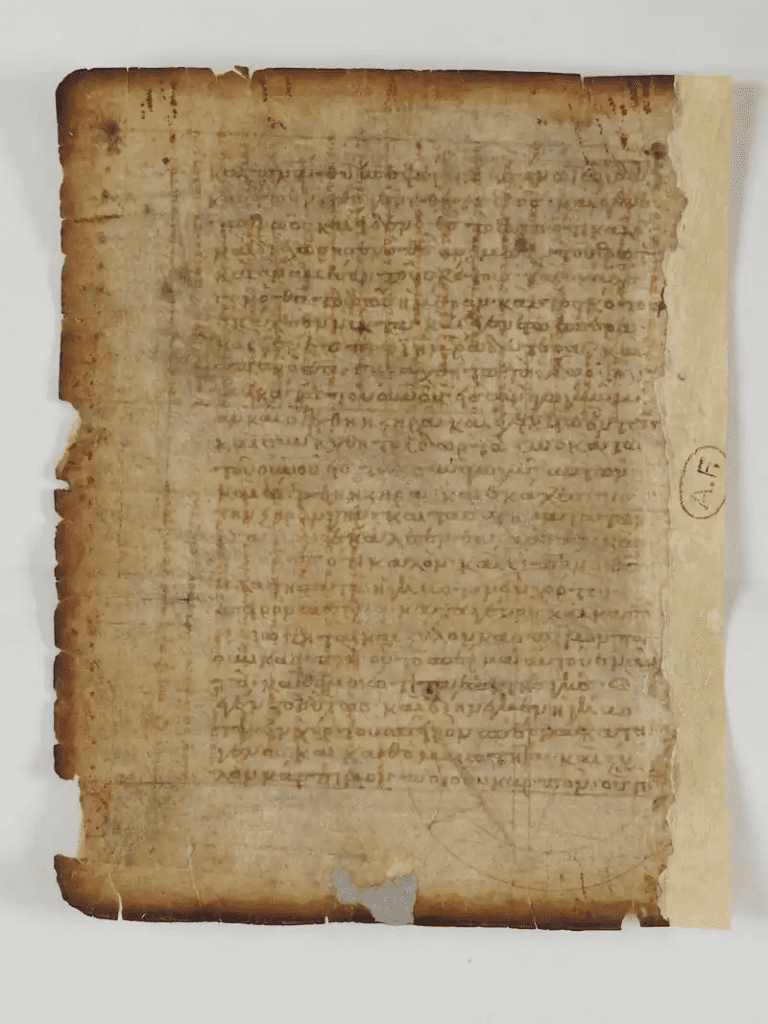
Gysembergh compared one of Heiberg’s plates directly with the Blois leaf. The correspondence was exact. Layout, ink traces, and geometric diagrams are all aligned.
The long-lost page had resurfaced.
Archimedes’ Geometry Still Visible Beneath Centuries of Reuse
Despite centuries of wear, much of the original Greek mathematical text remains legible. The folio preserves portions of “Book I of On the Sphere and the Cylinder”, specifically propositions 39–41, material central to Archimedes’ geometric reasoning about volume and surface relationships.
The Geometric diagrams accompanying the proofs remain discernible, aiding identification and future study.
But the manuscript’s layered history grows stranger.
On one side, the ancient text lies partially obscured by medieval religious writing added when the parchment was reused. On the other hand, something far more unexpected appears.
A Modern Painting Hides Ancient Mathematics
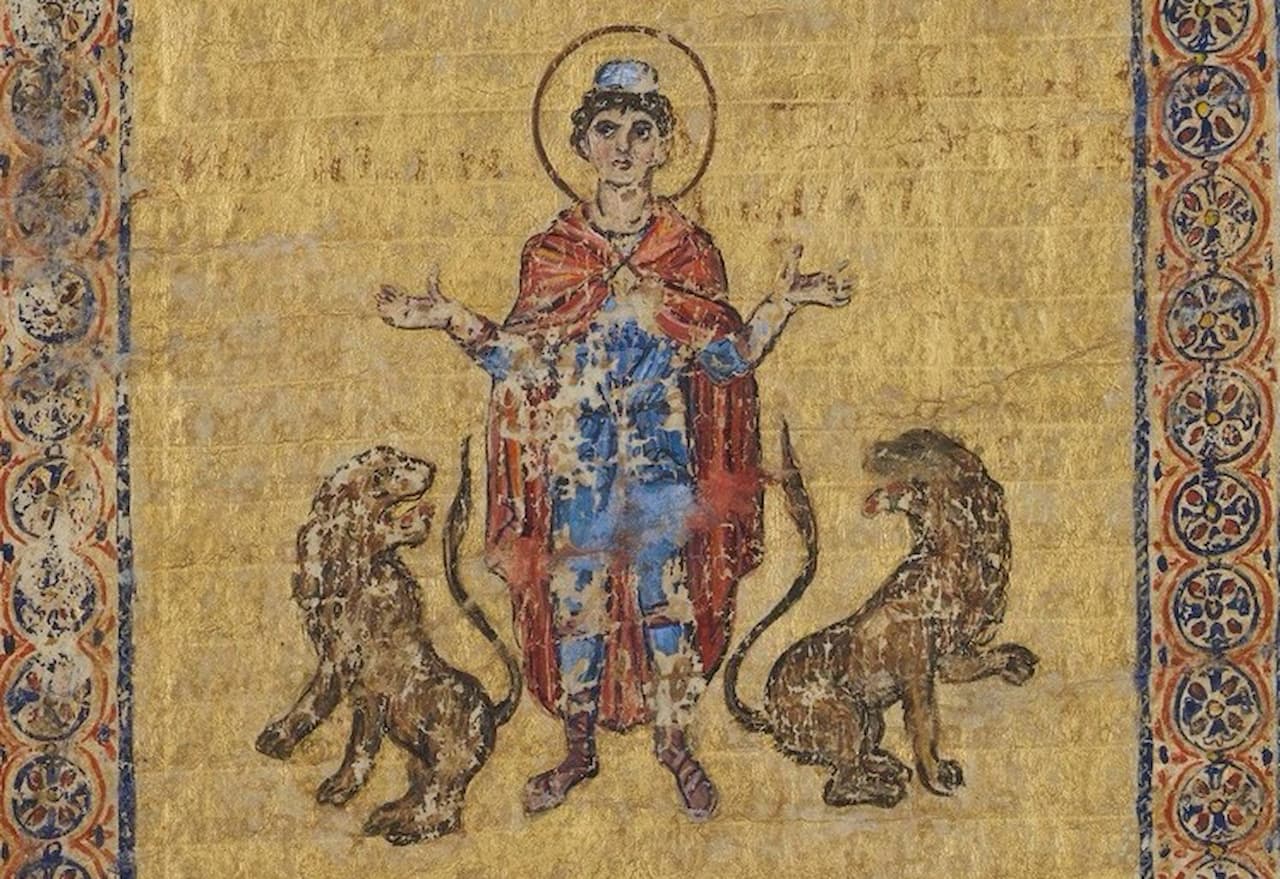
Around 1942, a devotional illustration was painted directly onto the parchment: the prophet Daniel standing beside two lions. Notes accompanying the piece suggest the artwork was commissioned by a private owner at the time, likely to enhance the manuscript’s aesthetic or commercial appeal.
The result was unintended erasure.
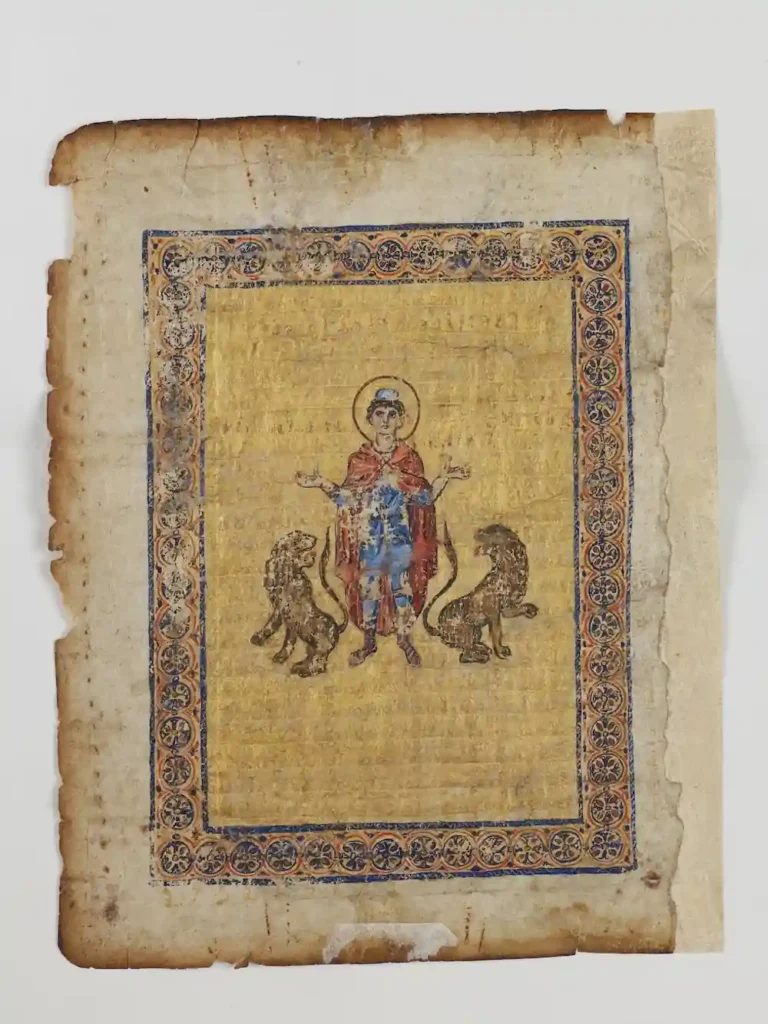
Unlike medieval ink, which modern imaging can often penetrate, the 20th-century paint layer conceals Archimedes’ text beneath an opaque surface. What survives below remains invisible to conventional examination.
For historians of science, that obscured side is now the most intriguing part of the discovery.
New Imaging Technology May Reveal the Hidden Text
Two decades ago, the Archimedes Palimpsest underwent a landmark imaging campaign using multispectral photography. That effort recovered previously unreadable texts and revealed additional classical material thought lost.
Technology has since advanced.
Gysembergh has announced plans to seek authorization for a new analysis campaign. The proposed work would combine cutting-edge multispectral imaging with X-ray fluorescence scanning powered by synchrotron radiation, a method capable of distinguishing chemical signatures in layered inks and pigments without damaging the parchment.
Such analysis could separate:
1. Archimedes’ original ink
2. Medieval liturgical writing
3. Modern paint pigments
If successful, the hidden mathematical text could become readable for the first time in decades.
A Renewed Call to Re-Examine the Entire Manuscript
The Blois discovery has revived discussion about a comprehensive new study of the entire palimpsest. Researchers argue that modern tools far surpass those available in the early 2000s and could clarify passages that remain only partially deciphered.
For historians of mathematics, the stakes are clear. Archimedes’ works underpin fundamental principles of geometry and physics. Even small textual recoveries can refine interpretations of his methods and intellectual legacy.
A single museum folio, quietly preserved far from major research centers, now holds the promise of revealing new details from one of antiquity’s greatest scientific minds.
Centuries of ink, paint, and parchment still guard his words, but not for much longer.
Victor Gysembergh, A leaf from the Archimedes palimpsest rediscovered in Blois. Zeitschrift für Papyrologie und Epigraphik, 6 mars 2026