
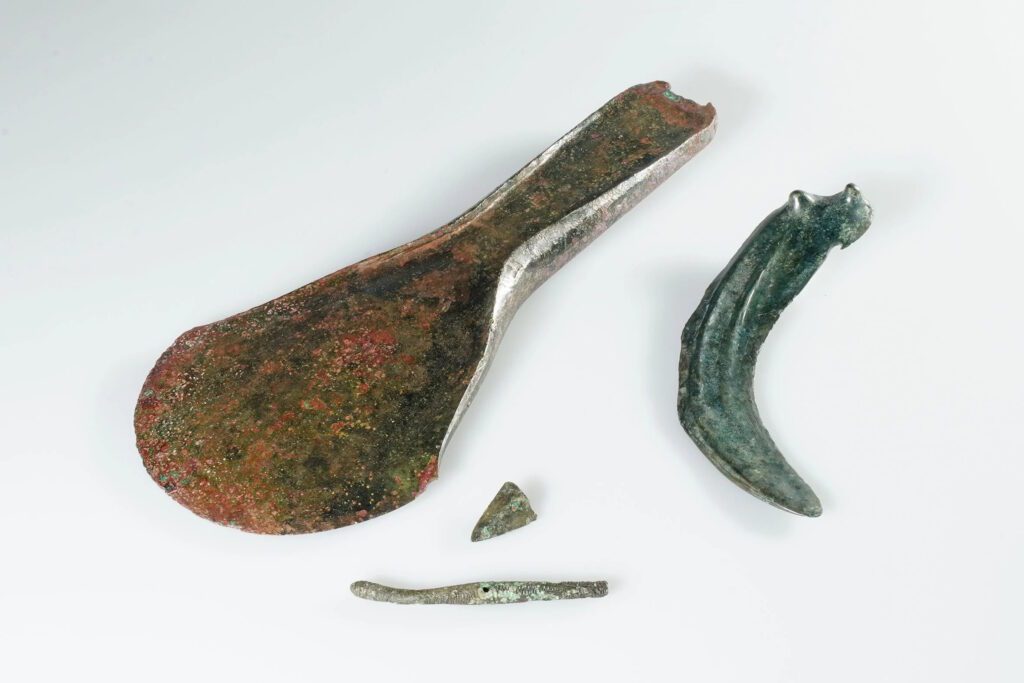
A remarkably well-preserved Middle Bronze Age bronze axe has been discovered on a steep hillside overlooking the border village of Burg im Leimental, offering fresh insight into ritual metal deposition and regional mobility some 3,500 years ago. Cast from solid bronze and measuring 22 cm (8.7 in), the weapon stands out not only for its size and unusual weight but also for the precision of its workmanship—an example of high-skill metallurgy in the mid-second millennium BCE.
The artifact surfaced during a systematic archaeological survey led by the Archaeology Department of Basel-Landschaft. Metal detectorist Sacha Schneider, working under official supervision, located the axe in a compact rock pocket filled with soil on a slope below a prominent outcrop.
A Classic “Grenchen Type” Weapon
Typologically, the object is a flanged axe of the Grenchen type—a well-known Central European form named after Grenchen, where a cache of Bronze Age axes and sickles was found in 1856. The type is associated with standardized casting traditions and long-distance exchange networks that linked communities across the Alpine forelands and beyond.
Near the axe, Schneider also recovered a bronze garment pin, likely used to fasten clothing. Although the two items were found close to each other, archaeologists say they do not appear to belong to a single, intact deposit.
Hoards, Offerings, and the Ritual Landscape
The discovery feeds into a broader archaeological pattern: the intentional burial of metal objects during the Bronze Age. Across Europe, hoards sometimes contain dozens—occasionally hundreds—of items tightly clustered in small areas. Tools, weapons, ornaments, and raw metal frequently appear together, suggesting structured deposition rather than casual loss.
Scholars widely interpret many such assemblages as votive offerings, placed in the ground for symbolic or religious reasons. Single objects discovered in distinctive contexts—rock crevices, riverbeds, wetlands—are often read the same way. The Burg axe’s placement in a natural rock pocket supports this interpretation.
Yet the picture remains open. Because other bronze objects have been found in the same locality, researchers caution that the site could once have held a larger hoard that was later disturbed, dispersed, or looted.
A Crossroads of Bronze Age Movement
Today, Burg sits quietly on the Swiss–French frontier. In prehistory, however, this landscape formed part of a fertile and well-connected corridor linking the Rhine and Rhône basins via the Burgundy Gate. Archaeological finds from nearby Rodersdorf confirm Middle Bronze Age settlement in the region.
Additional parallels strengthen the case for sustained activity and movement through these valleys. Another Grenchen-type axe was uncovered in 1968 during pool construction in Aesch, hinting at a route into the Birs Valley. Just across the modern border, a substantial bronze hoard discovered in 1998 in Biederthal underscores the area’s wider ritual and exchange networks.
Taken together, the evidence suggests that the transitional zone between the flat Sundgau plain and the northern Jura foothills held special cultural significance for Bronze Age communities.
Now on Public Display
The newly recovered axe has entered public view in a dedicated exhibition at the Historical Museum Basel, housed in the former church of Barfüsserkirche. It is presented alongside other regional Bronze Age finds, allowing visitors to trace technological skill, ritual behavior, and cross-border connectivity in deep time.
A single object, precisely made and deliberately placed, now anchors a much larger story—about craft, belief, and movement across one of Europe’s enduring cultural corridors.