The Iron Age is often imagined as a world shaped by scarcity—agrarian communities living under imperial pressure, far removed from luxury or global exchange. A single burial in northern Israel now undermines that assumption at its core.
At Ḥorvat Tevet, in the Jezreel Valley, archaeologists have uncovered evidence that elite status, wealth, and far-reaching connections were not confined to imperial capitals, but extended deep into rural landscapes during the 7th century BCE.
This is not a story about a grave.
It is a story about how empire was lived.
When Burial Practices Break the Pattern
In the Southern Levant, Iron Age funerary traditions are relatively well understood—and largely predictable. Inhumation dominates the record. Cremation does not.
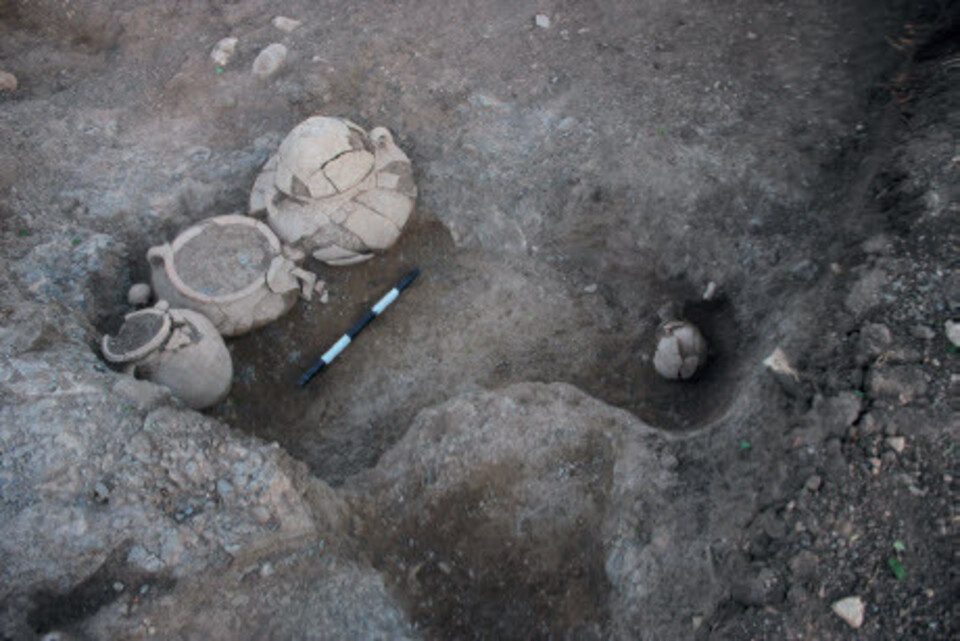
That is why the burial discovered at Ḥorvat Tevet immediately stood out. One of two adjacent burial pits contained cremated remains accompanied by an assemblage so unusual that it resists easy classification. Nothing comparable has been documented at a rural site in the region.
The burial dates to the Iron IIC period, when the Neo-Assyrian Empire exerted firm control over the Jezreel Valley. Yet what emerges here is not cultural uniformity, but selective difference—a mortuary choice that signals identity, status, and possibly affiliation beyond local norms.
Wealth That Does Not Belong to the Village
The surrounding settlement remains at Ḥorvat Tevet are unremarkable. Domestic architecture is modest. Material culture is restrained.
The burial is neither.
Only when viewed against this backdrop does the assemblage reveal its true significance. The objects placed with the cremated individual were not everyday possessions; they were markers of position within wider systems of power.
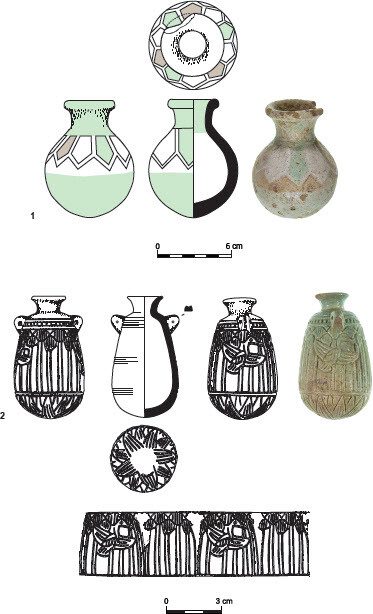
Among them were imperial-style Assyrian vessels, an administrative cylinder seal, a standardized weight, and luxury containers linked to Mediterranean trade. These were not symbolic tokens. They were functional objects of authority, exchange, and mobility.
Their presence suggests an individual whose life extended beyond the village—someone embedded in administrative, mercantile, or imperial networks that connected Mesopotamia, the Levant, and the Mediterranean world.
Empire Beyond the City Walls
Assyrian control in the southern Levant has long been described as pragmatic and extractive, focused on agricultural production rather than social investment. The Ḥorvat Tevet burial complicates that model.
Rather than signaling neglect, the burial points to active imperial integration, where selected individuals operated as intermediaries between rural landscapes and urban power centers.
The site’s proximity to Tel Megiddo—an Assyrian provincial capital less than 15 kilometers away—is critical. The burial may represent a deliberate spatial strategy: placing elite presence within agricultural territory, not isolating it within fortified cities.
In this light, the burial reflects governance through connection, not distance.
Cremation as Cultural Signal
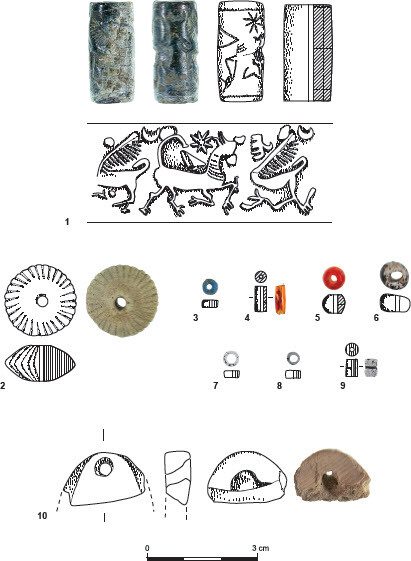
The choice of cremation adds another layer to this picture. In a region where burial traditions were conservative, cremation suggests exposure to alternative practices—possibly tied to imperial service, mobility, or hybrid identity.
Rather than reading the practice as foreign intrusion, researchers increasingly view it as selective adoption, a conscious expression of status in an imperial context.
Here, death becomes a final statement about belonging.
Why This Burial Matters
What Ḥorvat Tevet ultimately reveals is not a deviation, but a correction.
It shows that Iron Age societies under Assyrian rule were not uniformly poor, isolated, or culturally static. They were stratified, connected, and capable of sustaining elite lifestyles far from imperial centers.
Luxury, in this case, was not excess.
It was infrastructure.
Open Research, Broader Implications
The study, “A Unique Assemblage of Cremation Burial from Ḥorvat Tevet and Assyrian Imperial Rule in the Jezreel Valley,” published in 2025 in Tel Aviv: Journal of the Institute of Archaeology, is available open access.
Its implications extend well beyond one site. This burial forces a reconsideration of how empire functioned on the ground—and how deeply it shaped individual lives in the Iron Age Near East.
Peleg, O., Covello-Paran, K., Bezzel, H., Gadot, Y., & Sergi, O. (2025). A Unique Assemblage of Cremation Burial from Ḥorvat Tevet and Assyrian Imperial Rule in the Jezreel Valley. Tel Aviv, 52(2), 217–255. https://doi.org/10.1080/03344355.2025.2550116
Cover Image Credit: Area B, Level 3 burial pits at Ḥorvat Tevet, viewed from the southeast. Photo: Jordan Weitzel; courtesy of the Ḥorvat Tevet Expedition, Credit: Peleg et al., 2025