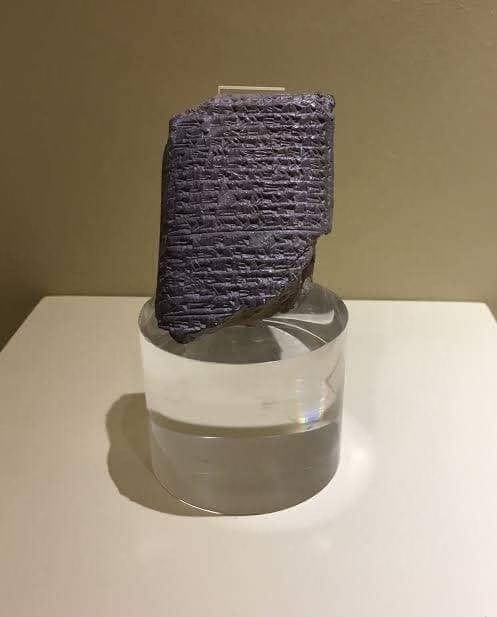
Nearly three millennia ago, two men sealed a deal by the banks of a river in ancient Mesopotamia. The object of the transaction was not gold, nor land in the abstract, but a fertile orchard heavy with fruit trees. With four witnesses present to stamp their seals, the agreement was etched into clay, creating what is now recognized as the world’s earliest property deed. Today, that contract is on display at the Mardin Museum in southeastern Türkiye.
The cuneiform tablet, which dates back to the 7th-8th centuries BC, the Neo-Assyrian period, was discovered in 1994 at the Girnavaz Höyük near Nusaybin, under the direction of the late Prof. Dr. Hayat Erkanal. After being stored in a warehouse for decades, the tablet began to be exhibited in 2011 and quickly became one of the museum’s most important exhibits.
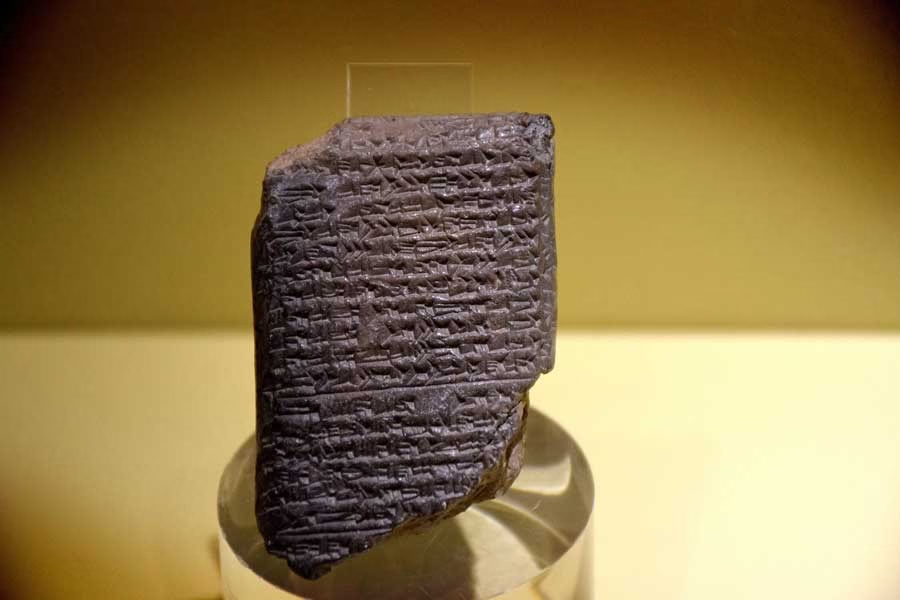
The text records the sale of an orchard owned by a man named Sarri and his three sons. The property—described as lying north of the ancient city of Nabulu, today’s Nusaybin—was sold to a man named Istarnadin, with four witnesses confirming the deal through their seals.
Translation of the Cuneiform Text
According to scholars, the inscription details the sale of an orchard:
“With the seals of Hampute, Abu-salam son of Urad-gula, Mannuki-Arbail, and Hansi, the orchard belonging to Sarri’s three sons—located by the noble road along the river in Nabulu, with its grapes and fruit trees—was sold to Istarnadin-ahhe for 1 mina and 20 shekels of silver.”
The discovery not only enriches our understanding of Assyrian society but also adds a new cultural layer to Mardin’s heritage. Local officials expect the artifact to draw thousands of visitors from across the world.
Girnavaz Höyük: The Northern Gateway of Mesopotamia
Girnavaz Höyük, located about 4 kilometers from Nusaybin in Mardin, Turkey, stands as one of the most significant archaeological settlements at the northern edge of Mesopotamia. Rising nearly 40 meters high and spanning 700 meters in diameter, it ranks among the largest mounds in Upper Mesopotamia.
Excavations indicate that Girnavaz was continuously inhabited from the 4th millennium BC through the Middle Ages. This long-term settlement underscores its strategic importance as a northern frontier of the Assyrian Empire and a key hub on trade routes linking Mesopotamia with Anatolia.
Systematic excavations were conducted from 1982 to 1991 (excluding 1985) under the direction of Prof. Dr. Hayat Erkanal. These efforts revealed temples, administrative buildings, and cuneiform tablets, particularly from the Neo-Assyrian period (9th–7th centuries BC), proving that Girnavaz functioned not merely as an agricultural settlement but as a major administrative and commercial center.
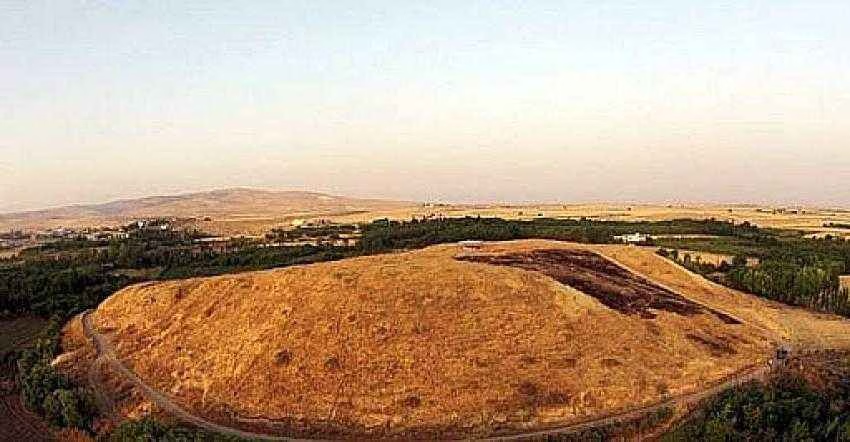
In 1994, archaeologists unearthed what is considered the world’s oldest known deed of sale: a cuneiform tablet documenting the transaction of a fruit orchard. This remarkable find confirms that Girnavaz was also a center where legal, economic, and social activities were formally recorded.
In 1991, two respected archaeologists, Metin Akyurt and Bahattin Devam, lost their lives in a bomb attack carried out by terrorists.
Efforts to resume excavations are continuing.