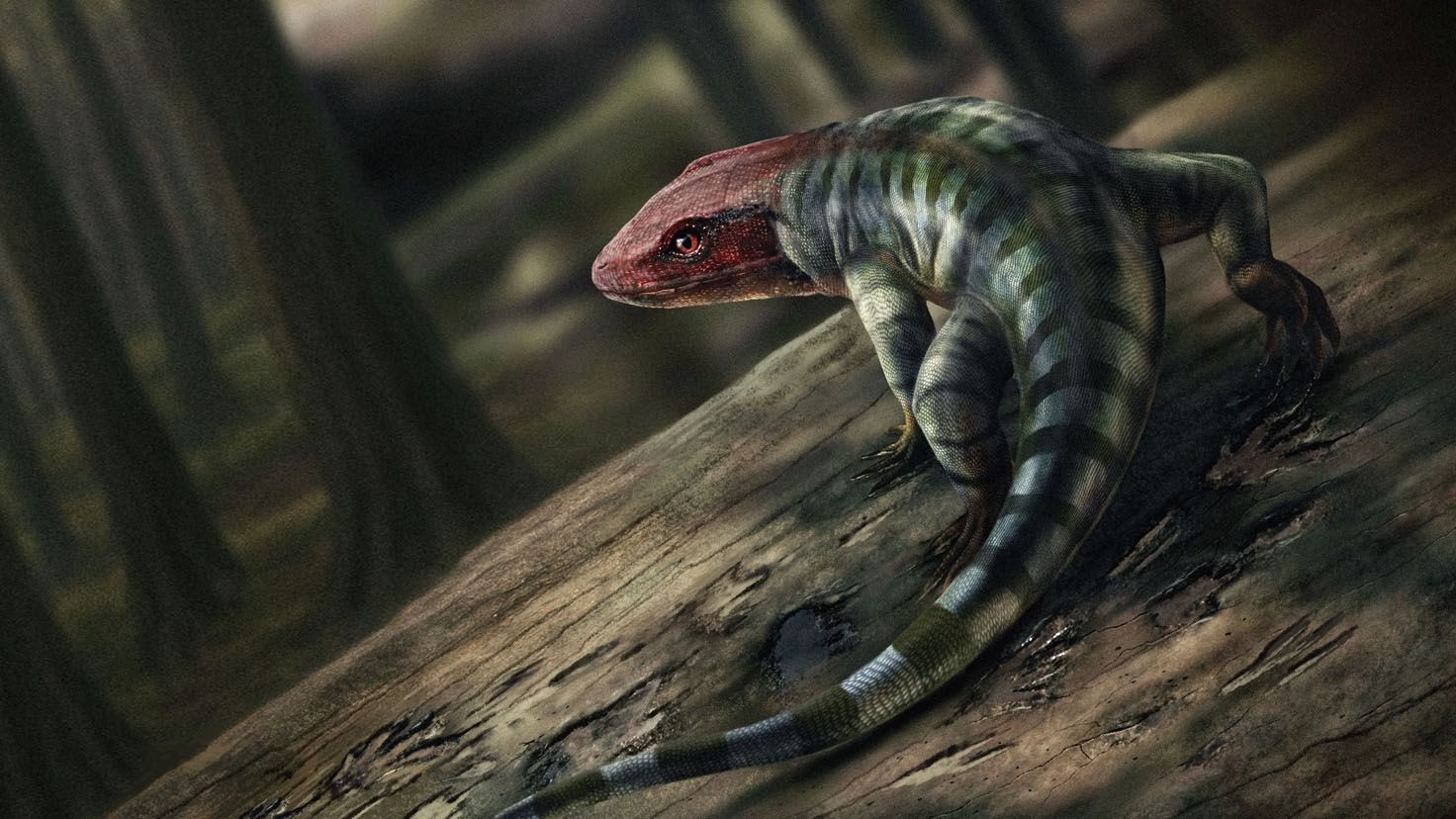
A fossil slab discovered in Australia has revealed the oldest known clawed footprints, dating back 355 million years. The groundbreaking find pushes the origin of reptiles 35 million years earlier than previously believed and reshapes the evolutionary history of tetrapods.
The study, led by researchers at Uppsala University, has been published in Nature.
Ancient Footprints Challenge Scientific Consensus
For decades, paleontologists believed that reptiles first appeared about 320 million years ago, during the late Carboniferous period. The new fossil evidence from Australia, however, tells a different story. The slab, which is small enough to be lifted by one person, contains well-preserved footprints with long toes and sharp claws. These features are unique to reptiles and their close relatives, meaning reptiles had already evolved much earlier than assumed.
“It is astonishing that a single piece of rock can overturn decades of established science,” said Professor Per Ahlberg of Uppsala University, who led the research team. “These are the oldest clawed footprints ever found, and they show that modern tetrapods originated far earlier than we thought.”
From Devonian Fish to the First Land Reptiles
Tetrapods—four-limbed vertebrates that include amphibians, reptiles, birds, and mammals—evolved from a group of lobe-finned fish about 390 million years ago in the Devonian period. These pioneering animals gradually adapted to life on land, giving rise to all modern land-dwelling vertebrates.
Until now, the oldest known amniote fossils—members of the group that includes reptiles, birds, and mammals—were dated to roughly 320 million years ago. The 355-million-year-old Australian slab forces scientists to push the timeline back by at least 35 million years, into the very earliest Carboniferous period.
“When I first examined the slab, I immediately noticed the claw marks,” explained Dr. Grzegorz Niedźwiedzki, co-author of the study. “Claws are characteristic of amniotes but almost never occur in other tetrapods. This strongly suggests the tracks were made by an early reptile.”
Fossil Evidence from Europe Strengthens the Discovery
To support their interpretation, the researchers compared the Australian fossil with newly discovered reptile tracks from Poland. While the Polish tracks are slightly younger, they are still much older than previously known reptilian fossils. Together, the two discoveries confirm that reptiles were already present much earlier than previously believed.
This also means that the evolutionary split between amphibians and amniotes must have occurred earlier, possibly in the late Devonian period. Using a combination of fossil dating and DNA analysis of living species, the research team concluded that the last common ancestor of amphibians and reptiles likely lived during this time.
Rethinking the Evolutionary Tree
The implications of the study extend far beyond the age of reptiles. If reptiles were already walking the Earth 355 million years ago, then advanced tetrapods were far more diverse during this period than scientists once believed. Previously, paleontologists assumed that only primitive “four-legged fish” such as Tiktaalik inhabited land in the Devonian and earliest Carboniferous.
“This discovery suggests that advanced tetrapods had already established themselves while we still imagined only primitive forms crawling along the shores,” said Ahlberg. “And the fact that this slab is just 50 centimeters wide, yet contains such groundbreaking evidence, raises exciting questions about what else remains undiscovered.”
The fossil was found in Gondwana, the ancient supercontinent that included Australia, Africa, South America, Antarctica, and India. This makes the discovery even more remarkable, as it provides the only known tetrapod fossil evidence from early Carboniferous Gondwana.
Looking Ahead: More Discoveries Await
The researchers emphasize that this is likely just the beginning. Countless fossil sites in Australia and other parts of Gondwana remain unexplored, and future excavations may reveal more evidence of early reptiles and other advanced tetrapods.
“The most exciting discoveries are still waiting to be made,” said Niedźwiedzki. “These Australian footprints are just one example of how much there is left to uncover in the fossil record.”
Study Details
The research was published under the title “Earliest amniote tracks recalibrate the timeline of tetrapod evolution” in Nature (DOI: 10.1038/s41586-025-08884-5). Authors include John A. Long, Grzegorz Niedźwiedzki, Jillian Garvey, Alice M. Clement, Aaron B. Camens, Craig A. Eury, John Eason, and Per E. Ahlberg.