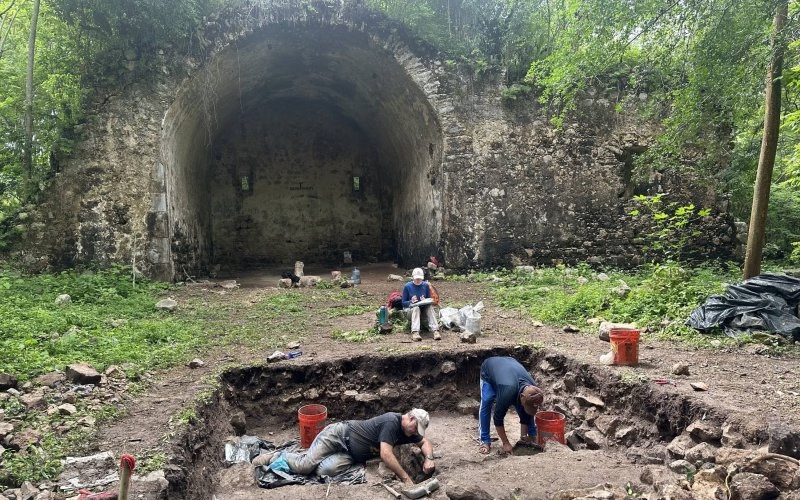
Yucatán, Mexico — Archaeologists have uncovered the dramatic story of Hunacti, a short-lived 16th-century Maya mission town that flourished for just 15 years before collapsing under colonial repression, famine, and defiant resilience.
Founded in 1557 as a Franciscan visita mission, Hunacti was laid out with gridded streets, a central plaza, and a Spanish-style church. Surrounding it stood three elite residences with plastered walls, arched windows, and niches that reflected European ideals. Yet beneath this façade, researchers found clear evidence of enduring Maya religious practices.
Excavations led by Marilyn A. Masson of the University at Albany, in collaboration with Mexico’s Instituto Nacional de Antropología e Historia, Morehead State University, and the University of South Wales, revealed ceremonial incense burners depicting Maya deities hidden inside elite houses and even the church itself — used until the very end of the settlement.
A Town Caught Between Two Worlds
Hunacti’s early leaders enjoyed rare privileges for Maya elites under Spanish rule — ownership of a cacao orchard, horses, and control of construction labor. But that visibility brought danger.
In the 1560s, Hunacti became entangled in Diego de Landa’s infamous “idolatry trials,” which sought to eradicate Maya rituals. In 1562, community leader Juan Xiu was tortured to death on accusations of human sacrifice, while others faced public lashings.
By 1572, famine struck and the town was abandoned, with residents relocating to nearby Tixmehuac.
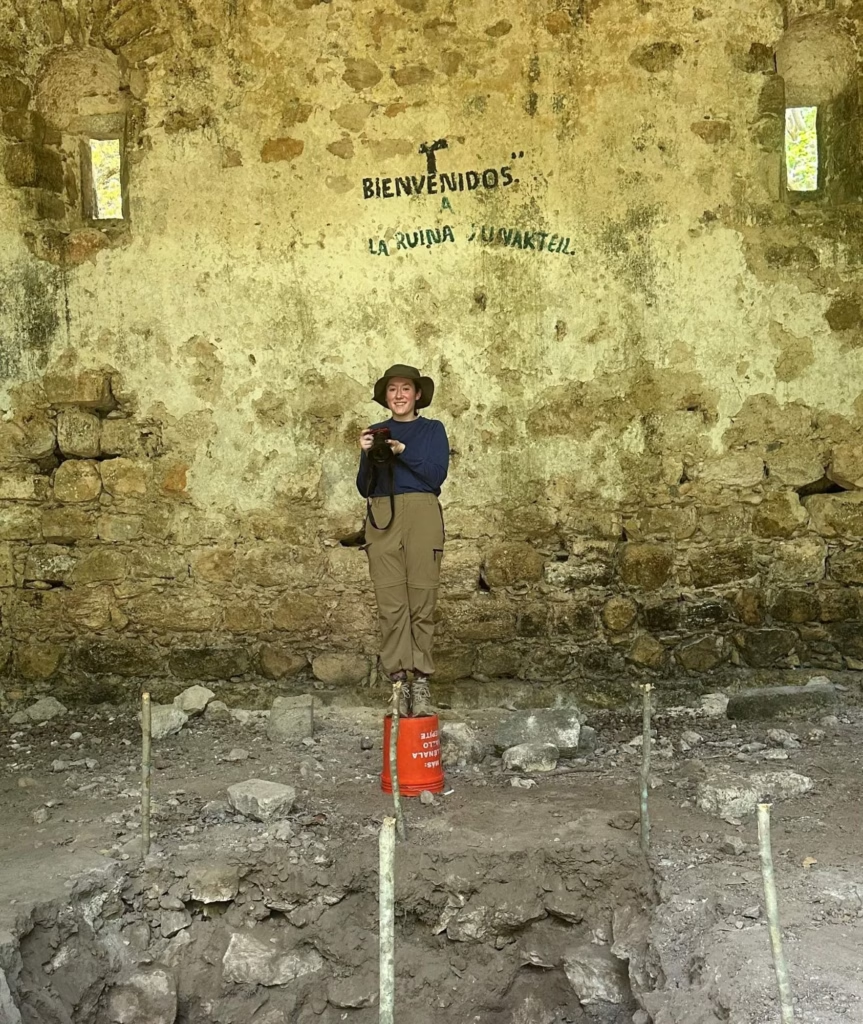
Key Findings from Hunacti
- Maya traditions endured: effigy censers and ritual objects remained in use despite Franciscan prohibitions.
- Local economy: stone tools were almost entirely made from regional limestone and chert; only one European metal axe was recovered.
- Sparse imports: unlike many mission towns, Hunacti yielded few Spanish goods and little evidence of surplus production for colonial markets.
- Faunal remains: deer, peccary, iguana, and one horse — a status symbol for elites.
Defiance Over Assimilation
While Spanish records might frame Hunacti as a failure, archaeologists interpret it differently. The community shifted from early cooperation to self-sufficiency and subtle resistance, prioritizing local autonomy over colonial integration.
“Success here isn’t measured by imported goods,” said Masson. “It’s about sustaining traditions and making your own choices under extraordinary pressure.”
Rewriting Colonial Histories
Published in Latin American Antiquity and supported by the National Geographic Society, the study emphasizes how household archaeology can expose Indigenous strategies of negotiation and resistance that written colonial histories tend to obscure.
Hunacti’s short but turbulent life shows that the Maya response to colonization was far from uniform. Some communities embraced Christianity and Spanish governance for material gain; Hunacti chose resilience, even at the cost of survival.