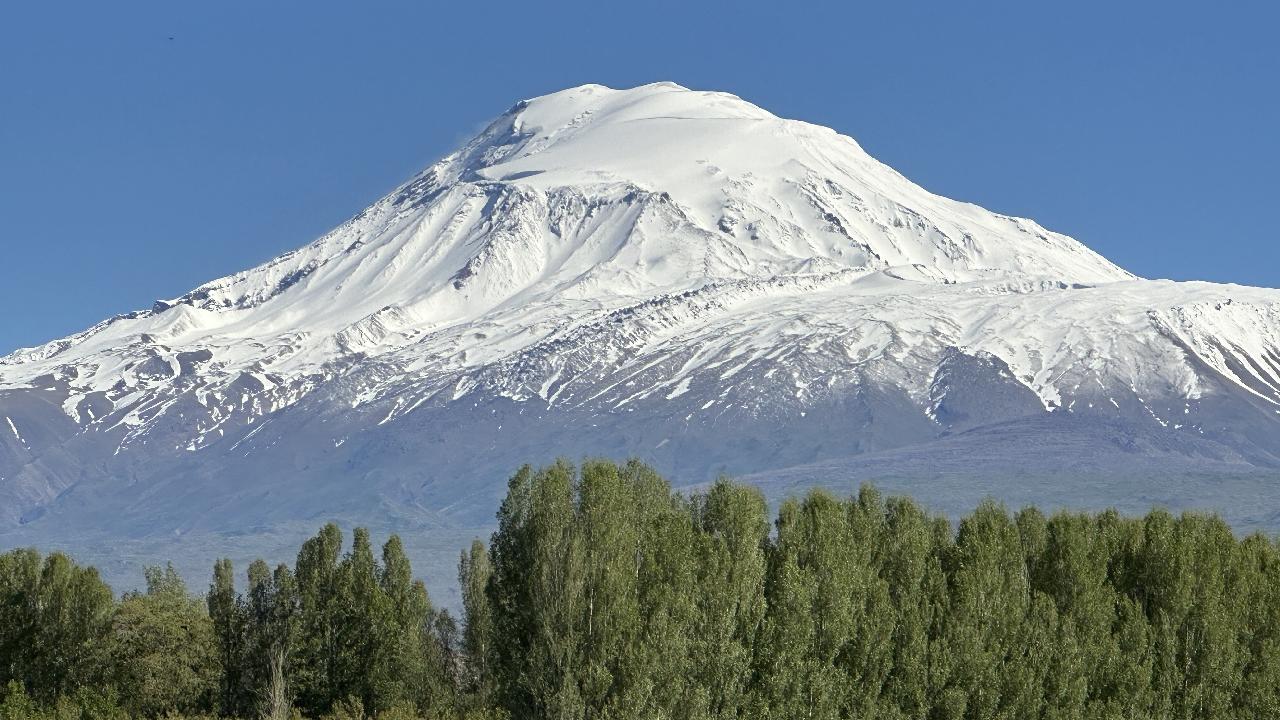
Few mountains carry as much symbolic weight as Mount Ararat. It stands inside modern Türkiye, dominates the skyline of Armenia’s capital, and appears—directly or indirectly—in the sacred narratives of multiple faiths. Its significance today is less about archaeological discovery and more about how different traditions interpret the same terrain.
A new academic reassessment does not attempt to prove whether Noah’s Ark physically rests beneath Ararat’s ice. Instead, it evaluates how Christian theology, and Islamic scripture assign meaning to the mountain in distinct yet overlapping ways. The focus shifts from timber remains to interpretive frameworks.
Islamic Theology: The Mountain Is Secondary
Interestingly, one of the clearest divergences appears in the Qur’anic account. The Ark is said to have come to rest on “Al-Judi,” not Ararat. Islamic exegetical traditions have debated the location of Al-Judi for centuries, with some identifying it in southeastern Türkiye.
Yet classical Islamic scholarship often emphasizes that the moral lesson outweighs geography. The narrative centers on patience, prophetic perseverance, and individual responsibility. Even Noah’s own son does not survive without faith—an explicit reminder that salvation is not inherited. In this interpretive model, the exact mountain is less important than the ethical message.
This approach contrasts with traditions that anchor theological meaning to a specific peak.
Christianity: A Covenant Anchored in Landscape
The Hebrew Bible’s Book of Genesis refers to the Ark resting on the “mountains of Ararat.” The phrasing is geographically broad, yet historically it became associated with the prominent volcanic massif known today.
Christian engagement with Ararat has often taken physical form. From medieval ascents to modern expeditions, explorers have searched for tangible confirmation of the Biblical account. While no verified remains have been documented, the absence of material evidence has not diminished theological importance.
In Christian thought, Ararat symbolizes transition: from judgment to mercy, from flood to renewal. The mountain functions as a geographical marker of covenant—a place where divine destruction gives way to divine promise.
Armenian Memory: Visibility Without Sovereignty
For Armenians, Ararat’s meaning extends beyond scriptural debate. The mountain appears on the national coat of arms and dominates Yerevan’s horizon. Yet it lies outside Armenia’s present-day borders.
This geographical paradox has deepened its symbolic force. Within Armenian Christian historiography, the Ark narrative intersects with ideas of ancestral origin. Medieval chroniclers linked Armenian lineage to Noah’s descendants, situating the rebirth of humanity on Ararat’s slopes.
Here, the mountain is not only sacred—it is cultural memory embodied in landscape. It represents endurance across centuries of political transformation and displacement.
Science and the Limits of Evidence
Geologically, Mount Ararat is a stratovolcano shaped by tectonic forces and glaciation. Climatic instability, avalanches, and ice movement complicate preservation of ancient organic material. Archaeological investigations have not produced verified remains of a large ancient vessel.
Scholars increasingly note that the durability of the Ark narrative does not depend on empirical confirmation. The story’s persistence across traditions suggests its significance lies in symbolic structure rather than physical proof.
A Mountain Shared, Interpreted, and Debated
What the new academic study ultimately demonstrates is not convergence but coexistence. The same mountain can function simultaneously as:
- a site of covenant in Christian theology,
- a symbol of continuity in Armenian identity,
- and a moral stage in Islamic scripture.
These interpretations do not cancel one another. They reflect different priorities: geography, ancestry, ethics.
In a region often framed by political tension, Mount Ararat remains a shared reference point across boundaries of nation and belief. Its power derives less from archaeological certainty and more from narrative endurance.
The Ark debate continues. Expeditions may resume. Scholars will keep analyzing texts. But regardless of whether wooden beams are ever found beneath ice and volcanic rock, Ararat’s influence is already secure—in theology, in national consciousness, and in the enduring human need to make sense of catastrophe and survival.
This article benefited from the academic study by A. Efe, “An Assessment of Mount Ararat’s Role in the Narrative of Noah’s Ark: Historical, Religious and Political Perspectives,” Ağrı İbrahim Çeçen Üniversitesi Sosyal Bilimler Enstitüsü Dergisi 11, no. 2 (2025): 261–290. https://doi.org/10.31463/aicusbed.1646109.