On the edge of the Danube, where Rome once stationed thousands of soldiers — including those of the First Italic Legion — to guard its northern frontier, a broken slab of stone has quietly returned a forgotten name to history.
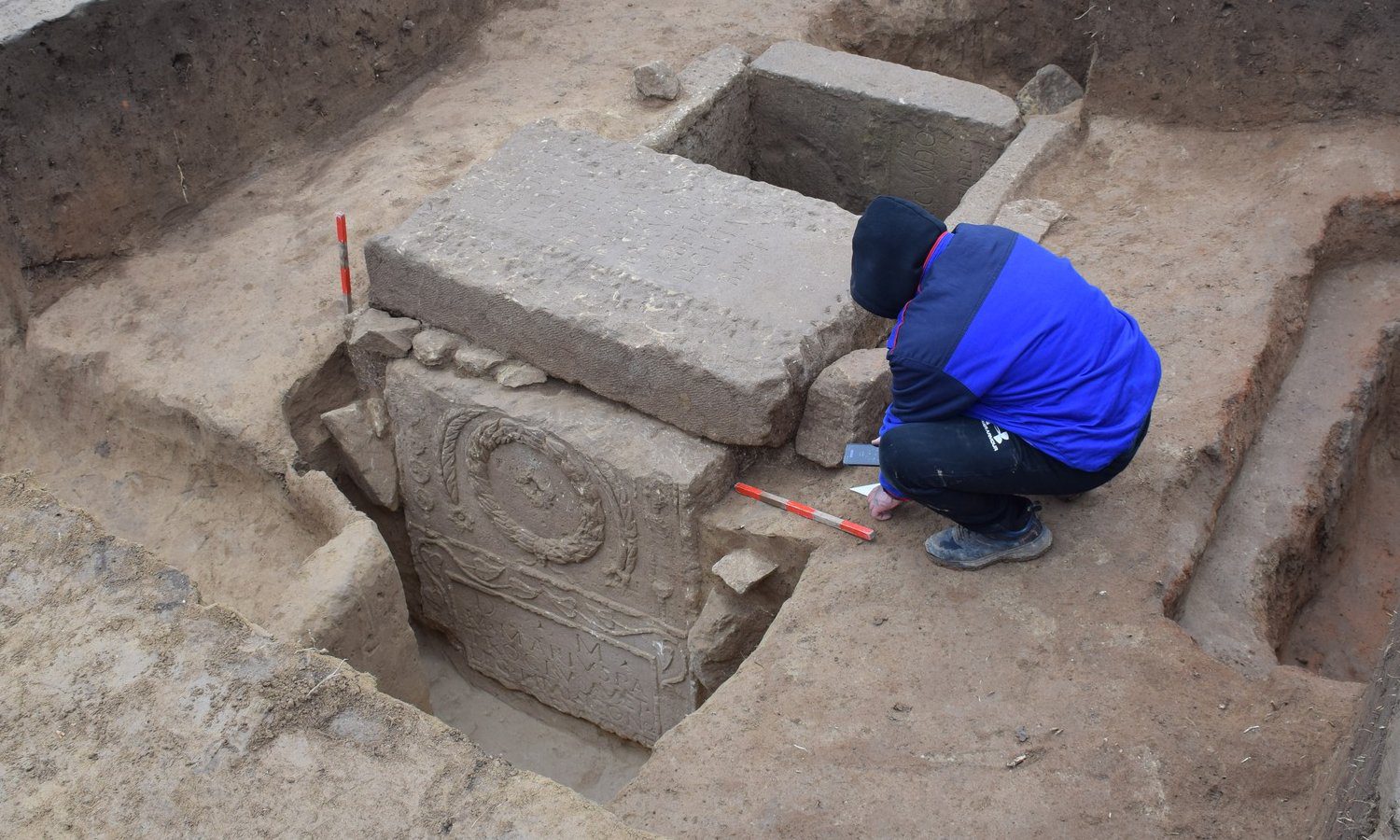
Rescue excavations in the western necropolis of Nove, near modern Svishtov in Bulgaria, have identified a fragment of a tomb plate belonging to a centurion of the First Italic Legion. The inscription names Gaius Valerius Verecundus — and describes him, in verse, as a man “heavily pressed by fate.”
The stone, however, was not found standing upright over a grave.
It had been reused.
A Centurion Built into a Grave Wall
Archaeologists discovered that the partially preserved tombstone had been incorporated into the structure of a later burial. Rather than marking the resting place of the centurion himself, the slab had been repurposed as building material inside a limestone cyst grave — a rectangular burial chamber constructed from large stone slabs.
This reuse tells its own story. By the time the later grave was built, older monuments in the necropolis had already been dismantled. Funerary stones were no longer sacred markers; they had become convenient construction elements.
The centurion served in Legio I Italica, a unit founded by Emperor Nero in 66 CE and long stationed at Nove. For centuries, the fortress functioned as a strategic stronghold on Rome’s Lower Danube frontier, housing soldiers drawn from across the empire.
A Military Community from Across the Empire
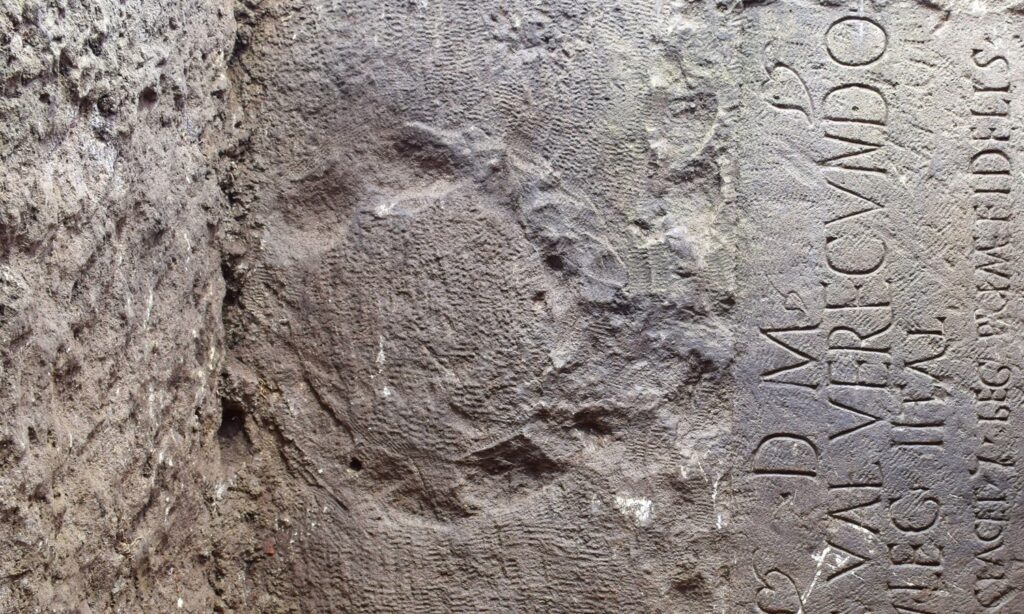
The reused tombstone of Gaius Valerius Verecundus was not alone.
Within the same grave structure, archaeologists identified other inscribed monuments. One belonged to Marcus Marius Patro, a veteran of the First Italic Legion originally from Iconium in Asia Minor — modern Konya in Türkiye. His monument includes carved signa, or military standards, underscoring his identity as a career soldier.
Another stela commemorated Aelia Basilia, described as soror pientissima — “a most devoted sister.” Her memorial had been erected by her brother, Publius Aelius Bassus, himself a veteran and beneficiarius of the legion, a rank associated with special administrative duties.
A second cyst grave yielded further evidence of spolia. Its eastern wall consisted largely of the well-preserved tombstone of Gaius Alpinius Secundus, a soldier of Legio XI Claudia from Colonia Claudia Ara Agrippinensium — today’s Cologne in Germany. Another reused slab recorded the career of a veteran who had served 25 years and died at age 60.
Together, the inscriptions reveal what Nove once was: not simply a fortress, but a frontier community where men from Asia Minor, the Rhineland, and the Balkans lived, served, retired, and were buried.
Graves Disturbed, Stories Intact
Five burial structures were documented during the emergency excavation. They included two limestone cyst graves, a brick-and-stone walled grave, a simple pit burial, and a stepped pit showing traces of burning. All had been looted, either in antiquity or in modern times.
Only a handful of objects survived: a bone needle, a spindle fragment, and two bronze fibulae. Mixed skeletal remains will undergo anthropological analysis, while epigraphists continue to study the Latin inscriptions in detail.
Three of the tombstones feature carved wreaths, ivy leaves, and branches — traditional Roman funerary motifs. Even in reuse, the decorative elements remain visible, faint reminders of the original monuments’ purpose.
A Frontier of Memory
The discovery began after a local resident noticed that an uprooted tree on his property had exposed what appeared to be ancient burials. Authorities were alerted, prompting a rapid response by archaeologists from the Municipal Institute in Svishtov and the Regional Museum of History in Veliko Tarnovo.
Yet the most compelling aspect of the find is not the dramatic exposure of graves, but the layered history embedded in the stones themselves. At Nove, monuments were erected, dismantled, reused, and rediscovered — each phase leaving traces.
Nearly two millennia after they stood watch along the Danube, the soldiers of Rome’s frontier continue to speak through fragments of stone.
Cover Image Credit : Archaeologia Bulgarica