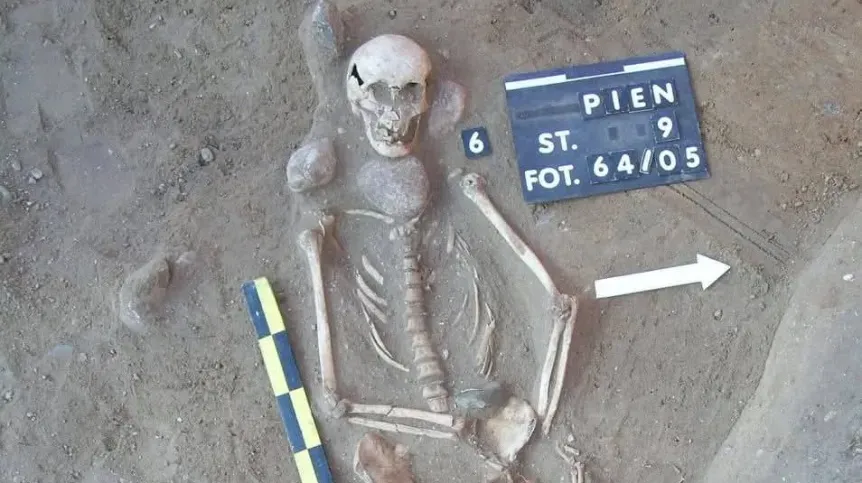
In the village of Pień in northern Poland, archaeologists have uncovered more than 100 graves from a 17th-century cemetery—many of them associated with what are often described as vampire burials. Yet as research deepens, a different picture is emerging: this site may have served as a burial ground for individuals pushed to the margins of society.
The cemetery has been under investigation for more than two decades by a team led by Prof. Dariusz Poliński of Nicolaus Copernicus University. While its origins appear to be Protestant, its defining feature is something else entirely—the unusually high number of atypical burials, where the dead were treated with visible caution.
At least a dozen graves have already been identified as atypical. Several more remain under study.
Where fear shaped burial practices
The objects placed in these graves were not symbolic. They were functional.
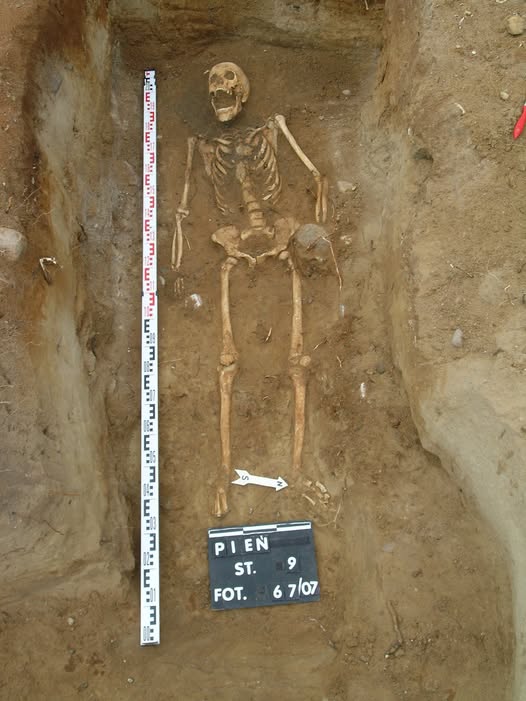
Sickles positioned across the neck may have been intended to injure the body if it attempted to rise. Stones were arranged to weigh down the deceased. Padlocks, sometimes attached to limbs, appear to have symbolized containment—ensuring the dead remained where they were buried. In some cases, individuals were laid face down, a practice rooted in the belief that, if they returned, they would burrow into the earth rather than emerge.
“The dead who caused fear were buried with sickles at the neck, weighed down with stones, or secured with padlocks,” Prof. Dariusz Poliński explained. “There were also burials placed face down, linked to the belief that the deceased might rise and harm the living.”
Such practices are widely associated with anti-vampire beliefs in early modern Central and Eastern Europe. At Pień, however, they appear not as isolated acts, but as a repeated and structured response.
Credit: Pień Project / TSE Evolution
Zosia and the human face of suspicion
Among the most widely discussed burials is that of a young woman known as Zosia.
She was found with a sickle placed across her neck and a padlock attached to her left foot. In 2024, her reconstructed face drew international attention. Scientific analysis suggested she suffered from a vascular condition affecting the sternum, likely causing visible swelling and chronic pain.
In a 17th-century rural community, such physical differences could easily provoke suspicion.
What modern medicine identifies as illness may once have been interpreted as something far more unsettling.
Illness, stigma, and exclusion
Other graves reinforce this interpretation.
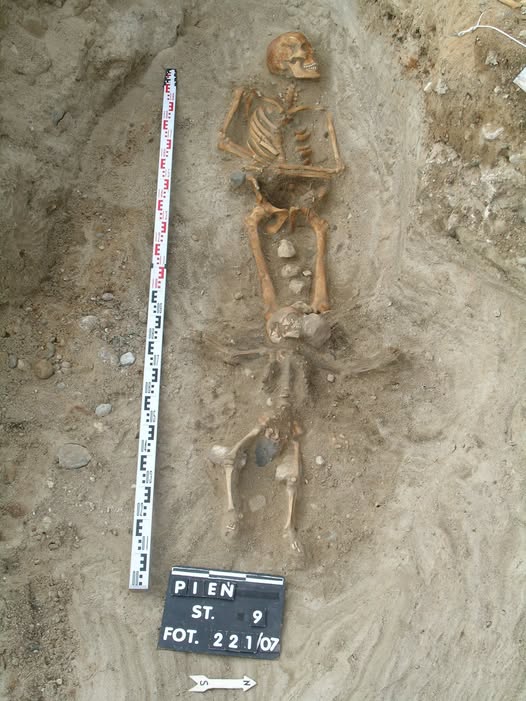
One burial near the edge of the cemetery belonged to a woman aged between 30 and 50. A stone rested on her hand, while smaller stones lined her body. Anthropological analysis indicated she suffered from advanced syphilis—a disease that, at the time, carried both physical consequences and strong social stigma.
Another grave, more recently uncovered, likely belonged to a young boy. Stones had been carefully placed across his chest and collarbones.
Elsewhere, archaeologists identified the remains of a pregnant woman buried with a fetus estimated at around 24–25 weeks. The preservation of such delicate remains is extremely rare, making the discovery particularly significant.
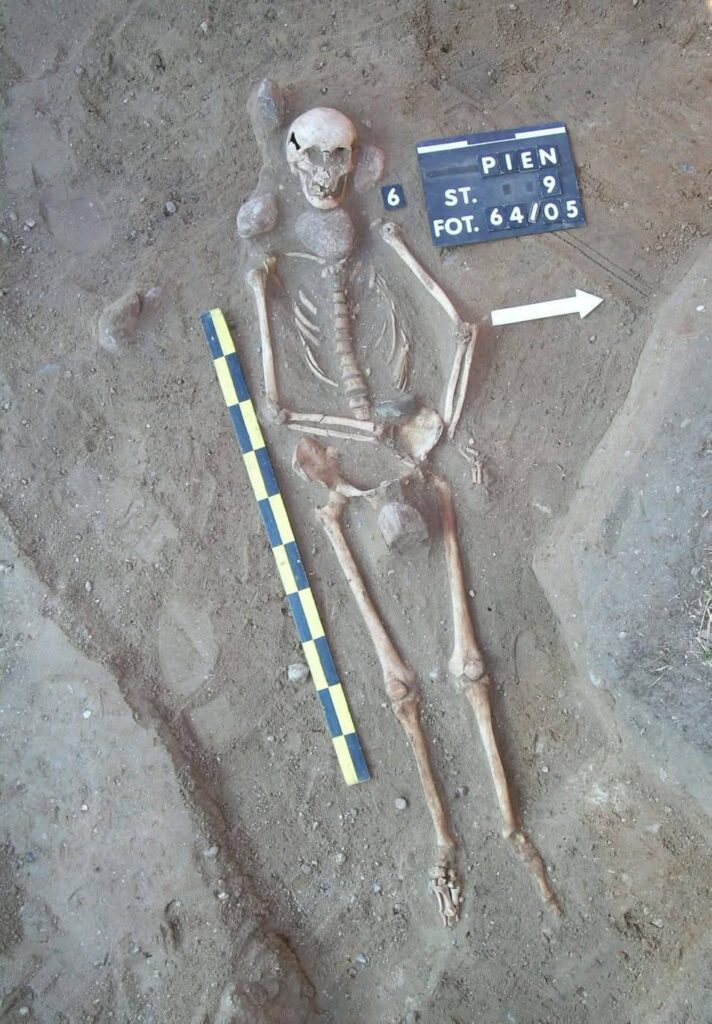
In another case, an older woman—around 60 years old—was buried with stones pressed tightly around her skull. Researchers later identified traces of an aneurysm, a condition that could have caused severe pain, neurological symptoms, or behavioral changes. In a pre-scientific world, such symptoms were often misunderstood—and feared.
A cemetery unlike others
Atypical burials are known from other sites in Poland, including Drawsko and Gliwice. In those cases, however, such graves appear only occasionally.
At Pień, they are far more frequent.
This concentration has led researchers to a broader interpretation: that the cemetery may have been used, at least in part, for individuals who were socially excluded—people whose illnesses, behavior, or appearance set them apart.
“The cemetery in Pień may be the largest necropolis of socially rejected individuals in Poland,” said Prof. Dariusz Poliński.
If confirmed, the site would represent one of the most significant archaeological examples of this phenomenon in the country.
The 17th century: a landscape of uncertainty
Credit: Pień Project / TSE Evolution
The historical context helps explain these practices.
The 17th century was marked by instability across Europe. The Little Ice Age brought colder conditions and poor harvests. Wars—including the Thirty Years’ War and conflicts affecting the Polish-Lithuanian Commonwealth—disrupted daily life. Epidemics spread through populations that had little understanding of disease.
In such an environment, communities searched for explanations—and sometimes for those to blame.
Individuals who appeared different, behaved unusually, or suffered from visible illness could easily become targets of suspicion. Burial practices, in turn, reflected attempts to control what could not be explained.
More than folklore
The discoveries at Pień are often framed through the lens of vampire folklore. But the archaeological evidence suggests something more complex.
These graves are not only about belief in the supernatural. They are about how communities responded to fear, disease, and social tension.
Each burial reflects a decision—how to treat the dead, how to protect the living, and how to define who belonged and who did not.
At Pień, those decisions were written into the ground.
Cover Image: Grave of a woman aged around 60, with a distinct aneurysm trace identified on the inner surface of the right parietal bone.
Credit: Pień Project / TSE Evolution