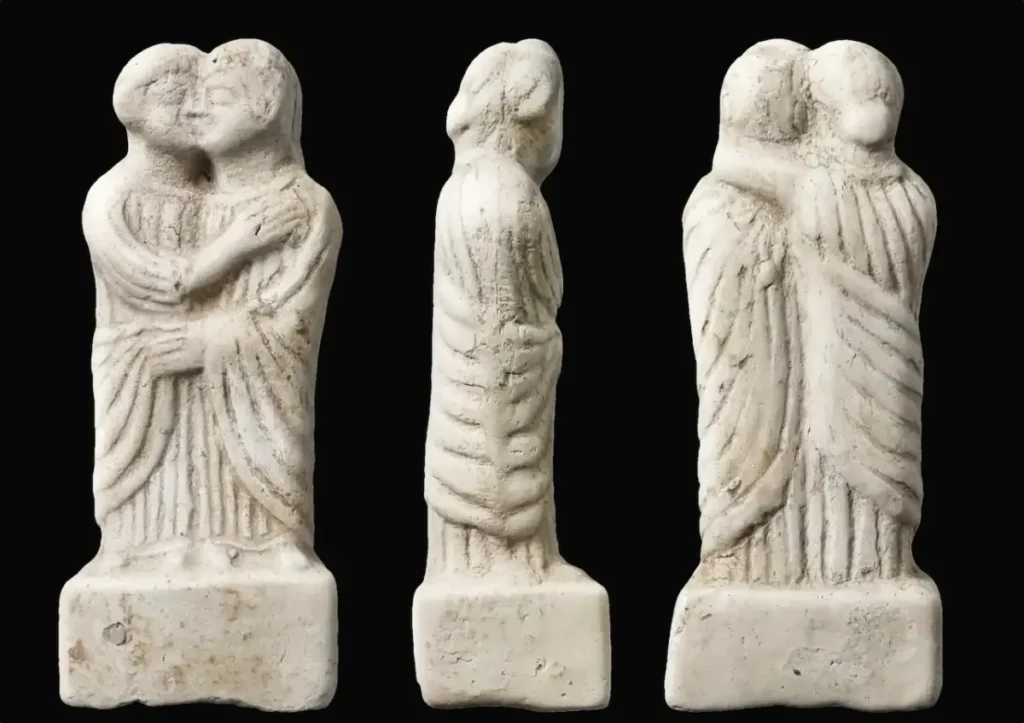
A small grave, easily overlooked among hundreds of archaeological features in northern France, has yielded one of the most quietly powerful discoveries of recent years: a terracotta figurine depicting a couple locked in an embrace, placed beside the cremated remains of a very young child.
The burial, dated to the 1st century AD, was uncovered during large-scale excavations at Ruyaulcourt, where archaeologists have been documenting an extensive rural settlement spanning the late Iron Age and the Roman period.
The figurine—showing two figures kissing or holding one another—appears to have been deliberately chosen as part of the child’s funerary offerings. Researchers suggest it may symbolize parental presence or protection, accompanying the child into the afterlife.
A Burial That Stands Apart
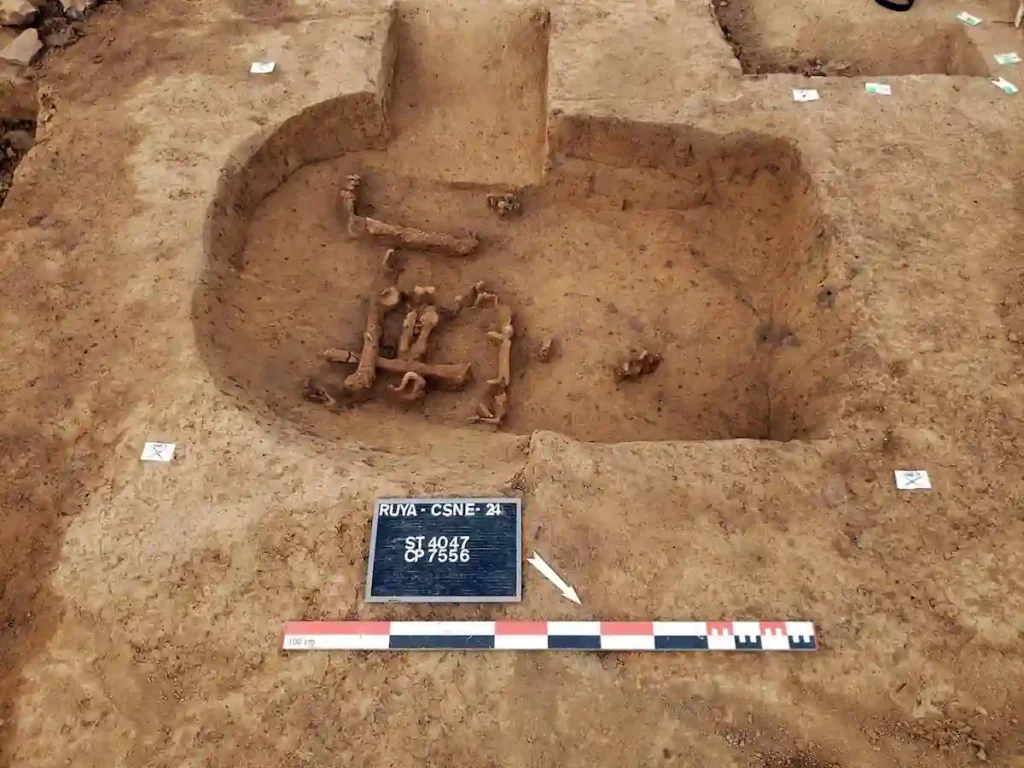
The grave belonged to a child estimated to be under two years old. Like others in the same area, the burial followed a cremation ritual: the remains were carefully collected and placed within a rectangular wooden container, now visible only through surviving nails and faint organic traces.
Yet what sets this burial apart is not only the figurine, but the broader composition of the grave goods. The ceramic vessels accompanying the remains were miniaturized versions, a detail that appears intentional rather than practical.
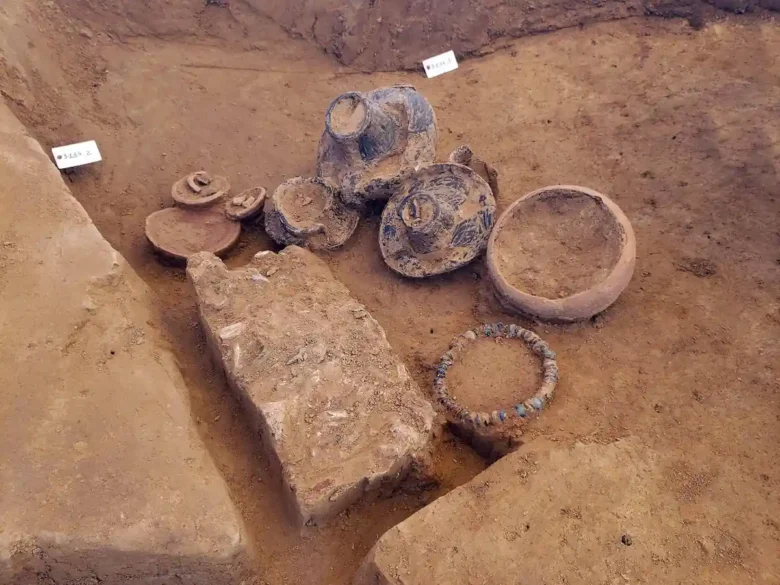
Credit: F. Simon – Inrap
Such scaled-down offerings are often interpreted as symbolic—objects adapted to reflect the age or status of the deceased. In this case, the combination of miniature pottery and the intimate figurine suggests a highly personalized funerary gesture, rather than a standardized ritual.
Organized Cemeteries Along Ancient Routes
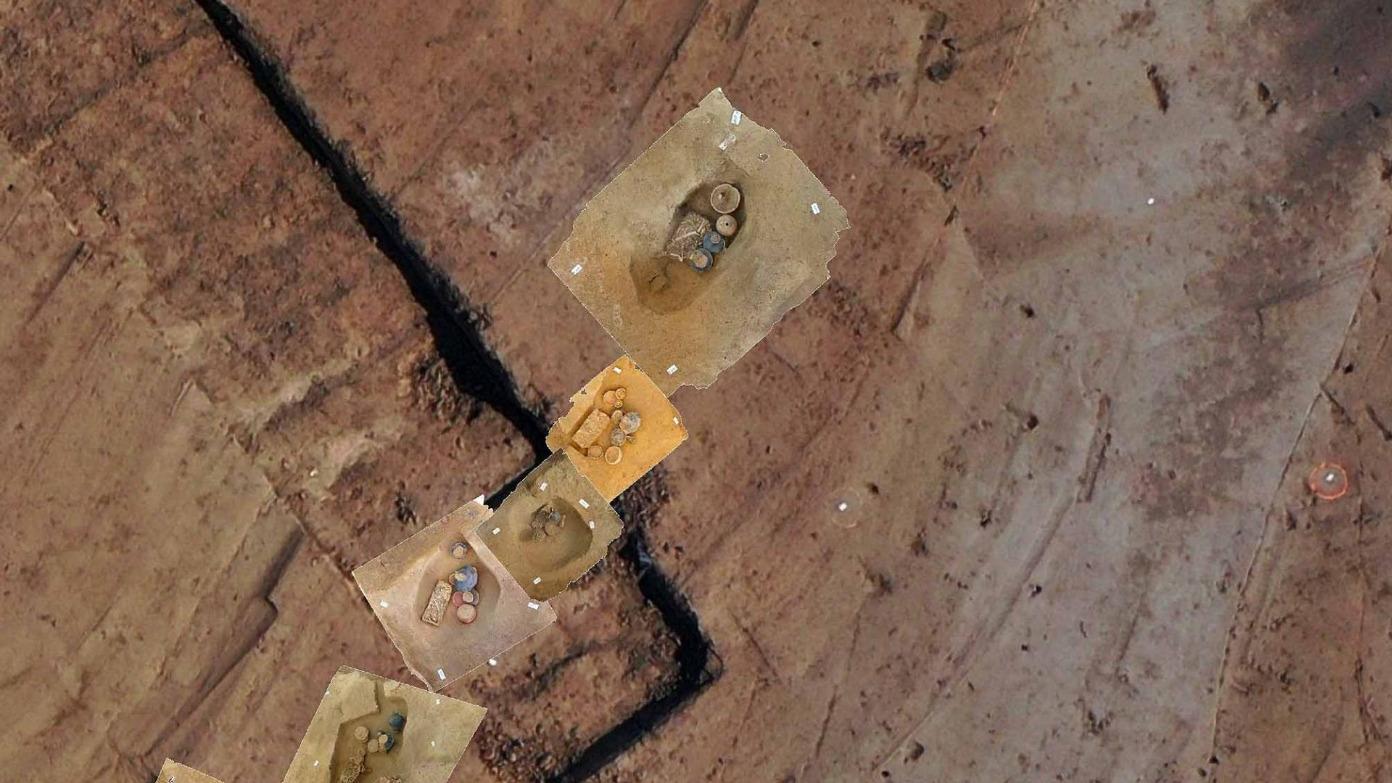
The child’s grave forms part of a structured burial group in the northeastern sector of the excavation. Here, eight graves were arranged in alignment along what was once a local ճանապարհ, indicating a deliberate relationship between movement through the landscape and remembrance of the dead.
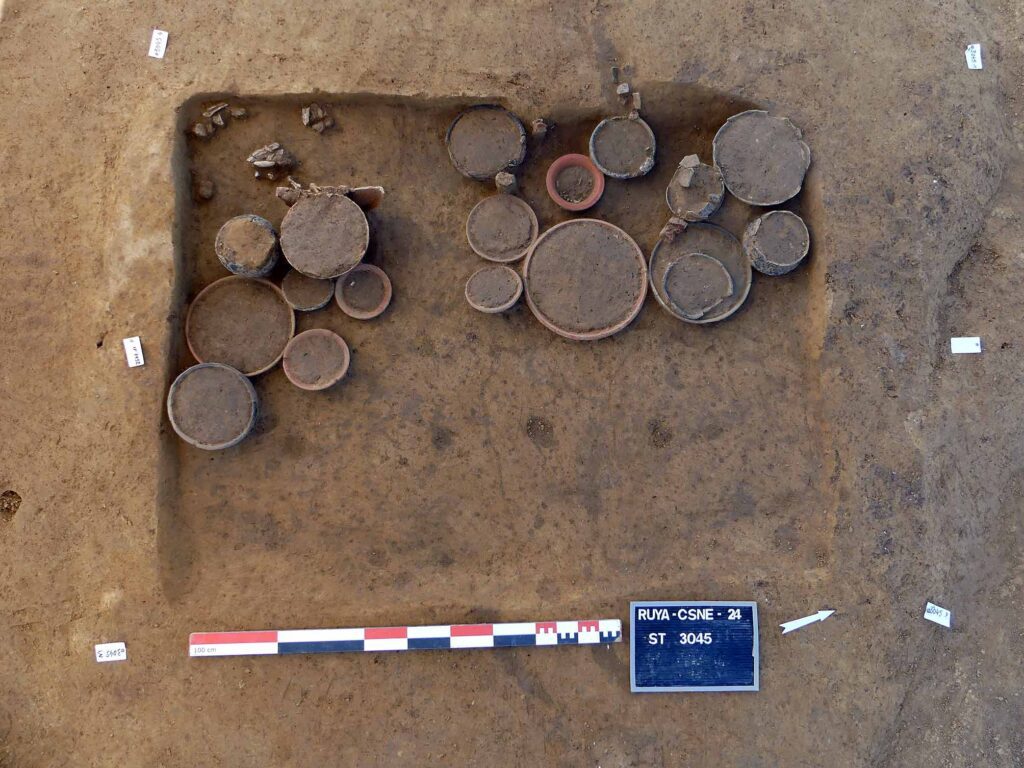
A second burial cluster, located nearby, follows a different logic. Instead of linear organization, graves appear in small, dispersed groups, likely corresponding to family units. The contrast between these two layouts hints at coexisting funerary traditions within the same community.
Some burials in this area are notably richer than others. One contained as many as nineteen ceramic vessels, while others held only a few objects. This uneven distribution raises questions about social differentiation, status, or ritual choices.
Life and Death in a Rural Settlement
Beyond its funerary significance, the site itself offers a detailed picture of everyday life over several centuries. Archaeologists identified enclosures, storage silos, pits, and agricultural installations, many dating back to the La Tène period (c. 400–30 BC).
Deep silos—some reaching two meters in diameter—were initially used to store crops. Later, they were repurposed as refuse pits, preserving fragments of ceramics, animal bones, and tools tied to daily activities such as textile production and leatherworking.
Among the finds are spindle whorls, loom weights, and small metal implements, pointing to a community engaged in both farming and craft.
Traces of habitation are more elusive, but evidence of granaries, wells, and a cellar structure suggests the presence of modest dwellings. Inside one such feature, archaeologists recovered coins and a decorative fitting depicting a Gorgon (Medusa)—a motif often associated with protection.
Changing Landscapes Under Roman Influence
By the early Roman period, the settlement underwent noticeable reorganization. Enclosures became more regular, and occupation intensified in certain areas. At the same time, burial practices diversified, as seen in the coexistence of different cemetery layouts and ritual forms.
Later phases of the site, particularly in the 2nd and 3rd centuries AD, reveal the emergence of metallurgical activity. Large quantities of ironworking slag suggest sustained production, possibly supported by the use of mineral coal—an uncommon fuel in this era.
Even in its final stages, during the 4th century AD, the site maintained connections beyond its immediate region. Some artefacts, including a wool comb and metal objects, may have originated from northern Europe or beyond, pointing to long-distance exchange networks.
A Quiet but Human Story
Amid this long sequence of occupation—fields, workshops, enclosures, and industry—it is the small grave of a child that draws the most immediate attention.
The terracotta figurine does not speak in grand historical terms. It does not reshape chronologies or redefine settlement patterns. Instead, it captures something more intimate: a moment of care, memory, and symbolic expression preserved across two millennia.
Why this particular object was chosen, and what exactly it meant to those who placed it in the grave, may never be fully known. But its presence suggests that even within structured ritual systems, there was room for deeply personal gestures—ones that continue to resonate today.
Cover Image: Overview of the funerary area along the path (locus 1).
Credit: F. Audouit – Inrap