
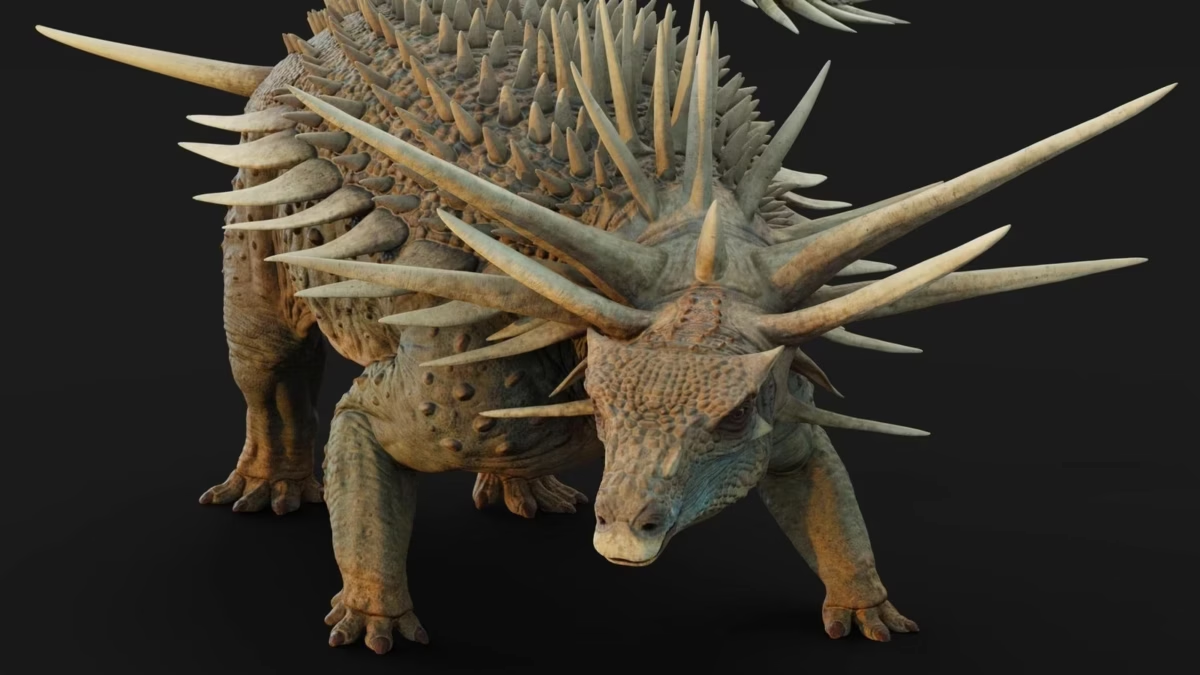
Paleontologists have unearthed one of the strangest dinosaurs ever discovered: a spiky, armored creature nicknamed the “punk dinosaur.” The newly identified species, called Spicomellus, lived around 165 million years ago and challenges long-held assumptions about the evolution of ankylosaurs, the heavily armored dinosaurs famous for their club-like tails.
According to Professor Richard Butler of the University of Birmingham, who co-led the study, the dinosaur’s appearance was unlike anything seen before. “It is one of the strangest dinosaurs ever discovered,” Butler told the BBC. “It was the punk rocker of its time,” he added, referencing the creature’s spiky, hair-like structures that encircled its neck.
The discovery was made near Boulemane, Morocco, where a local farmer unearthed the first known bones of an ankylosaur on the African continent. Previous research from 2021 could only rely on a single rib fragment, but the new fossils provide a clearer picture of this unique species.
Spiky Armor and Club-Like Tail
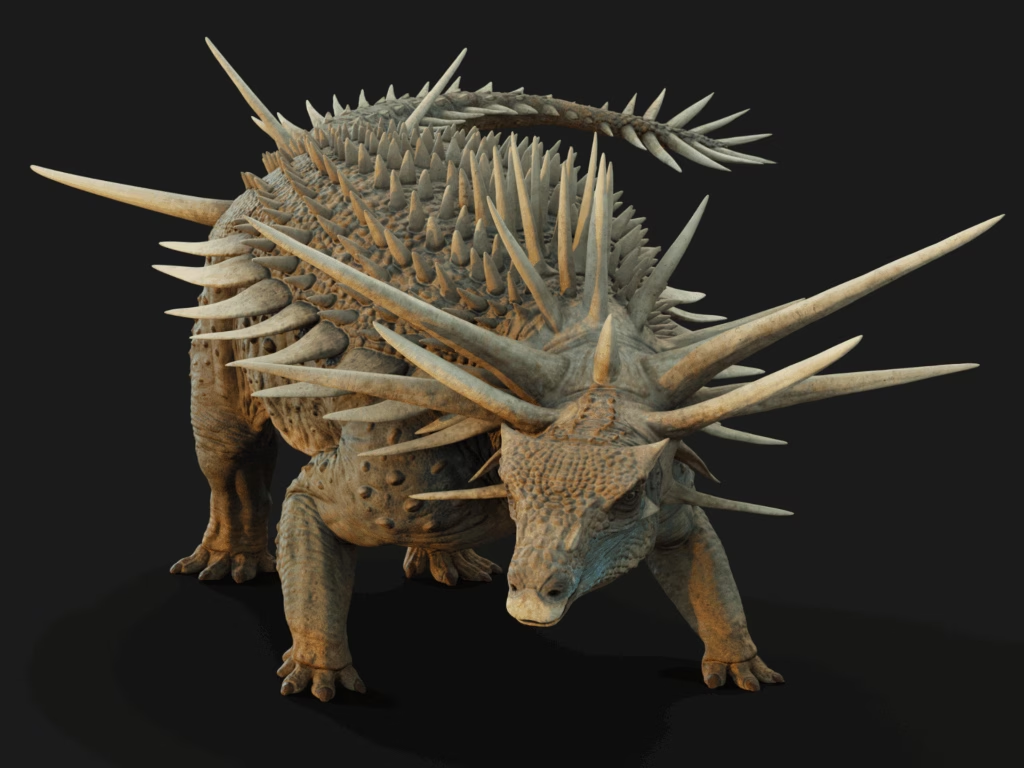
Spicomellus possessed an impressive array of defensive adaptations, including up to a meter-long spikes arranged in two rings around its neck. Additional spikes fused to its chest bones covered much of its body, creating a formidable armor. Unlike its later relatives, which evolved simpler, more efficient protective plating, Spicomellus’s elaborate armor may have served multiple purposes beyond defense.
Professor Susannah Maidment from the Natural History Museum in London, co-author of the study published in Nature, explained that the spikes might have been used to attract mates and intimidate rivals. “Spicomellus had a variety of plates and spikes covering its body, including massive upward-pointing spikes over the hips and a series of blade-like spines along the shoulders,” Maidment said. “This is something we have never seen before in any animal.”
The dinosaur also carried a tail club, a feature it passed down to later ankylosaurs. While the neck spikes may have been more for display, the tail club likely provided effective defense against predators, remaining useful even almost 100 million years later.
Rethinking Ankylosaur Evolution
Ankylosaurs like the famous Ankylosaurus of the Late Cretaceous, living 66 to 68 million years ago, are known for their heavy armor designed to protect against giant predators such as Tyrannosaurus rex. However, the discovery of Spicomellus, predating these apex predators by tens of millions of years, suggests that early ankylosaurs developed complex armor for reasons beyond mere survival.
This remarkable find not only sheds light on the evolution of ankylosaurs but also emphasizes the paleontological significance of African dinosaur fossils. Butler and Maidment stress that discoveries like Spicomellus highlight how much remains to be learned about prehistoric life on the continent.
Physical Characteristics and Legacy
Researchers estimate that Spicomellus reached around four meters in length and weighed roughly two tons. Its unique armor, combined with a powerful tail club, made it a truly distinctive member of the ankylosaur family. While later species streamlined their armor for defense efficiency, Spicomellus’s extreme spikiness may have served as an early experiment in combining protection with social signaling.
The discovery underscores the incredible diversity of dinosaur evolution and provides a glimpse into the early experimentation with body armor long before the age of the T. rex. For paleontologists, it’s a reminder that even well-known dinosaur families can still surprise us with bizarre and unexpected evolutionary adaptations.
As the study authors conclude, Spicomellus not only redefines what we know about ankylosaurs but also reaffirms the importance of continued exploration and research in Africa’s fossil-rich regions.
Maidment, S.C.R., Ouarhache, D., Ech-charay, K. et al. Extreme armour in the world’s oldest ankylosaur. Nature (2025). https://doi.org/10.1038/s41586-025-09453-6
Cover Image Credit: The Spicomellus was almost entirely covered with spikes. Matt Dempsey / NHM