
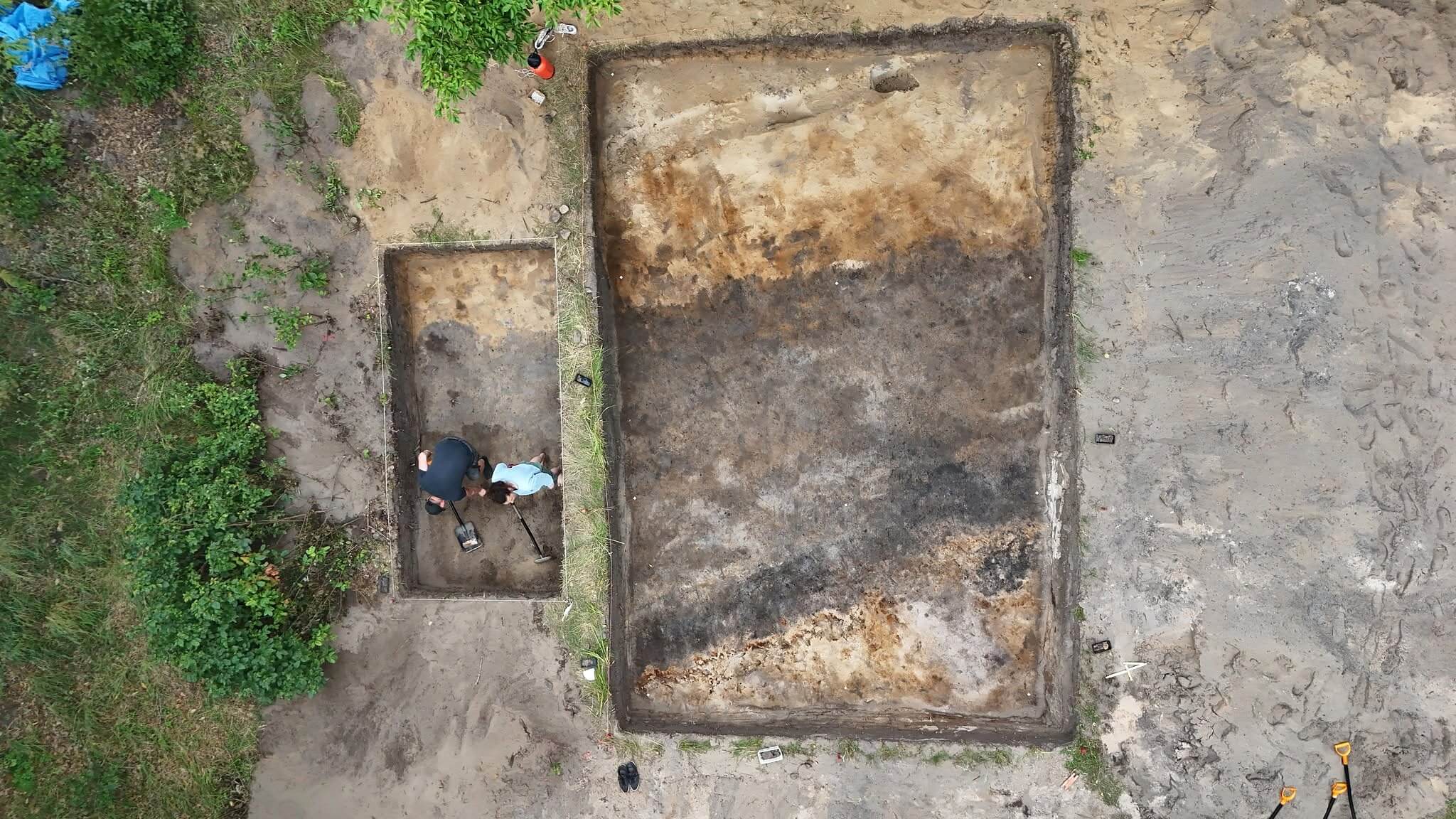
Archaeologists have discovered a rare 2,500-year-old longhouse at Łysa Góra in Poland, revealing how an Iron Age community organized its domestic space. The building represents an exceptional example of this architectural tradition in Mazovia and northeastern Poland.
The discovery emerged during the 2026 excavation season near Chorzele in northern Mazovia. Researchers from the State Archaeological Museum in Warsaw have investigated Łysa Góra for three seasons, uncovering a settlement associated with the Western Baltic Barrow Culture alongside increasing signs of contact with Celtic groups.
A mysterious earthwork becomes a house
Archaeologists first identified the buried feature during the 2025 season. Its shape initially suggested that it might have formed part of a defensive reinforcement or perhaps a ditch associated with ritual activity.
Further excavation revealed a very different structure. The earthworks belonged to a long wooden building measuring approximately 17.5 metres in length and four metres in width.
Internal divisions separated the building into residential sections, each measuring roughly four by five metres. These compartments may have provided distinct living or working areas within the same structure.
Dr. Bartłomiej Kaczyński of the State Archaeological Museum described the discovery as an important step toward reconstructing the character of the settlement. The house stood in the southern part of Łysa Góra, which appears to have been one of its wealthier areas.
An exceptional form of architecture in Mazovia
Researchers identify the structure as a Biskupin-type longhouse. Archaeologists commonly encounter comparable buildings in southwestern Poland, but this form of architecture remains exceptionally rare in Mazovia and northeastern Poland.
A local community belonging to the Western Baltic Barrow Culture probably constructed the house during the fifth century BC. Its dimensions and internal layout provide researchers with evidence about how the settlement’s inhabitants organized domestic life and shared space.
The discovery also raises questions about the movement of architectural ideas across Iron Age Poland. Further investigation may reveal whether the building followed a wider regional tradition or represented an unusual experiment by the Łysa Góra community.
A Thracian coin travelled nearly 1,500 kilometres
Another discovery from Łysa Góra shows that the settlement’s connections extended far beyond its immediate region. Archaeologists recovered a bronze coin minted in ancient Thrace, almost 1,500 kilometres southeast of the site.
The coin was produced at Seuthopolis, near present-day Kazanlak in Bulgaria, during the reign of the Odrysian king Seuthes III. It dates to between 323 and 316 BC, making it more than 2,300 years old.
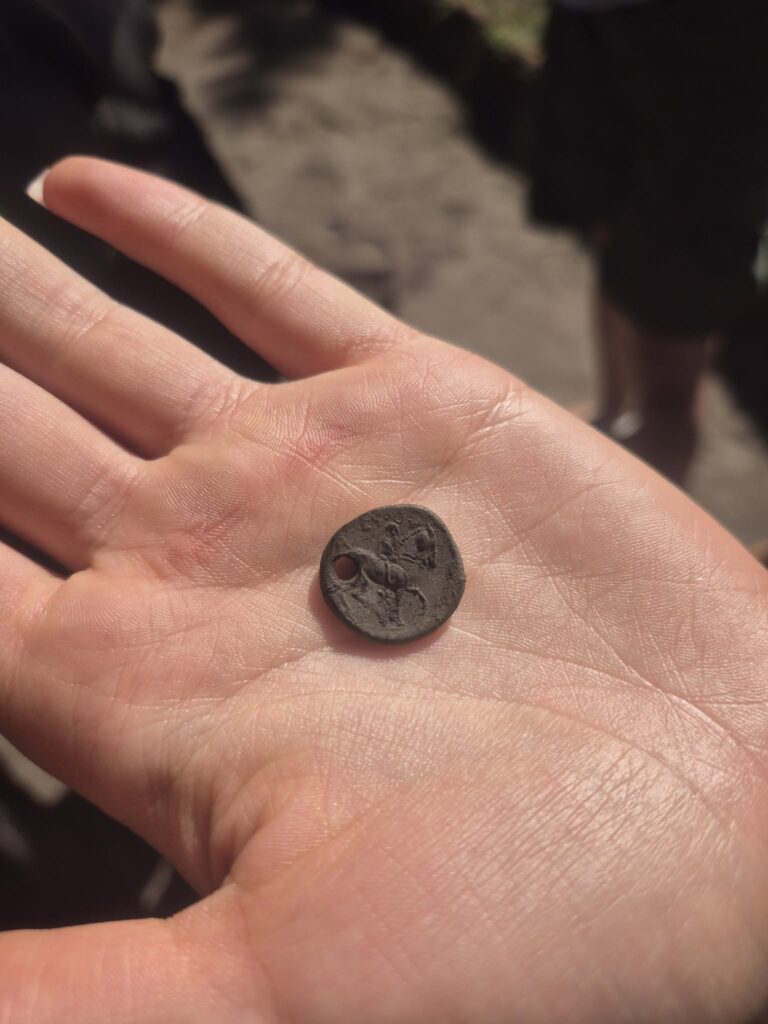
One side depicts a horseman accompanied by a mint mark, while the other carries a laureate image of Zeus. Someone later pierced the coin, and wear around the opening indicates that it hung from a cord or leather strap.
The object therefore appears to have served as a pendant rather than ordinary currency. Researchers describe it as the oldest ancient coin recovered during a documented archaeological excavation in Poland. It is also the country’s first securely recorded ancient coin from an Early Iron Age context.
A similarly remarkable discovery emerged in Britain, where archaeologists documented the country’s largest known Iron Age gold coin hoard at Great Baddow.
Did Celtic networks carry the coin north?
Archaeologists believe Celtic networks may explain how the coin reached Mazovia. Seuthopolis suffered a Celtic attack during the first half of the third century BC, raising the possibility that someone connected with those campaigns carried the object north as a keepsake or personal ornament.
For now, this remains a hypothesis. Previous discoveries at Łysa Góra, however, point to contact between the local population and Celtic groups. These finds include a rare fourth-century BC Celtic helmet and an instrument interpreted as a tool used for trepanation, a surgical procedure involving the skull.
Two additional objects discovered during the latest excavation may also prove to be Greek obols. Specialists must complete further analyses before confirming their identification.
The longhouse and the Thracian coin belong to different stages in the settlement’s history. Together, however, they reveal two sides of life at Łysa Góra: the house preserves the physical setting of an Iron Age community, while the coin records a remarkable connection between Mazovia and the distant world of ancient Thrace.
Aerial view of the excavation at Łysa Góra, where archaeologists uncovered the remains of a rare 2,500-year-old longhouse. Credit: Bartłomiej Kaczyński / State Archaeological Museum in Warsaw