
Troodon fossils from Montana have given researchers their most complete view yet of how the enigmatic dinosaur’s pelvis and hindlimbs developed from embryo to adult. The bones also reveal a curious pattern: possible foot pathologies appear unusually common among the animals examined.
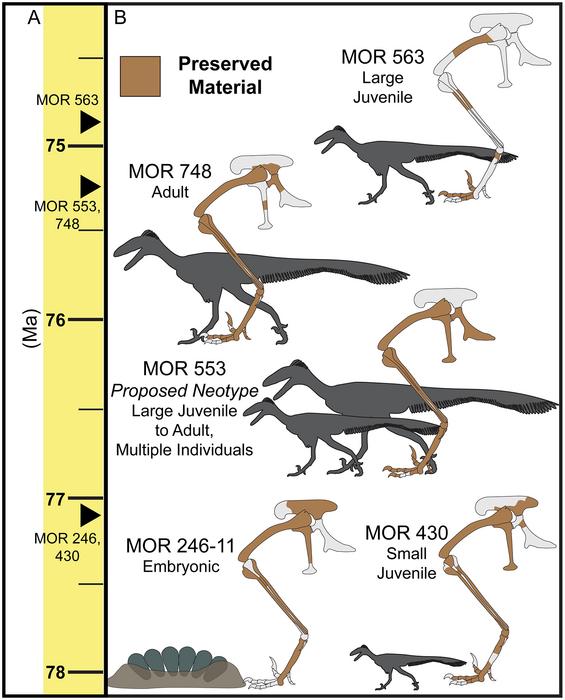
The study, published in PLOS ONE, focuses on specimens from the upper Two Medicine Formation of western Montana. Dating to approximately 77–75 million years ago, the fossils collectively preserve almost the entire pelvic and hindlimb skeleton of Troodon formosus.
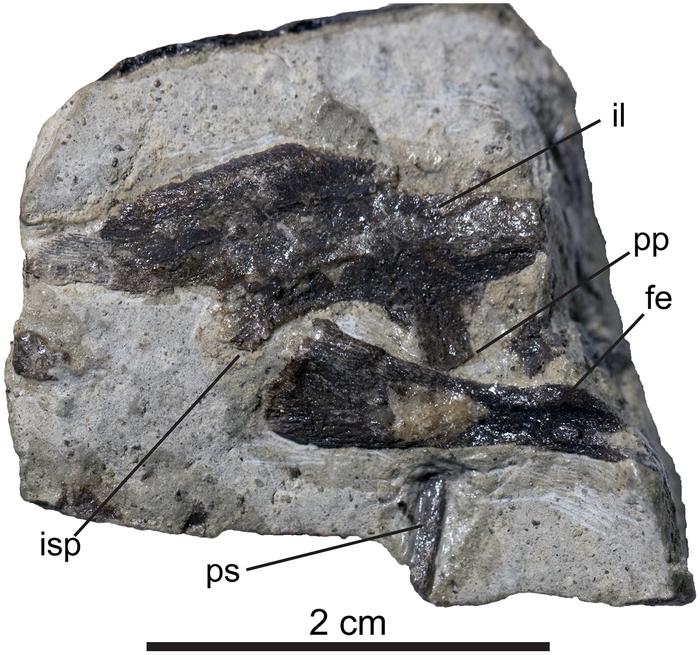
David J. Varricchio of Montana State University and Heath R. Caldwell of North Carolina State University examined five principal specimens alongside additional fragmentary remains. The collection includes an embryo, a small juvenile less than a year old, a large juvenile around one year old and older individuals representing several stages of adulthood.
From a single tooth to an almost complete skeleton
Troodon has one of the most complicated identities in dinosaur paleontology. Joseph Leidy named Troodon formosus in 1856 from a single tooth reportedly discovered near Montana’s Judith River. That fossil remains difficult to diagnose at species level because teeth can vary considerably even within a single troodontid.
The uncertainty has led some researchers to abandon the name Troodon and classify related North American fossils as Stenonychosaurus. Varricchio and Caldwell instead follow a recent proposal to preserve the familiar name by designating a much richer fossil collection as its new reference specimen, known as a neotype.
That proposed neotype is MOR 553, a bonebed assemblage from Jack’s Birthday Site in the Two Medicine Formation. It contains disarticulated remains from several Troodon individuals, ranging from large juveniles to adults.
Unlike the original tooth, MOR 553 includes bones from across much of the skeleton and could provide a stable anatomical definition for the species. The proposal remains under review by the International Commission on Zoological Nomenclature, however, meaning the new study does not formally settle the debate over the Troodon name.
Troodon’s basic anatomy appeared early
The Montana fossils form a rare growth series extending from an embryo to skeletally mature animals. Most major features of the pelvis and hindlimbs were already recognizable during the earliest stages of life and remained relatively consistent as Troodon grew.
The proportions of the limbs changed more clearly than their fundamental anatomy. Juveniles had relatively elongated lower legs and feet, while these elements became proportionally shorter and more robust in larger animals. The femur-to-tibia ratio, for example, increased from approximately 0.72 in the small juvenile to about 0.89 in an adult.
Bone surfaces also became less porous with maturity, and some elements eventually fused. Yet this fusion appears to have occurred relatively late. Even several large specimens retained unfused bones, highlighting the risk of using skeletal fusion alone to determine a dinosaur’s age.
The limited anatomical change may also help paleontologists distinguish young dinosaurs from genuinely separate species. Some small Asian troodontids have previously been interpreted as juveniles of larger forms. The stability observed in Troodon supports the argument that dinosaurs such as Philovenator curriei possessed genuine anatomical differences rather than simply representing immature individuals of another genus.
Eight foot bones show possible pathologies
The most striking evidence came from the feet. Researchers identified possible pathologies in eight bones, including three metatarsals and five toe bones. Within the relevant categories of juvenile and adult material, affected specimens represented roughly 20 to 30 percent of the available sample.
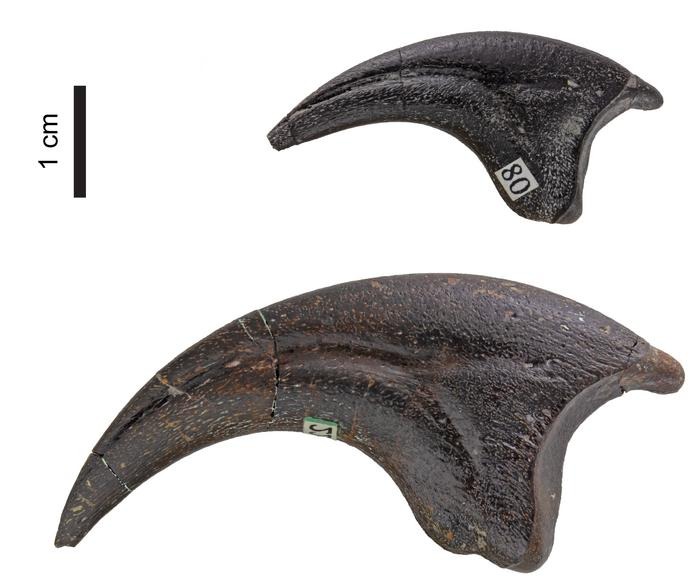
One toe bone showed particularly severe deformation. Its unusually rough surface and the offset between the shaft and the joint indicate that it may have broken and subsequently healed during the animal’s lifetime.
Foot abnormalities have also appeared in previous studies of troodontids. By comparison, paleontologists have reported them much less frequently among similarly sized theropods. Published descriptions of comparable damage are also rare among dromaeosaurids, even though these dinosaurs possessed an enlarged, retractable claw on the second toe.
The researchers do not identify a definite cause for the pattern. Differences in movement, ecology or foot function could have contributed, but broader comparisons will be necessary before the damaged bones can reveal anything specific about Troodon’s behavior.
A distinctive kind of runner
Troodon’s feet and legs combined several characteristics associated with cursorial, or running-adapted, animals. These included an arctometatarsalian foot, in which the middle metatarsal narrows between the surrounding bones, and a reduced fibula that did not reach the ankle.
Its adult limb proportions nevertheless differed from those of smaller troodontids. Troodon had a relatively shorter tibia and metatarsus, possibly because its greater body size changed the mechanical demands placed on its legs.
This combination suggests that Troodon moved differently from both smaller members of its family and dromaeosaurids such as Deinonychus. The anatomy does not establish how fast it could run, but it provides a stronger foundation for future biomechanical studies.
The Montana fossils transform Troodon from an animal long defined by isolated teeth into one that researchers can now follow across much of its life. They show a dinosaur whose basic skeletal design appeared early, whose proportions shifted as it matured and whose feet sometimes preserved the physical consequences of an active life.
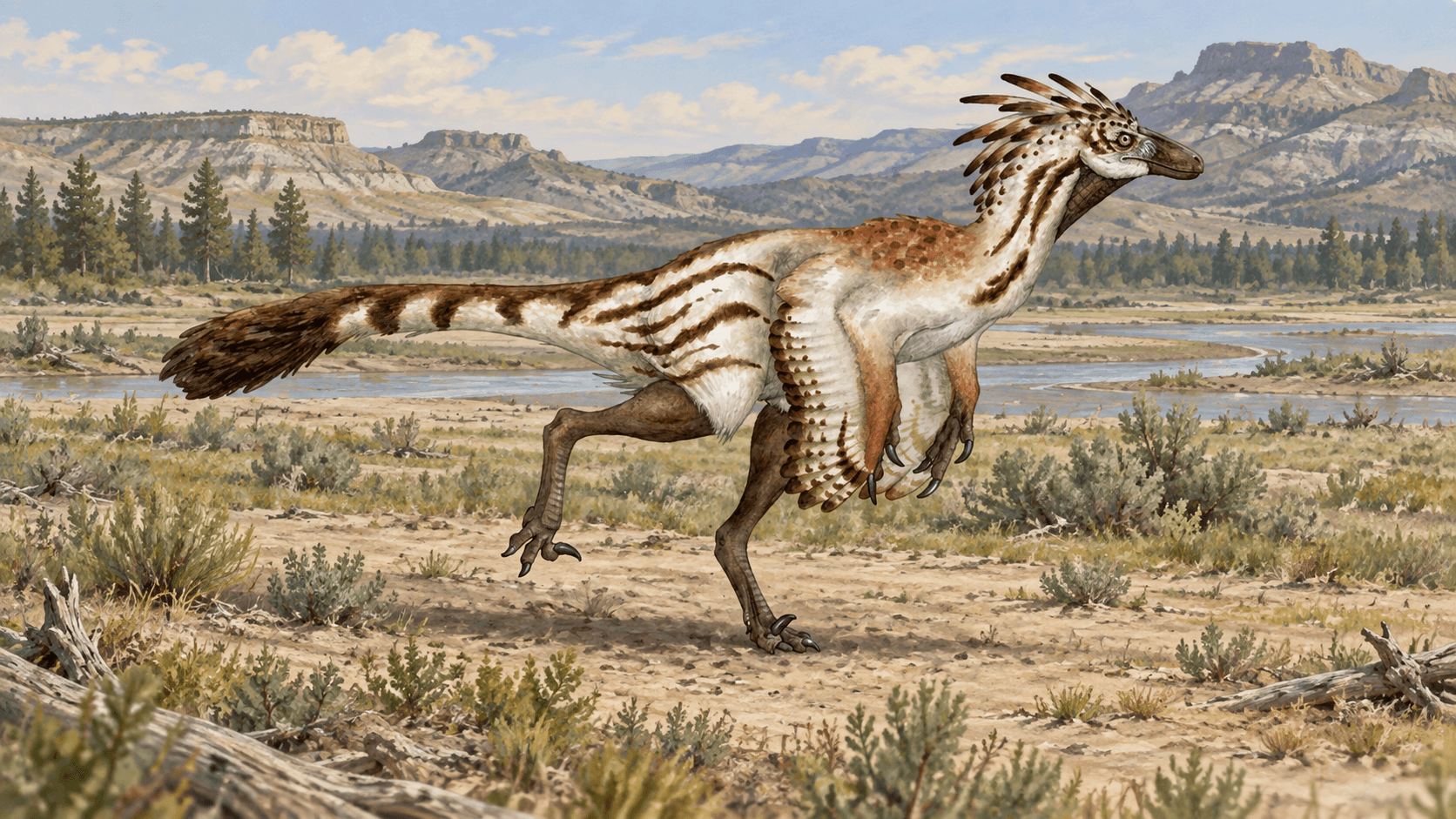
Cover Image: An artistic reconstruction of Troodon formosus, whose Montana fossils reveal its growth and possible foot pathologies. Original illustration by Clarissa Koos, licensed under CC BY 4.0; background digitally adapted for Ancientist.