
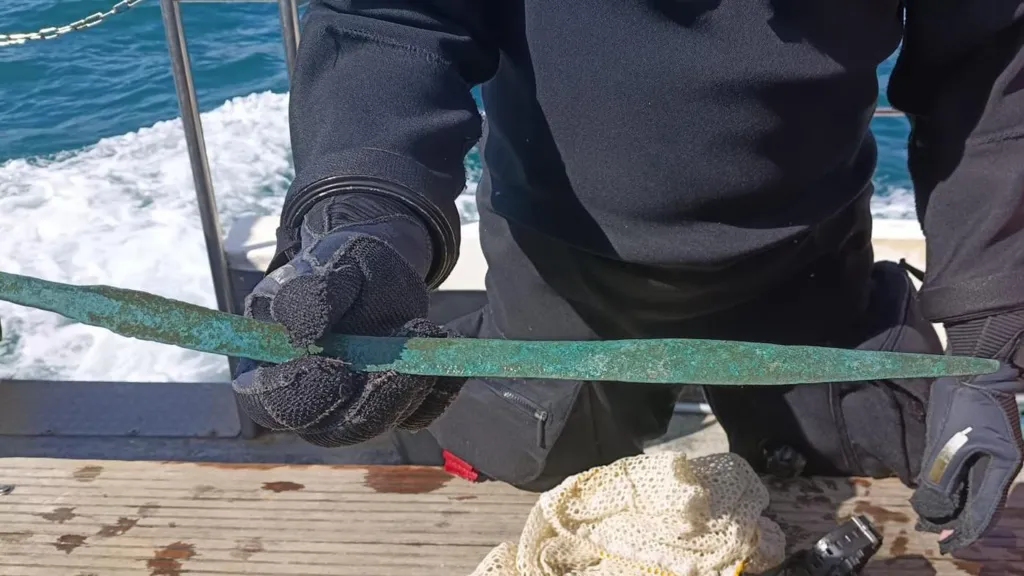
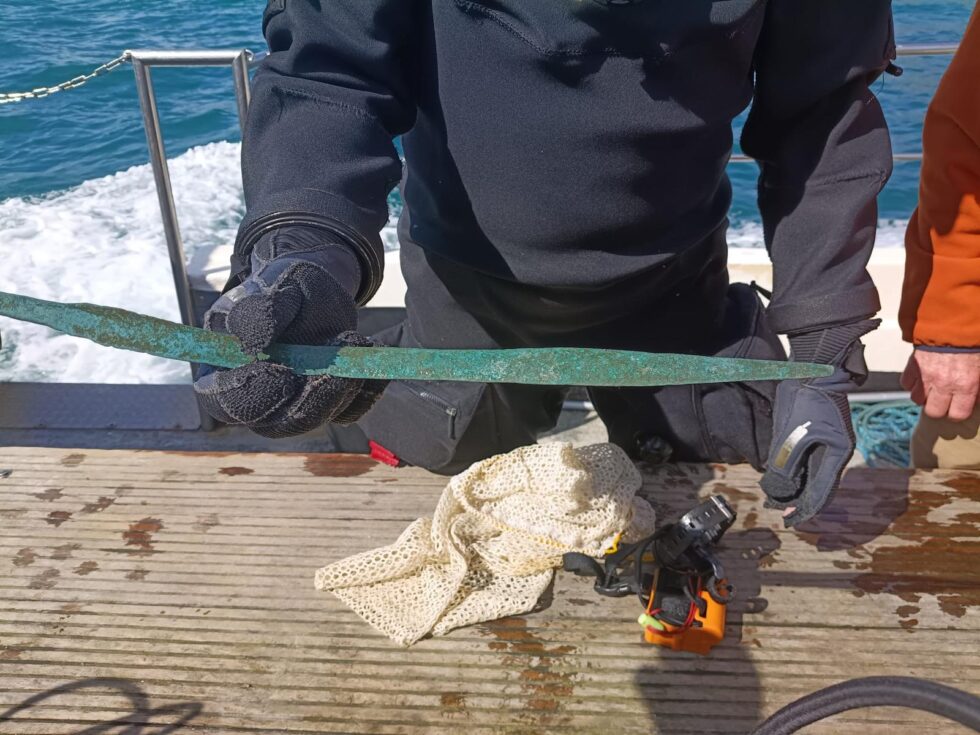
A remarkably rare Bronze Age sword has been recovered from the seabed at the protected Salcombe wreck sites off the coast of Devon in south-west England.
The weapon was discovered earlier this year by volunteer divers Becky Gill and Catherine Gill during archaeological investigations by the South West Maritime Archaeological Group. Initial specialist assessment dates the sword to the Middle or Late Bronze Age, between approximately 1300 and 800 BC.
The sword was found in an area first investigated during the late 1970s by maritime archaeologist Keith Muckelroy. His work helped establish Salcombe as one of the most important prehistoric underwater archaeological sites in north-west Europe.
“A kid at Christmas does not come close to the excitement of finding this sword,” Becky Gill said. She described the discovery as the result of years of work by both past and present members of the diving team.
Catherine Gill said the find immediately raised questions about the people connected with the weapon.
“I wonder where and who made it, who was planning to use it, and who was the last person to touch it, before us, around 3,000 years ago,” she said.
Erosion makes the sword difficult to classify
Although the object has been identified as a Bronze Age sword, erosion has damaged some of the features normally used to determine its exact type.
Researchers have therefore assigned it a broad date range for now. Further examination may reveal more about its manufacture, form and place within Bronze Age weapon traditions.
The sword is currently undergoing conservation by MSDS Marine. Once the work is complete, it will be transferred to the British Museum, where it will be available for further study.
Neil Wilkin of the British Museum described the sword as an important addition to the archaeological record of Salcombe.
He said earlier discoveries from the site had helped researchers understand connections between Bronze Age Britain and continental Europe. The new weapon may provide further evidence about maritime travel, exchange and the movement of metal objects around Britain roughly 3,000 years ago.
Salcombe may contain more than one Bronze Age wreck
The seabed around Salcombe has produced Bronze Age weapons, tools and metal objects during several phases of investigation.
Previous discoveries suggest that the remains may come from at least two separate Bronze Age shipwrecks. However, no complete prehistoric vessel has been identified, and researchers are still working to understand how the objects reached the seabed.
The newly discovered sword may have formed part of a cargo, belonged to someone travelling by sea or entered the water under different circumstances. Its precise archaeological context remains uncertain.
What is clear is that the Salcombe coast lay within active maritime routes during the Bronze Age. The objects recovered there reflect contact between communities around Britain, the Atlantic coast and continental Europe.
Found by a new generation of volunteers
The discovery was made during a Historic England-funded project created to train new maritime archaeology volunteers and support the long-term management of the protected wreck sites.
The programme placed new divers alongside experienced members of SWMAG, allowing practical skills and knowledge of the Salcombe sites to pass between generations.
Alison James, project manager at MSDS Marine and archaeological adviser to SWMAG, said the find demonstrated both the importance of protected wreck sites and the role played by volunteer archaeologists.
Investigations at Salcombe have continued for decades, but the discovery shows that significant prehistoric objects may still remain beneath the seabed.
Further analysis will now focus on the sword’s form, date and archaeological context. Researchers hope the results will provide a clearer picture of Bronze Age seafaring, trade and metal movement along the coast of south-west England.