
Nearly 4,000 years ago, Egyptian princesses trained with bows and daggers, a new study of skeletal remains from Dahshur suggests. The women were buried with bows, arrows, maces and decorated daggers—objects long debated as either personal weapons or symbols of royal rank.
The new analysis indicates that the answer may be both. Pronounced muscle attachment areas in their shoulders, arms, forearms and hands are consistent with repeated bow-drawing, strong gripping and possible weapon handling.
Researchers found pronounced muscle attachment areas in the shoulders, arms, forearms and hands of several Egyptian princesses. The changes are consistent with repeated, forceful movements such as drawing a bow, maintaining a strong grip or handling a dagger.
The evidence does not prove that the women fought in battles. It does, however, suggest that some may have received archery or weapons training rather than being buried with objects they had never used.
Published in Frontiers in Environmental Archaeology, the study was conducted by Zeinab Hashesh, Ahmed Gabr and Roxie Walker. The researchers examined the remains of King Hor, four named princesses and an unidentified royal woman from the late Middle Kingdom.
Royal bones rediscovered in a museum basement
French archaeologist Jacques de Morgan uncovered the burials during excavations around the pyramid complexes of Amenemhat II and Amenemhat III in 1894 and 1895.
Early examinations focused mainly on King Hor and Princess Noub-Hotep. The remains of Princesses Ita, Khenmet and Itaweret, along with an unidentified woman who may have been Princess Sathathormeryt, received little detailed study.
The bones remained largely unexamined for more than a century before being relocated and reassessed in the Egyptian Museum in Cairo in 2020. Some still carried handwritten names left by nineteenth-century excavators, while others were stored with old labels and fragments of newspaper once used as wrapping material.
Most of the skulls are now missing. They had been transferred to the anatomical museum of the Cairo School of Medicine and were subsequently lost, leaving researchers to work mainly with surviving limbs, ribs, vertebrae and parts of the pelvis.
Despite the incomplete state of the skeletons, the surviving bones preserved evidence of habitual movement, injury and disease.
Princess Ita’s bones match the grip of a weapon
Princess Ita died between approximately 28 and 34 years of age. Her right shoulder and forearm showed particularly strong attachment areas for muscles involved in rotating the arm, extending the thumb and controlling the fingers.
The muscles used to bend the fingers and maintain a firm grip were also well developed. Researchers argue that this combination reflects repeated handling of an object requiring strength and control, possibly a dagger or mace.
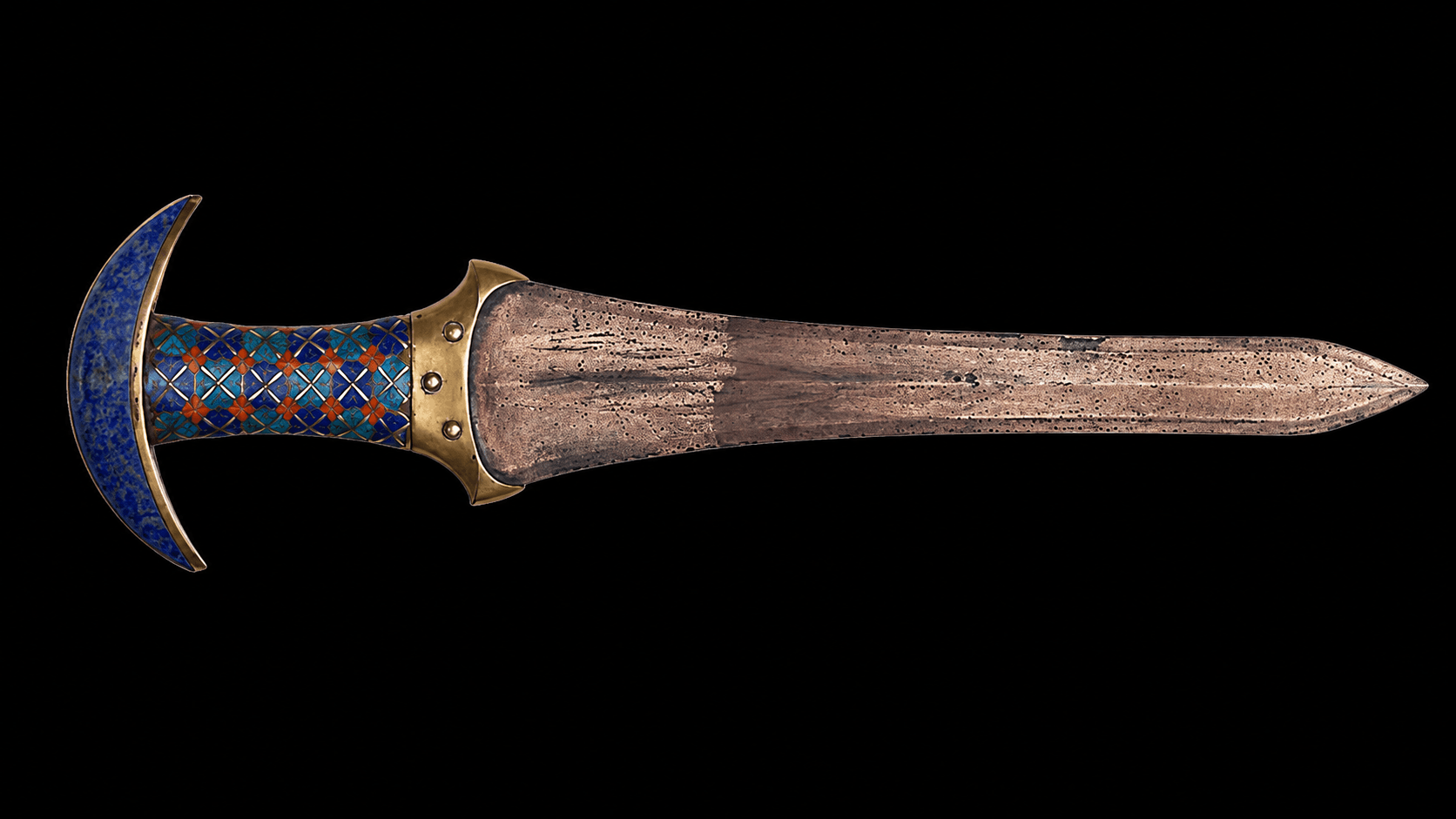
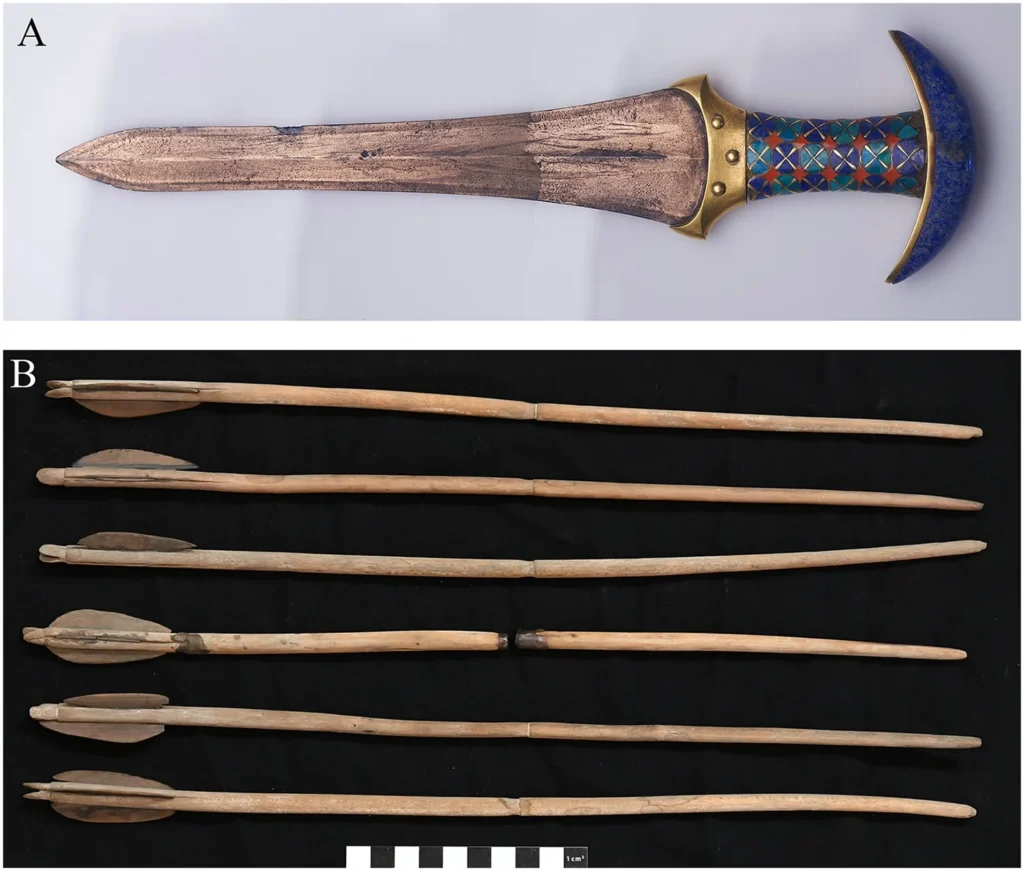
A decorated dagger was found in Ita’s tomb.
The burial object alone could be interpreted as a symbol of royal authority. When considered alongside the changes in her hand and forearm, however, it becomes possible that the dagger also represented an activity she had practised during life.
Khenmet and Itaweret may have practised archery
Princesses Khenmet and Itaweret displayed changes in the upper limbs that the researchers associate with repeated bow-drawing.
Khenmet’s forearm bones contained pronounced muscle attachments in areas involved in bending and rotating the arm. Itaweret showed similar development, together with strong attachment areas across the chest, shoulders and clavicles.
Drawing a bow requires coordinated effort from the chest, shoulder, upper arm, forearm and hand. The distribution of changes across Itaweret’s upper body matches that type of repetitive movement.
Itaweret had also suffered fractures to several ribs and bones in her foot. The injuries had healed before she died. They may have resulted from a fall, a forceful impact or repeated physical strain, although they cannot be directly connected with archery, hunting or military training.
The successful healing of these fractures may indicate that members of the royal household had access to skilled medical care.
Noub-Hotep offers one of the clearest cases
Princess Noub-Hotep’s forearm and right hand showed extensive muscular development. The affected areas were connected with rotating the palm, controlling the fingers and producing a powerful grip.
One of the bones in her right hand was also bowed without evidence of disease. Researchers interpret this remodelling as a possible response to repeatedly stabilising and drawing a bow.
Arrows were discovered in her burial.
The combination of skeletal adaptation and archery equipment makes Noub-Hotep one of the clearest examples in the study. It remains impossible to identify her exact activity, but the evidence suggests that the arrows may have reflected a skill she used rather than serving only as funerary decoration.
The women cannot yet be called warriors
Muscle attachment changes are not direct records of occupation. Age, genetics, nutrition, illness and body structure can all affect how these areas develop.
The same physical pattern may also result from different activities. Archery is a strong possibility, but hunting, ceremonial training, sport or specialised court rituals could have placed similar demands on the body.
There is no skeletal evidence proving that the princesses took part in warfare.
Weapons also carried powerful symbolic meanings in Egyptian royal burials. The women were interred within carefully organised funerary complexes surrounding royal pyramids, where their presence supported ideas of royal renewal and life after death.
Practical use and symbolism, however, were not necessarily separate. A bow could serve as a ritual object while also belonging to a woman who had learned to use it.
Royal privilege did not prevent injury or illness
The study also documented spinal strain, inflammation, joint disease, possible bone-density loss and healed trauma among the Dahshur royal family.
Several individuals shared unusual congenital features in the spine. The researchers suggest that these similarities may reflect close family relationships and marriage within the royal line, although ancient DNA testing will be needed to confirm this.
Chemical analysis of dark material preserved on the bones identified frankincense and juniper resin, substances likely used during embalming. Ita’s remains differed from the others because her sample contained juniper without frankincense.
The most significant finding remains the close relationship between the objects placed in the tombs and the physical changes recorded in the women’s bodies.
The Dahshur princesses cannot be described with certainty as warriors. Yet their bones suggest lives involving more physical skill and specialised training than their formal titles and luxurious burials once revealed.
Cover Image: The decorated dagger discovered in the tomb of Princess Ita. Credit: Sameh Abdel Mohsen / Egyptian Museum
Hashesh Z, Gabr A and Walker R (2026) Bioarchaeological reassessment of Dahshur royal skeletal remains from the Late Middle Kingdom (c. 1850–1700 BCE). Front. Environ. Archaeol. 5:1844402. doi: 10.3389/fearc.2026.1844402