
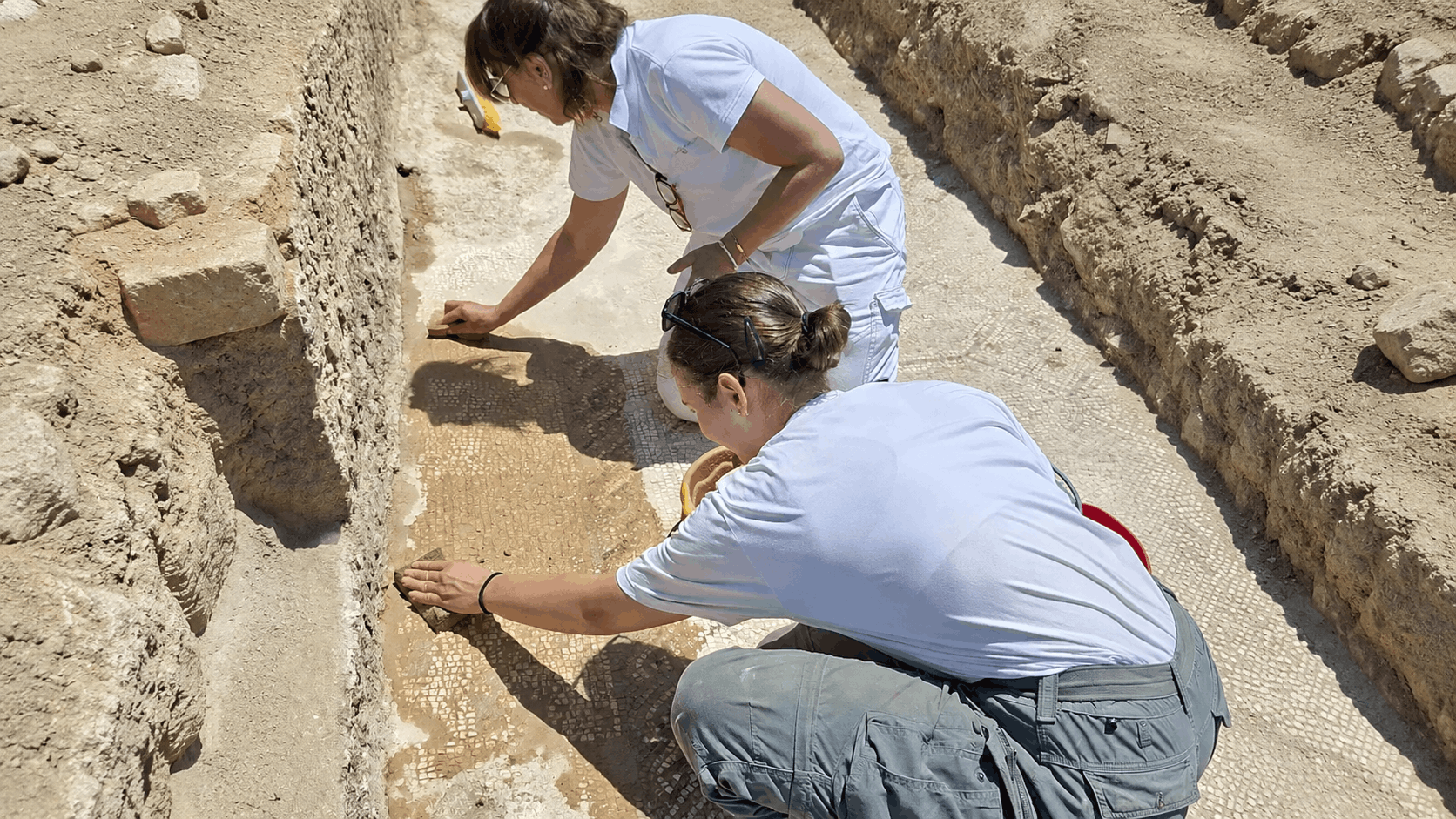
Archaeologists working in Agrigento, Sicily, have uncovered a polychrome geometric mosaic and a group of objects linked to the city’s early Christian community.
The discoveries were made during the 11th excavation campaign in the Hellenistic-Roman Quarter of ancient Agrigentum, close to a large Roman bath complex. The excavated building remained in use for nearly eight centuries, from the third century BC until at least the fifth century AD.
Floors reveal centuries of change
Successive floor layers allowed archaeologists to reconstruct how the building changed over time.
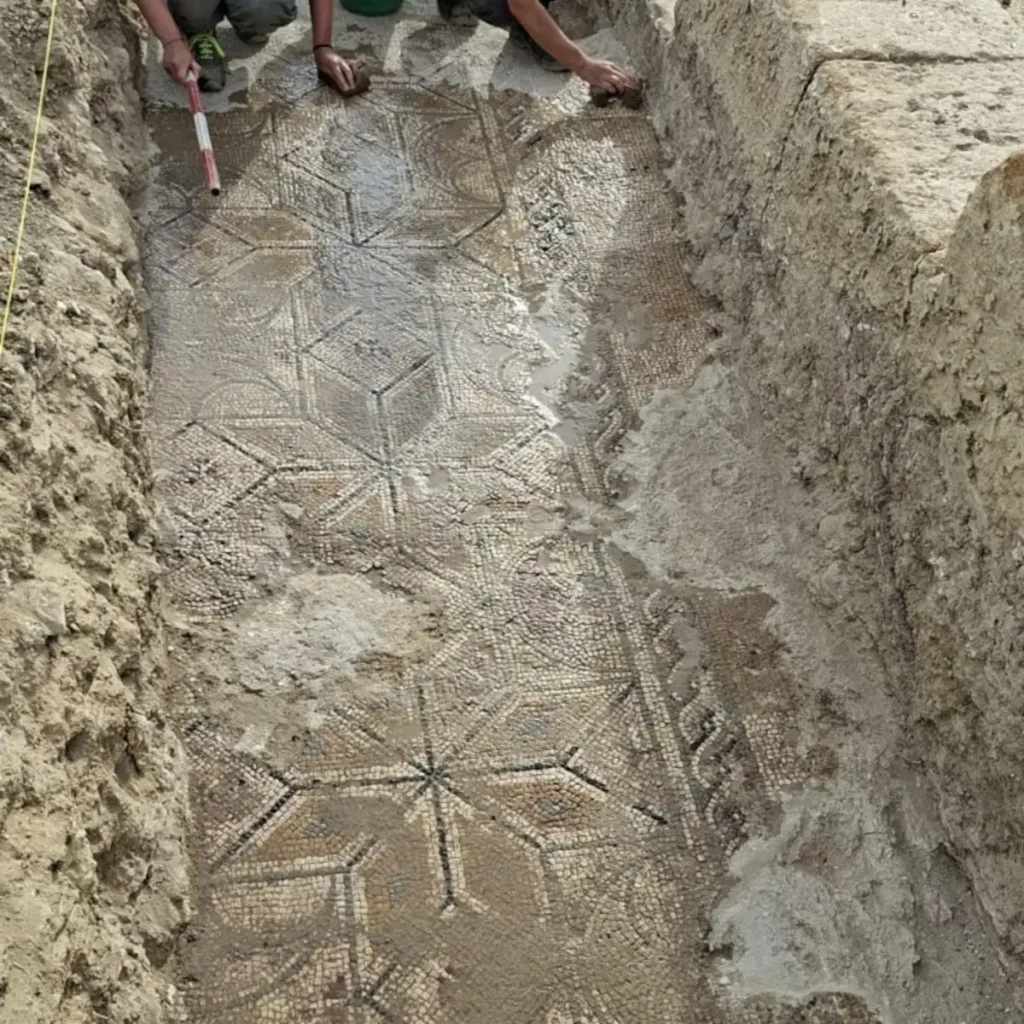
The earliest known surface was made from yellow calcarenite. It was later replaced by a Republican-period cocciopesto floor containing traces of red pigment. During Late Antiquity, the interior was remodelled again and decorated with the newly discovered polychrome mosaic.
The mosaic features a geometric composition made from differently coloured tesserae. It has already been cleaned, stabilised and secured following its excavation.
Its discovery adds a later chapter to the history of Agrigentum’s residential quarter, where houses, streets and public buildings continued to be altered long after the city came under Roman control.
Christian monogram found in a basin
Further evidence emerged from a quadrangular basin inside the building.
Archaeologists recovered coins, amphora stoppers and the remains of small animals. The animal bones may be associated with communal or ritual meals, although specialists are still examining the material.
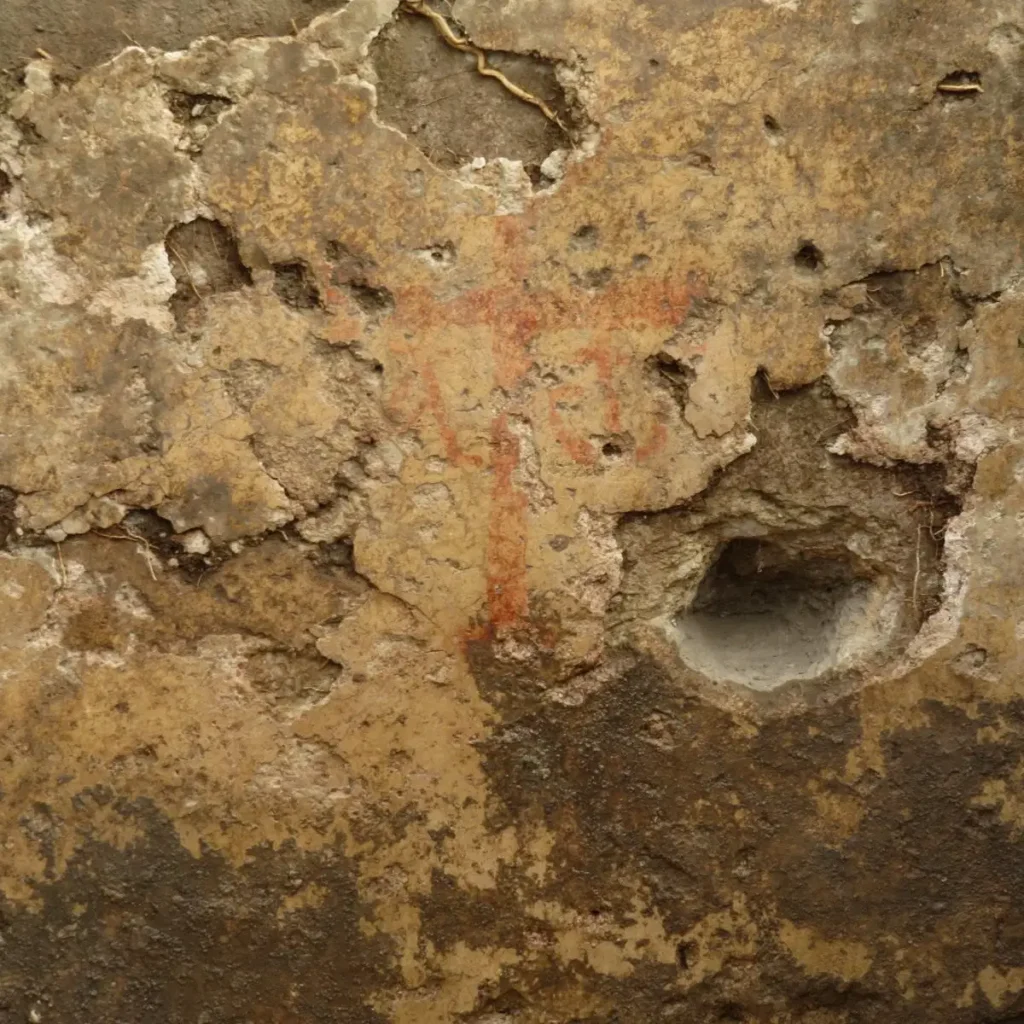
One amphora stopper bears an engraved Christian monogram. The object is especially important because an early Christian place of worship had previously been identified nearby, inside a cistern belonging to the bath complex.
The basin and its contents may therefore be connected with Christian activity in the area between the third and fourth centuries AD. The exact purpose of the space, however, remains uncertain.
Rather than identifying the building as a church, the finds suggest that religious practices may have extended into structures surrounding the known place of worship.
Ancient Agrigentum in transition
Agrigento was founded as the Greek city of Akragas in the sixth century BC and later became the Roman city of Agrigentum. Its Hellenistic-Roman Quarter preserves evidence of long-term occupation, including houses, roads, mosaics and bathing facilities.
The newly excavated building reflects that long history particularly clearly. Beneath its Late Antique mosaic, archaeologists documented earlier Greek and Roman floors, showing how the same space was repeatedly adapted across changing political, social and religious periods.
The excavation was directed by Professor Giuseppe Lepore of the University of Bologna and archaeologist Maria Serena Rizzo of the Valley of the Temples Archaeological Park. Conservation work was supervised by Marilanda Rizzo Pinna.
Analysis of the coins, animal remains, amphora stoppers and associated contexts is continuing.
Cover Image: Conservators clean the newly uncovered polychrome Late Antique mosaic in Agrigento’s Hellenistic-Roman Quarter, Sicily. Credit: Valley of the Temples Park