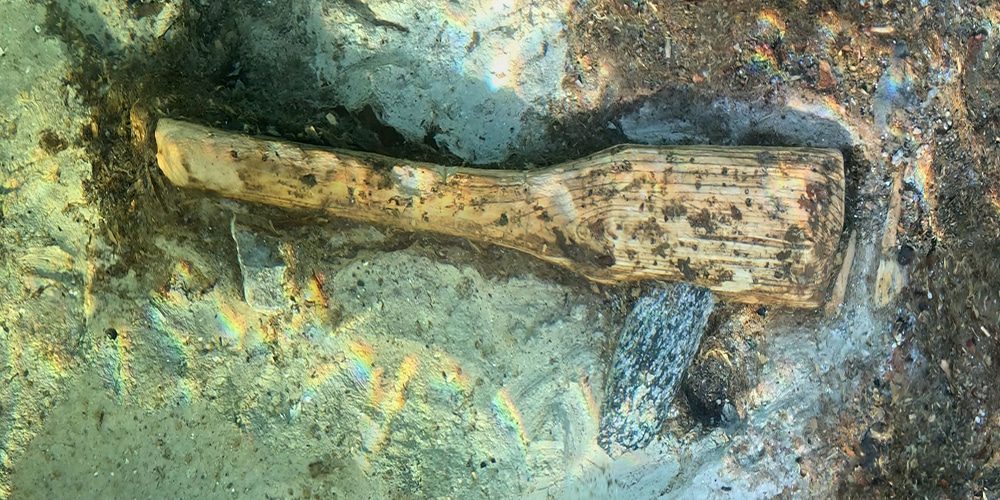
A rare 4,800-year-old Neolithic axe discovered in Lake Constance, Switzerland is offering new insight into prehistoric craftsmanship and lakeside life in Central Europe. Recovered during controlled underwater excavations in Steckborn harbor, the tool stands out not only for its completeness, but for the unusually clear picture it provides of material choices and local resource use in the Late Neolithic period.
From Routine Dredging to Archaeological Discovery
What began as a standard dredging operation in the winter of 2025/26 quickly shifted direction. Falling water levels and heavy sediment buildup had made maintenance unavoidable in Steckborn’s harbor—an area already known for prehistoric pile-dwelling remains since the 19th century.
Instead of proceeding directly, authorities opted for a preventive archaeological approach.
In spring 2025, a specialized dive team from the Thurgau Office of Archaeology carried out a controlled excavation across roughly 50 square meters. Beneath layers of marl and silt, they uncovered a well-preserved Neolithic settlement horizon.
Wooden piles, animal bones, pottery fragments, and stone tools emerged from the lakebed. But one object immediately stood apart.
A nearly complete felling axe, preserved with both its wooden shaft and stone blade intact.
A Rare Case of Organic Preservation
Radiocarbon dating places the axe’s wooden handle at around 2800 BCE, firmly within the Late Neolithic. What makes the find exceptional is not just its age—but its condition.
Organic materials such as wood almost never survive.

Here, however, the oxygen-poor, waterlogged environment acted as a natural preservative. As a result, the axe retains details that are usually lost, offering direct evidence of prehistoric woodworking practices.
The handle was made from ash wood, a material valued for its strength and flexibility. This was not a random choice—it reflects a deliberate and informed selection of raw materials.
Stone, Landscape, and Local Knowledge
The blade was crafted from prasinit, a dense metamorphic rock associated with Alpine geology. At first glance, this might suggest long-distance transport.
But researchers point to a different explanation.
Rather than importing the material from the Alps, Neolithic communities likely sourced it locally from glacial deposits scattered across the region. This detail matters. It suggests a practical and highly developed understanding of the surrounding landscape—not dependence on distant exchange networks.
Life on the Edge of the Water
The Steckborn find belongs to a wider cultural landscape: the prehistoric pile-dwelling settlements around the Alps.
These communities, built along lake shores and wetlands between roughly 5000 and 500 BCE, are now recognized as a UNESCO World Heritage phenomenon. Their significance lies in preservation.
Waterlogged conditions turn these sites into natural archives.
Wood, plant remains, and other organic materials—normally lost—can survive for thousands of years. Because of this, discoveries like the Steckborn axe do more than classify tools. They help reconstruct daily life, economy, and environmental adaptation.
Evidence from similar Lake Constance sites shows that these communities practiced a mixed subsistence strategy: farming, animal husbandry, fishing, and foraging.
Within this system, tools like the axe were essential—used in woodland management, construction, and maintaining settlement structures.
From Lakebed to Museum Display
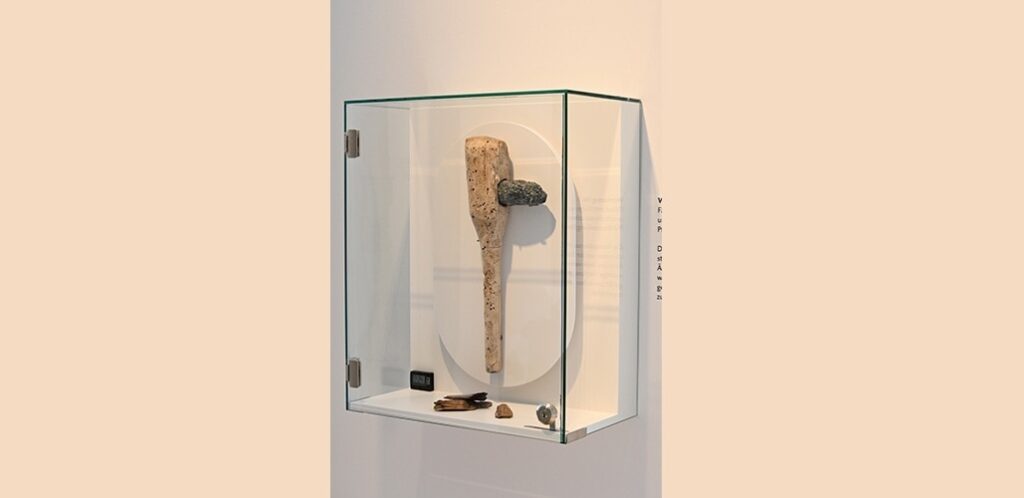
After its recovery, the axe underwent careful conservation in the laboratories of the Thurgau Office of Archaeology. Both the wooden shaft and stone blade were stabilized to prevent deterioration once exposed to air.
The turnaround was быст.
Within a year, the artifact moved from excavation to exhibition.
Today, it is on display at the Museum of Archaeology in Frauenfeld, where it offers visitors something rare: a direct, physical connection to a prehistoric lakeside world.
A Small Object with Unusual Clarity
The Steckborn axe is not monumental. It does not dominate by size or decoration.
Its importance lies elsewhere.
It represents a rare convergence of preservation, context, and craftsmanship—a combination that almost never survives intact.
And because of that, it does something many discoveries cannot:
It makes the Neolithic tangible—not as an abstract period, but as a moment shaped by human hands, decisions, and daily work nearly five millennia ago.
Cover Image Credit: ©Canton Thurgau