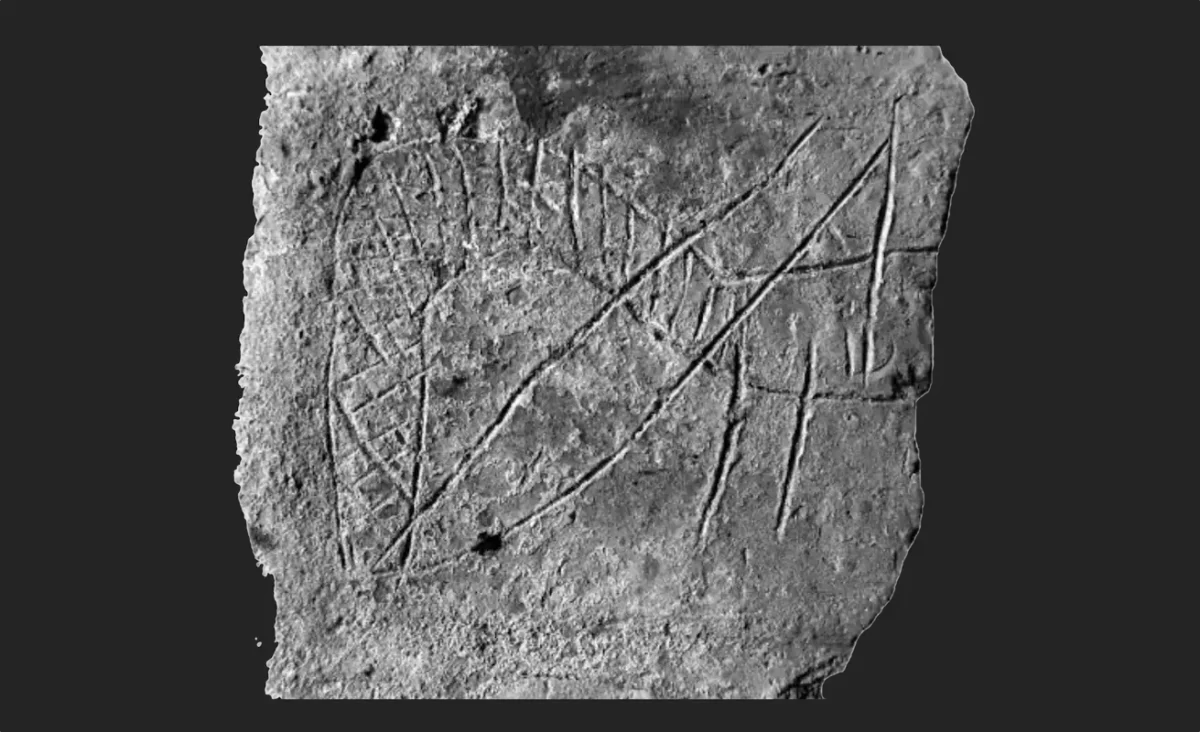
A roughly scratched drawing on a fragment of clay, discovered in central Spain, may be forcing historians to reconsider a long-standing assumption about European warfare. What appears at first to be a crude sketch could, in fact, represent the earliest known stirrup in Western Europe—potentially pushing its use back by more than a century.
A Small Object, A Big Question
The artifact comes from the archaeological site of Cerro de la Muela (El Pulpón), near Carrascosa del Campo in Cuenca. It is a modest brick fragment, just over 25 centimeters wide, bearing a simple engraved scene created before the clay was fired.
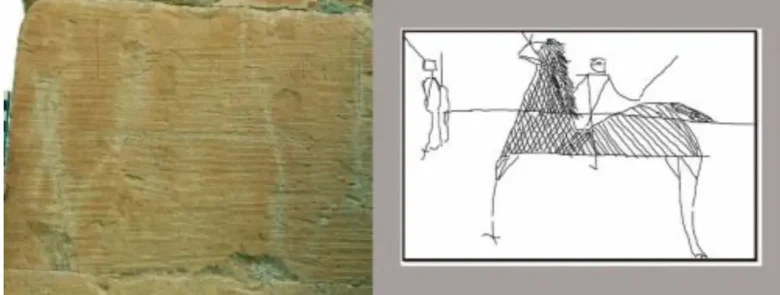
At the center of the composition is a mounted figure. The horse is rendered with some attention to detail, while the rider is reduced to a single vertical line. Yet beneath that line, positioned at the horse’s belly, a distinct curved element intersects the figure at a right angle.
Researchers argue that this is not a foot—but a stirrup.
If correct, the engraving dates to the late 4th or early 5th century AD, making it significantly earlier than the traditionally accepted introduction of stirrups into Western Europe.
Dating Anchored in Context, Not Guesswork
The strength of the claim lies in its archaeological context. The fragment was recovered from a domestic structure alongside ceramics typical of the late 4th century and two coins of the usurper Magnus Maximus (383–388 AD).
This combination provides a secure chronological framework, placing the engraving firmly within a period of political instability and military movement across the Western Roman Empire.
It is precisely the kind of environment where technological exchange could occur faster than written records suggest.
More Than a Rider: Signs of Heavy Cavalry
The engraving offers another important clue. The horse’s head and neck are marked with cross-hatched and linear patterns that likely represent protective gear—possibly textile or leather armor.
These features resemble known elements of heavy cavalry equipment, such as a chamfron and crinet. Such gear is more commonly associated with eastern Roman or Persian-influenced units, rather than local Iberian traditions.
This raises a compelling possibility: the image may depict something unfamiliar to the artist, observed rather than imagined.
Why the Stirrup Changes Everything
The stirrup is not a minor innovation. It transforms mounted combat by giving riders stability, leverage, and control, enabling more effective use of weapons such as lances and bows.
For this reason, its arrival in Europe is typically placed in the 6th century AD, often linked to steppe-origin groups like the Avars.
The Cuenca engraving challenges that narrative. It does so not through written testimony, but through visual evidence embedded in a well-dated archaeological layer.
A Drawing Made to Explain the Unfamiliar
The medium itself is revealing. The engraving was made quickly on soft clay, likely during the drying phase before firing. This was not a formal artwork, but an accessible surface for spontaneous expression.
What stands out is selective emphasis. The horse’s armor is carefully indicated, and the curved element beneath the rider is clearly intentional, despite the otherwise simplified figure.
This suggests the drawing was not decorative, but communicative—perhaps an attempt to capture and explain an unusual piece of equipment.
Rethinking a Long-Held Timeline
The absence of early written references to stirrups in Western sources has long shaped scholarly consensus. But as researchers note, silence in the texts is not proof of absence.
Comparable cases exist elsewhere. In China, early stirrups appear in the archaeological record before they are clearly documented in writing. The same pattern may apply here.
Late Roman Hispania was far from isolated. It was a region marked by military diversity, shifting allegiances, and troop mobility, conditions that could facilitate the early spread of innovations.
A Debate Just Beginning
The interpretation is already likely to spark debate. Some will question whether such a simplified figure can support a claim of this magnitude. Others will point to the strength of its context and the deliberate depiction of key features.
What is certain is that this modest brick fragment has introduced a new variable into the history of cavalry technology.
If confirmed, it would not merely adjust a date—it would reshape our understanding of how and when one of warfare’s most transformative tools reached Western Europe.
Rafael Barroso Cabrera, Jorge Morín de Pablos, Dionisio Urbina Martínez, Grabado de un jinete sobre ladrillo procedente del yacimiento de El pulpón (Carrascosa del Campo, Cuenca). ARPI: revista de Arqueología y Prehistoria del Interior Peninsular, 2025, n.10, pp. 16-29. hdl.handle.net/10017/68655
Cover Image: Engraved depiction of a mounted rider—possibly showing a stirrup—on a brick fragment from Cerro de la Muela (Cuenca). Credit: R. Barroso Cabrera et al., 2025.