
A rare Celtic elite grave discovered near Bad Camberg in Germany has revealed gold jewelry, the remains of a two-wheeled wagon, an iron spearhead, and an Etruscan bronze jug, placing the Taunus find among the most important Iron Age burials recently identified in Hesse.
The discovery, first reported by hessenschau, was made during archaeological work connected with a planned photovoltaic project near the A3 motorway. What began as a routine investigation soon turned into an exceptional find: the first known Celtic “princely grave” from the Taunus, a region already rich in traces of later Celtic activity but not previously known for a burial of this rank.
A pattern in the ground led archaeologists to the grave
The first clue came from a geomagnetic survey. Beneath an unused area near Bad Camberg, archaeologists detected two narrow, parallel lines leading toward a circular structure. Inside the circle, the images showed a sharply defined rectangular feature.
For an Iron Age specialist, the pattern was difficult to ignore. It resembled the layout of high-status Celtic burial sites, where processional paths and grave mounds formed part of the funerary landscape. Similar monumental arrangements are known from major Celtic sites in Hesse, including Glauberg.
At first, the possibility seemed almost too perfect. But excavation quickly confirmed that the anomaly was not a natural feature or a simple settlement trace. Metal appeared in the soil, including fragments of an iron spearhead. From that moment, archaeologists knew they were dealing with the remains of a burial chamber.
Gold survived after wood and bone disappeared
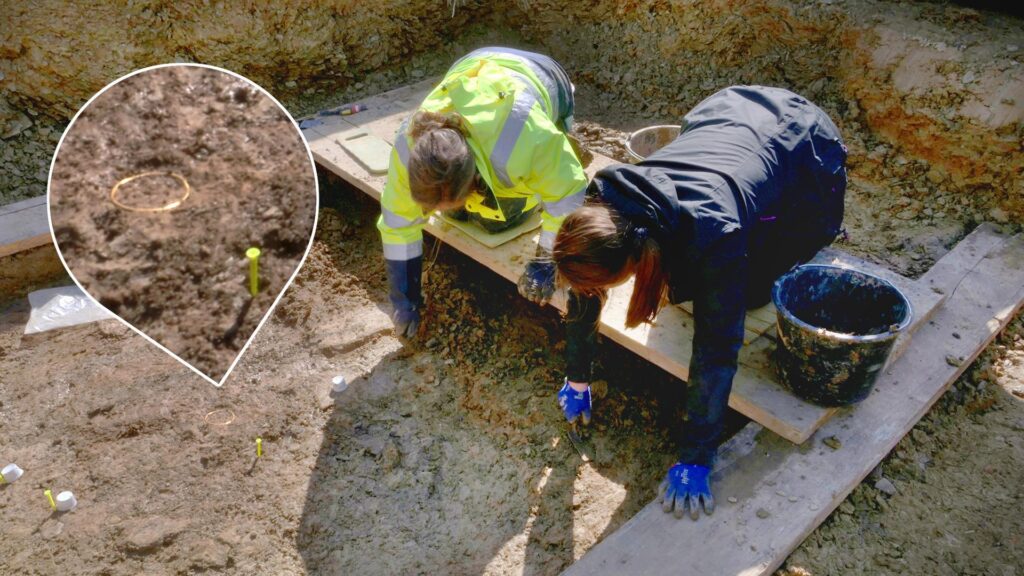
The chamber’s wooden walls had vanished over more than two millennia. The body had also completely decomposed. Yet the objects placed with the deceased remained in the ground, enough to reveal the exceptional status of the person buried there.
The most eye-catching finds are three gold ornaments. They appear to have been worn at the neck, on the arm, and on a finger during the burial. Gold of this kind is unusual in Celtic graves of the period and immediately marks the Bad Camberg grave as a high-ranking burial.
The jewelry was not merely decorative. In Iron Age Europe, gold could signal authority, inherited status, and access to networks of wealth. Its presence, combined with the other grave goods, points to a person whose identity was deliberately displayed in death.
A two-wheeled wagon raised the status of the burial
The grave also contained parts of a two-wheeled wagon, one of the most important features of the discovery. Archaeologists identified iron fittings from two wooden wheels, including metal bands that once formed the running surfaces.
The wheels may have stood up to about 1.20 meters high. They were likely removed from the vehicle and placed upright inside the chamber, possibly against one of its walls. Decorative hubcaps and axle fittings made from non-ferrous metal, perhaps bronze, suggest that the wagon had once been visually striking.
Such vehicles were not ordinary transport in this setting. In Celtic burials, wagons often carried symbolic weight. They could refer to mobility, rank, warfare, ceremony, or the journey of the dead. In Bad Camberg, the wagon strengthens the impression of a carefully staged funeral for a person of unusual importance.
An Etruscan jug connects the Taunus to the Mediterranean
One of the most important objects is still being studied inside a block of soil. X-ray imaging revealed an Etruscan bronze jug, an imported vessel from the Mediterranean world.
This find changes the scale of the story. The person buried near Bad Camberg was not only part of a local Taunus community. The grave goods show access to long-distance exchange networks that connected Central Europe with regions to the south.
Etruscan metal vessels are known from other high-status Celtic contexts. They were often associated with feasting, prestige display, and elite ritual. Their appearance in graves north of the Alps shows that Celtic leaders did not live in isolated mountain or forest societies. They participated in a wider Iron Age world shaped by trade, diplomacy, and the movement of luxury objects.
The Taunus had a deeper Celtic story than expected
The Taunus is already known for important Celtic remains, including the large Heidetränk Oppidum near Oberursel, one of the major late Celtic fortified settlements in Hesse. Other sites in the broader region show that Celtic communities controlled resources, routes, and fortified landscapes over several centuries.
The Bad Camberg grave adds an earlier and more personal dimension to that picture. It does not represent a town, a fortress, or a production zone. It represents one person, buried with objects chosen to express rank, identity, and memory.
The grave is believed to date to the first half of the 5th century BC, in the early Iron Age. That places it in a period when high-status burials north of the Alps were used to make power visible. Gold, weapons, wagons, and imported vessels were not random possessions. They formed a language of authority that the community would have understood.
The person in the grave remains unidentified
Archaeologists cannot yet say whether the deceased was male or female. The spearhead and wagon may suggest a male burial, especially because comparable graves with weapons are often linked to men. But without surviving bones, certainty is impossible.
A richly furnished female burial also remains possible. Celtic women of high rank could be buried with impressive grave goods, and some female elite graves from Iron Age Europe are even richer than male examples.
The term “princely grave” should therefore be understood carefully. It does not mean the deceased was a prince in the modern sense. It refers to an exceptionally rich burial belonging to a person who stood at or near the top of their society.
Laboratory work may reveal the grave’s hidden details
Many of the objects from Bad Camberg are too fragile to expose quickly. Instead of removing them directly in the field, archaeologists lifted them in blocks of soil and brought them to conservation laboratories in Wiesbaden.
There, restorers are using X-ray and other imaging techniques before the objects are fully uncovered. This slower process can reveal details that might otherwise be destroyed: traces of wood, the position of fittings, hidden ornaments, construction methods, and the order in which objects were placed in the chamber.
Nearly 100 finds have already been recorded. Alongside the gold, wagon parts, spearhead, and bronze jug, the grave contained beads, rings that may have belonged to a belt, pottery fragments, and a small sickle-shaped knife.
The Bad Camberg burial is still under study, but its importance is already clear. In a landscape shaped by later Celtic settlements and fortified sites, archaeologists have now found evidence of an early Iron Age figure whose burial combined local power with Mediterranean connections.
Gold, a wagon, and an Etruscan jug have turned a construction site in the Taunus into one of Hesse’s most significant Celtic discoveries.
Cover Image Credit: Gold ornaments for the neck, arm, and finger are among the unusual finds from Celtic graves of this period. © Thomas Kurella, hr