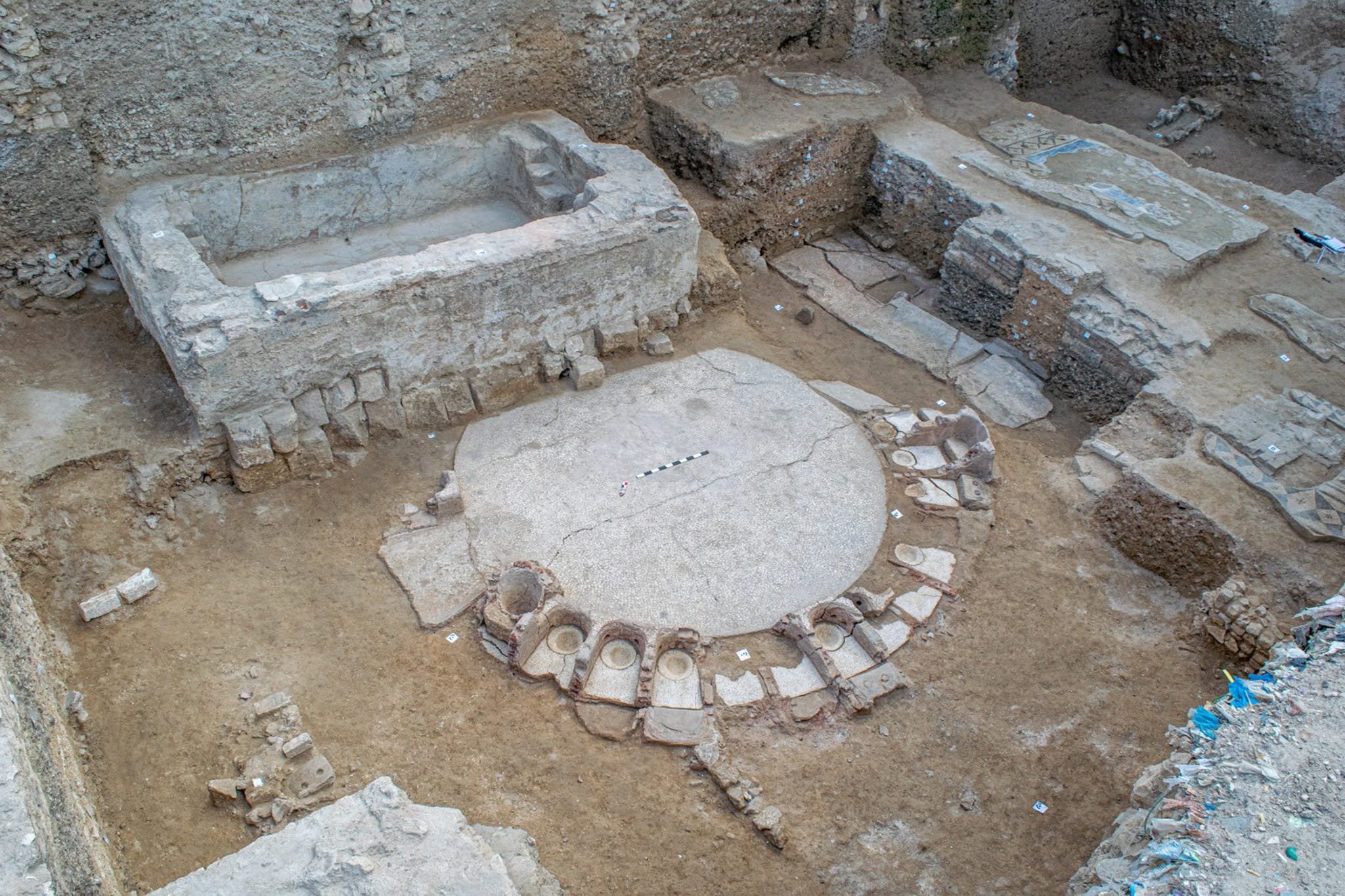
For a city as famous as Alexandria, surprisingly large parts of its ancient body still remain archaeologically quiet. Moharam Bek has now broken that silence.
An excavation in the Moharam Bek district of Alexandria, Egypt, has uncovered a rare Ptolemaic circular bath and the remains of a Roman-era villa decorated with mosaic floors. The discovery offers new evidence for how the city developed from the Ptolemaic period into the Roman and Byzantine eras, and may force scholars to refine the ancient map of Alexandria.
The excavation was carried out in the southeastern sector of the ancient city, an area that has not been investigated as extensively as Alexandria’s more famous archaeological zones. The newly uncovered remains suggest that this part of Moharam Bek was not a marginal space in antiquity. It appears to have remained within the city’s urban fabric into the Byzantine period, before later transformations altered the neighborhood’s place in Alexandria’s historical landscape.
A rare circular bath from the Ptolemaic period
The most unusual discovery is a circular public bath dating to the late Ptolemaic period. Its plan follows the tholos form, a circular architectural model known from the Greek world and often associated with columned structures covered by a domed or conical roof.
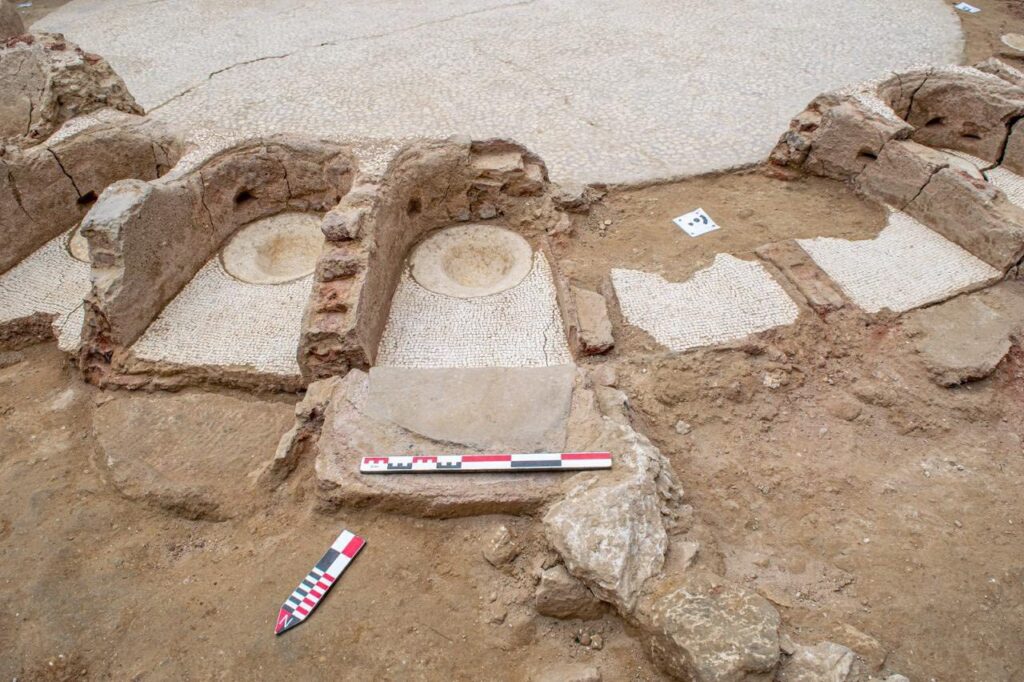
That detail is what makes the find so important. Public baths were familiar in the ancient Mediterranean, especially in the Roman period, but circular public baths of this architectural type are rare. In Alexandria, a city where Greek, Egyptian, and Mediterranean traditions constantly interacted, the structure opens a valuable window onto public architecture before the full Roman reshaping of urban life.
The bath was not an isolated monument. It belonged to a wider neighborhood that included domestic spaces, water installations, decorated interiors, and evidence of long-term occupation. Together, these remains suggest a district with both practical and elite functions, shaped by changing social habits across several centuries.
A Roman villa with mosaics and private water systems
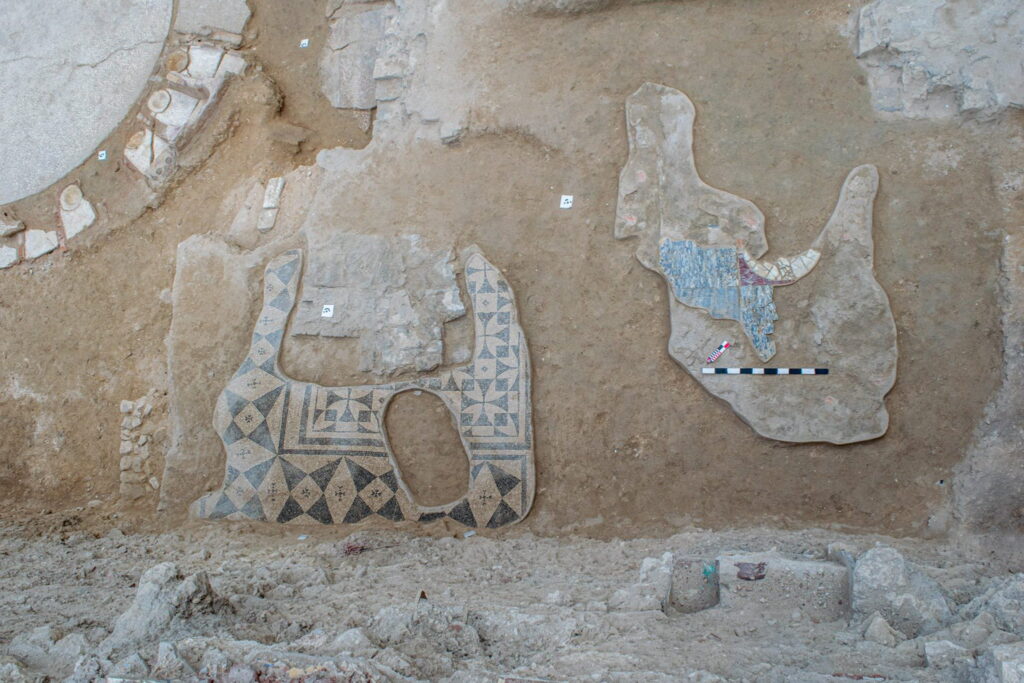
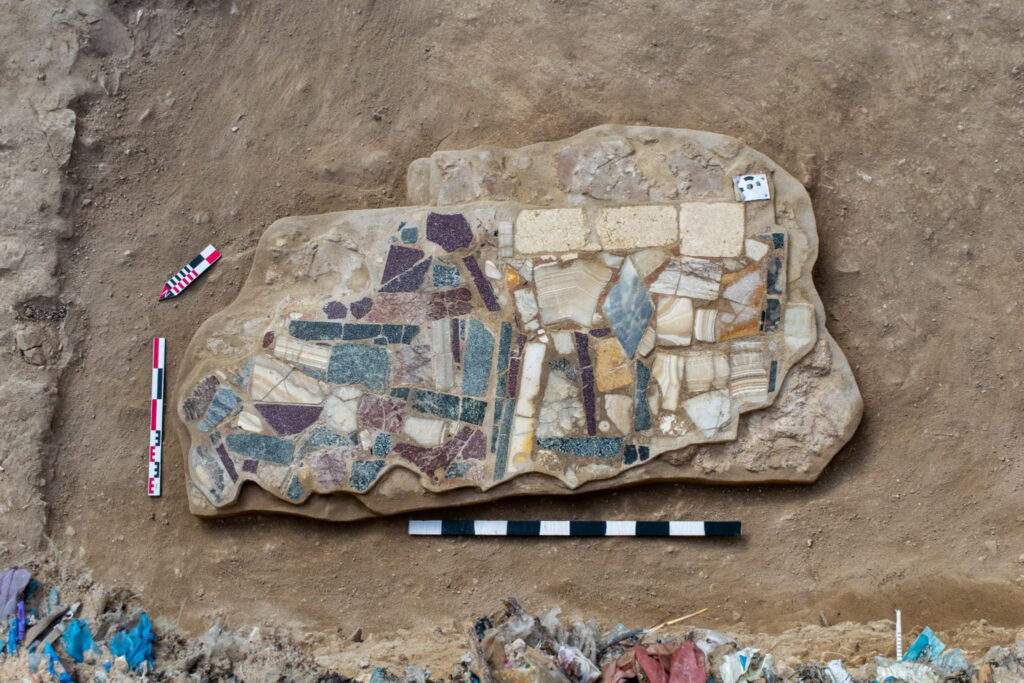
Near the bath, archaeologists uncovered parts of a Roman villa whose floors were decorated with intricate mosaics. Surviving sections include examples of opus tessellatum, made from small stone or ceramic cubes, and opus sectile, a more expensive decorative technique using cut pieces of colored stone.
The combination points to a residence of status and taste. In Roman Alexandria, mosaic floors were not simply decorative surfaces. They reflected wealth, artistic preference, access to skilled workshops, and a desire to bring Mediterranean visual culture into private life.
The villa also contained a small plunge pool supplied by an advanced water management system. This detail gives the discovery another layer of importance. It shows how private comfort, engineering, and urban infrastructure worked together in Roman Alexandria. In a city dependent on carefully managed water supply, such systems were never just technical features. They were part of how elite households displayed order, refinement, and control over the built environment.
Marble gods and traces of color
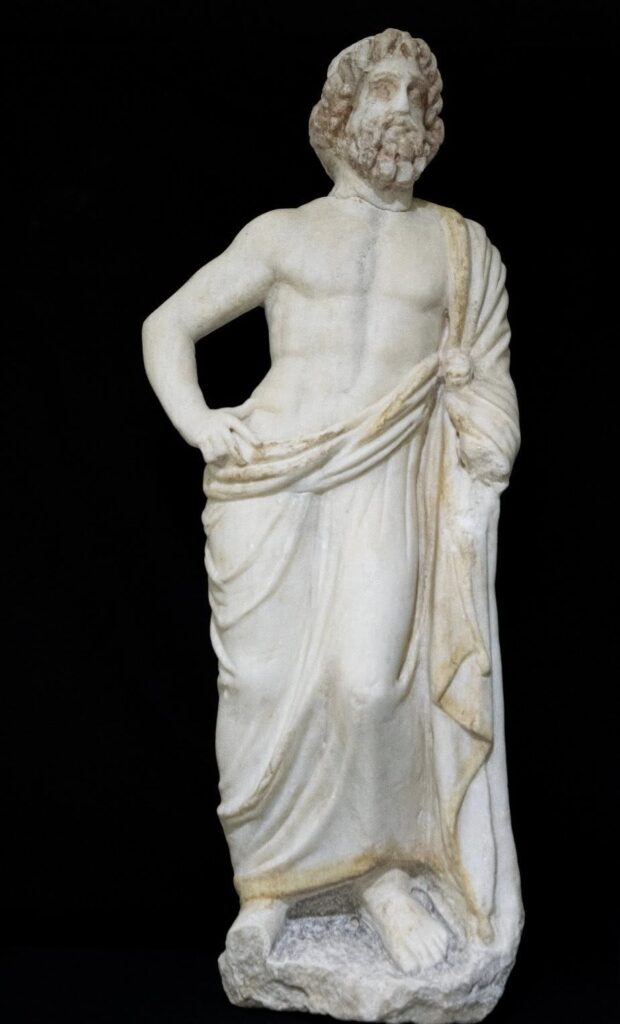
The architectural remains were accompanied by a rich group of movable finds. Among the most striking are marble statues of deities, including Bacchus, the god associated with wine and festivity, and Asclepius, the god of healing.
Archaeologists also recovered headless statue bodies with carefully carved drapery, sculpted heads, and pieces preserving stone eye inlays and traces of ancient color. One of the detached heads appears to match one of the statue bodies, offering conservators a rare opportunity to reconnect fragments of a once-complete figure.
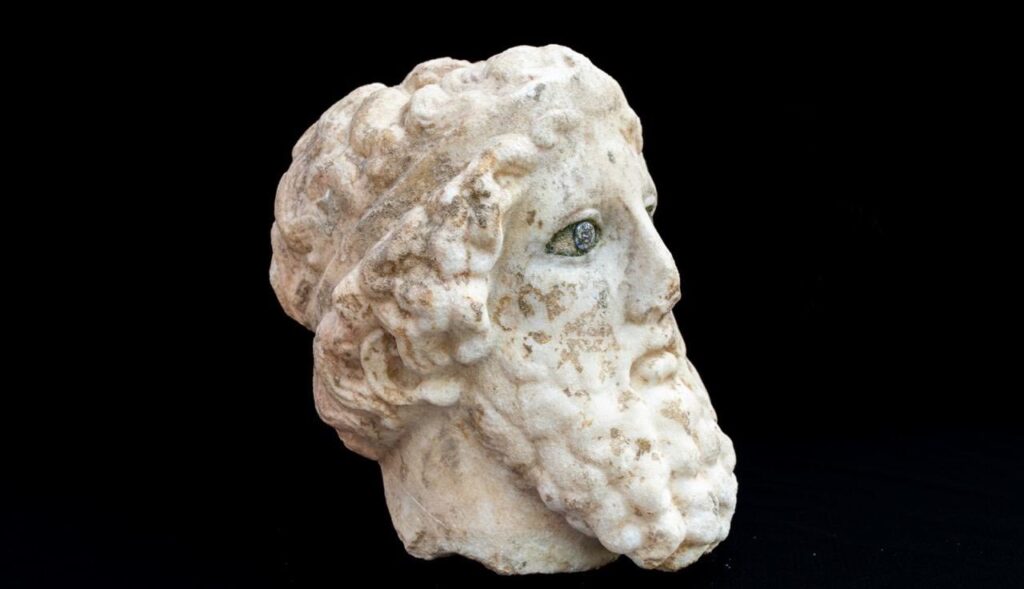
These details matter because they bring the site closer to life. The statues were not pale, silent objects in their original setting. Their eyes, pigments, polished surfaces, and placement within architectural space would have shaped how ancient viewers experienced them. In the mixed cultural world of Alexandria, such images belonged to a visual language shared by domestic, religious, and public spaces.
The presence of Asclepius is especially interesting in a site where water installations and bathing facilities were found. It would be premature to assign the area a specific healing function, but the association between health, water, and divine imagery is an important clue for future study.
Moharam Bek and the changing map of Alexandria
The discovery’s greatest value may be topographical. Alexandria’s ancient layout has long been reconstructed through literary sources, historical maps, rescue excavations, and scattered archaeological windows opened beneath the modern city.
Moharam Bek now adds a crucial new piece to that puzzle. The evidence suggests that the southeastern part of ancient Alexandria remained active and integrated for longer than previously visible in the archaeological record. If this district stayed within the city’s walls and urban life into the Byzantine period, then the lived geography of Alexandria may have been broader and more complex than older reconstructions suggested.
That is why the phrase “redraw the map” is not an exaggeration here. The excavation does not merely add a bath, a villa, and statues to the record. It changes how scholars may understand the city’s boundaries, density, and social organization across time.
A discovery still in progress
The finds are now undergoing preliminary restoration before being transferred to specialized laboratories. Once conservation work is complete, a selection of the most important pieces is expected to go on display at the Greco-Roman Museum in Alexandria.
For now, the excavation has already achieved something significant. It has returned attention to a part of Alexandria that had remained largely hidden beneath the modern city. Beneath Moharam Bek, archaeologists have found not a single moment of the past, but a sequence of urban life: a Ptolemaic bath, a Roman villa, Byzantine continuity, water systems, mosaic floors, marble gods, and fragments of color still clinging to stone.
Alexandria has always been a city of layers. This time, one of those layers has begun to speak with unusual clarity.
Cover Image Credit: Ministry of Tourism and Antiquities