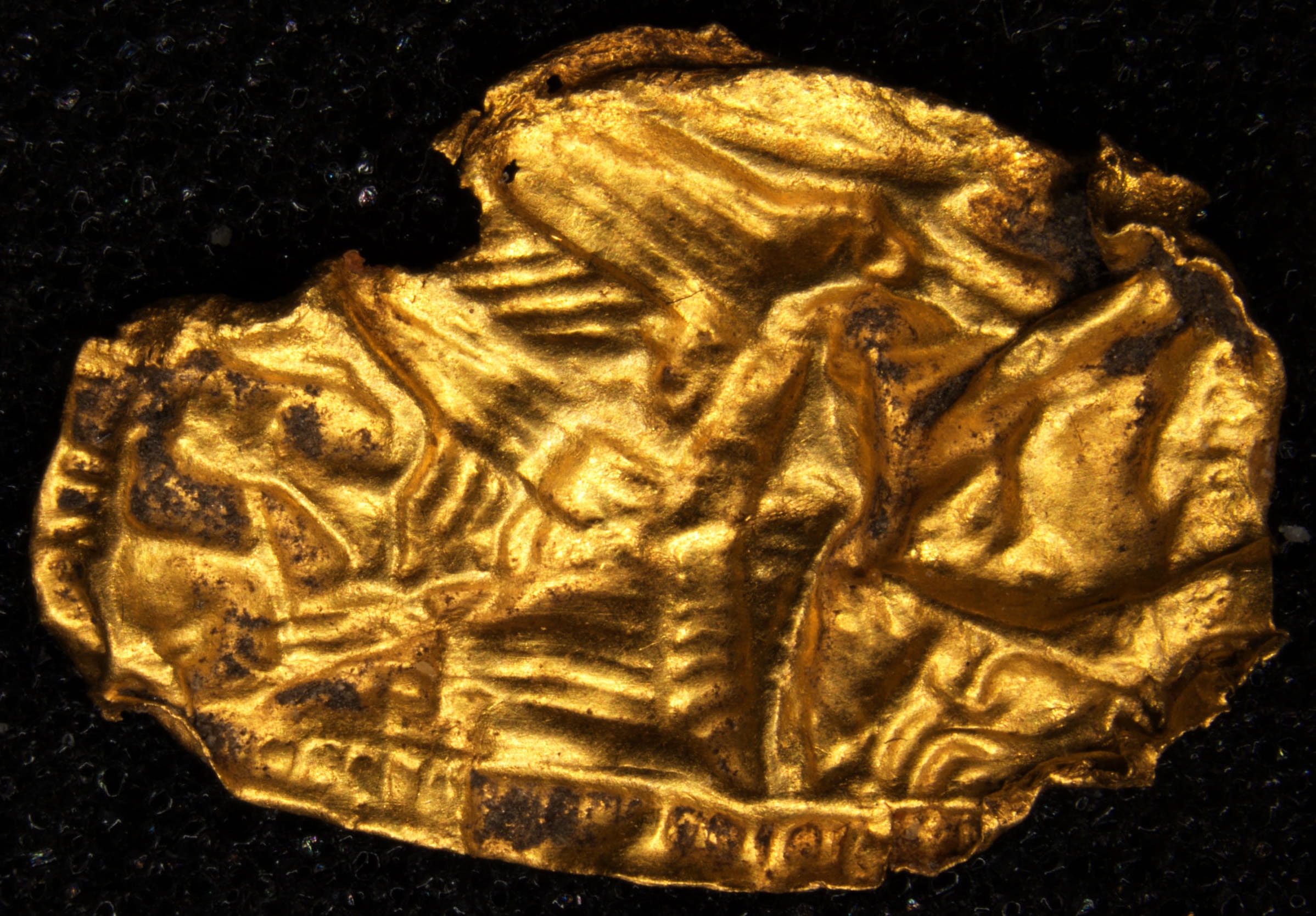
In southwestern Norway, a metal detectorist has uncovered a rare gullgubbe—a delicate gold foil stamped with the image of a man and a woman—dating to the Nordic Iron Age (c. 550–793 A.D.). Despite measuring just 1 centimeter in length, the object may offer critical clues about a forgotten ceremonial landscape.
A Rare Find in Rogaland After 127 Years
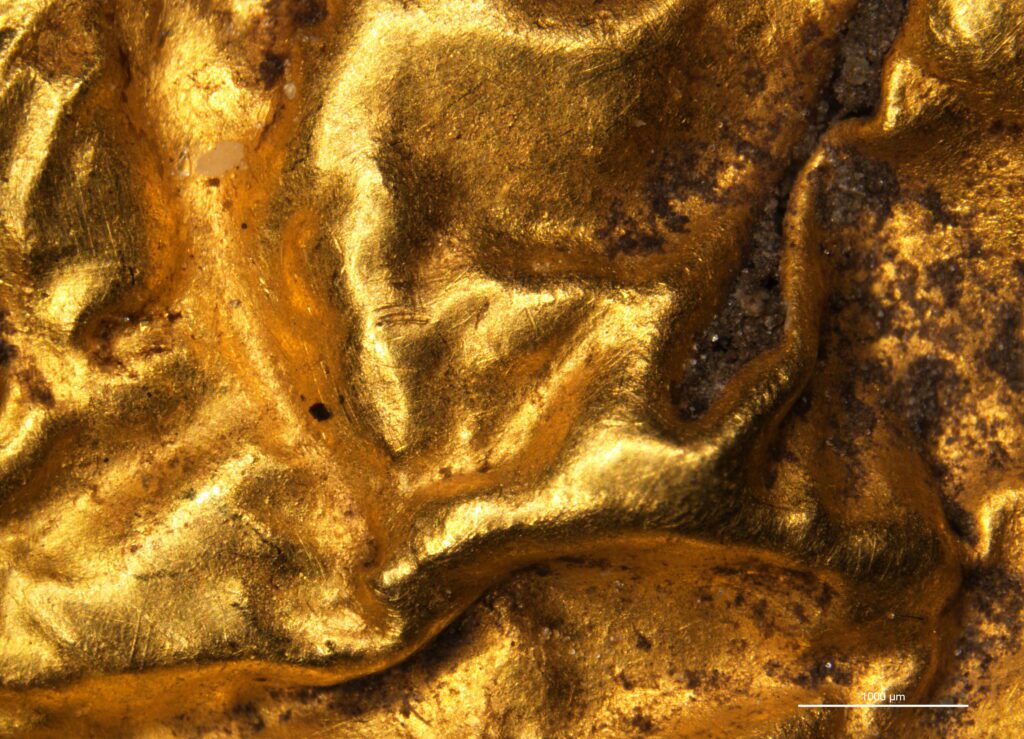
The artifact was discovered by Kjetil Særheim on his family farm in Klepp, in Rogaland province. So thin that it barely triggered his detector, the foil represents one of the most fragile categories of archaeological material in northern Europe.
While more than 3,600 gullgubber have been documented across Scandinavia—primarily in Denmark—Norway has yielded only around 50 examples. None had been found in Rogaland for over a century. The last known discoveries in the region date back to 1897, when 16 similar gold foils were uncovered at nearby Hauge.
This new find is therefore not just rare—it is geographically significant.
More Than Decoration: Symbols of Ritual Power
Unlike coins or jewelry, gullgubber were never meant for circulation or display. Archaeologists widely interpret them as ritual deposits, often associated with large communal halls—structures that likely served as political, social, and religious centers.
Sigmund Oehrl, professor of archaeology at the Archaeological Museum of the University of Stavanger, explains:
“We believe they were used in ritual contexts and placed as offerings in hall buildings.”
The imagery itself—typically depicting a man and a woman—has long intrigued researchers. Some interpret these figures as symbolic representations of sacred unions, possibly linked to fertility, alliances, or mythological narratives. Others see them as visual expressions of elite identity and authority.
A Landscape of Power Beneath the Soil
The discovery site in Klepp was already known to archaeologists. The surrounding area contains burial mounds and a ring-shaped courtyard, both indicators of long-term settlement and ceremonial activity.
The newly discovered gullgubbe strengthens the hypothesis that the site may once have hosted a large hall complex or cultic center—a focal point of regional power during the late Iron Age.
Unlike the 19th-century finds at Hauge, which were unearthed without proper documentation, this discovery comes with a precise archaeological context. That alone significantly increases its research value.
It allows scholars to begin mapping not just isolated artifacts, but the broader social and ritual landscape in which they were used.
Returning History to Its Place of Origin
The earlier gold foils discovered in 1897 were transferred to the University Museum in Bergen, as Stavanger had no museum at the time. This new gullgubbe, however, will remain in the region.
For the first time, a find of this kind from Klepp will be housed at the Archaeological Museum in Stavanger, close to where it was originally deposited nearly 1,500 years ago.