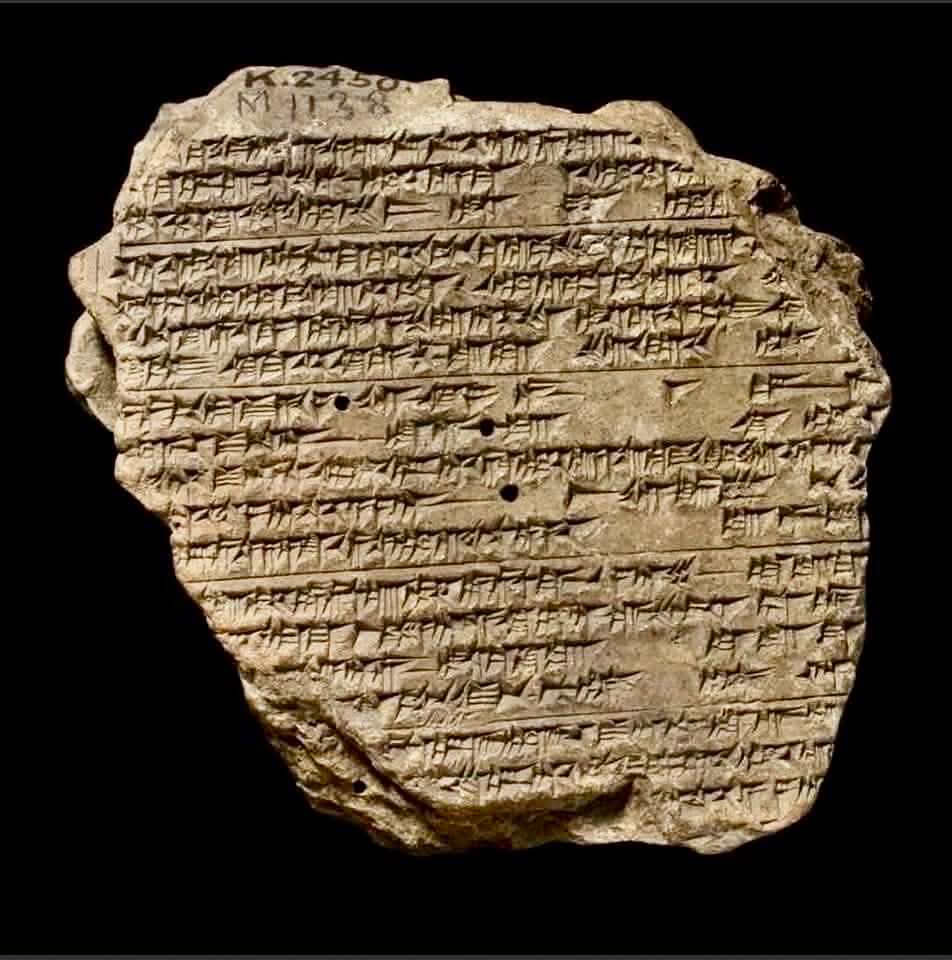
In the royal archives of Ashurbanipal, a small creature makes a radical demand.
It refuses fruit.
It rejects grain.
It asks to live between human teeth.
This is not medieval folklore or later legend. The claim survives in cuneiform, preserved on Neo-Assyrian tablets excavated at Ninova and now housed in the British Museum. These tablets contain direct textual evidence that ancient Mesopotamians believed tooth decay was caused by a supernatural worm.
And the evidence is written in Akkadian.
Primary Cuneiform Evidence
The best-known manuscript of the so-called “Tooth Worm Incantation” is preserved in the Kuyunjik Collection (including BM K.2413 and parallel fragments such as K.2450, K.5418, and K.8932). The surviving copies date to the 7th century BCE, though philological comparison indicates the tradition is considerably older, likely Old Babylonian in origin.
Below is the standard scholarly transliteration reconstructed from the tablet series:
enūma Anu šamê ibnu
šamû erṣetim ibnu
erṣetu nārāti ibnu
nārātu atappāti ibnu
atappātu ṣīru ibnu
ṣīru šēru ibnu
šēru šūšû ibnu
The cosmological chain moves from heaven to earth from rivers to marshland — and from marshland to the worm.
The text then shifts to dialogue:
ana mīnī akkal
ana mīnī ašatti
li-šakna-anni ina šinni u šēni
dāma šinni akkal
išdi šinni uḫtannab
A literal rendering reads:
“What shall I eat? What shall I drink?
Place me between the tooth and the gum.
I will eat the blood of the tooth
And gnaw at its root.”
The incantation typically concludes with an invocation of Marduk, whose authority is called upon to expel or destroy the worm through ritual speech.
Magic and Medicine, Not Superstition
This text does not stand alone as mythological narrative. It belongs to the Mesopotamian medical corpus, in which incantations were frequently paired with practical remedies.
Following the incantation in some manuscripts are therapeutic instructions involving plant mixtures and oils applied to the affected tooth. In Mesopotamian healing practice, the āšipu (ritual specialist) and the asû (physician) operated within a complementary system. Ritual speech and pharmacological treatment were not separate disciplines.
Scholarly editions by R. Campbell Thompson (1904) and later philological studies by Markham J. Geller confirm that the tooth worm incantation belongs to a broader, standardized healing tradition preserved in Ashurbanipal’s archive.
Archaeological Provenance
The tablets were recovered in the 19th century during excavations at Nineveh, specifically from the mound of Kuyunjik, where Ashurbanipal’s royal library once stood. Thousands of clay tablets from this archive were transported to London and catalogued.
Philological analysis confirms:
Language: Akkadian
Script: Neo-Assyrian cuneiform
Date of surviving copies: 7th century BCE
Tradition: likely rooted in earlier Babylonian textual transmission
Parallel versions of the same incantation appear in older Babylonian contexts, demonstrating continuity across centuries.
Why a Worm?
Advanced dental decay produces visible cavities and internal erosion. Without microbiological theory, the progressive hollowing of a tooth could plausibly be interpreted as the work of a living entity.
The Mesopotamian explanation frames this observation within cosmology. The worm originates in marshland — a symbolic source of life in Mesopotamian thought — and relocates into the human body. The model is theological, but it is built on empirical observation of symptoms.
Importantly, this belief did not remain confined to Mesopotamia. Variants of the tooth worm explanation appear in Egyptian, Greek, and medieval European traditions. The Nineveh tablets represent the earliest securely documented textual version.
Ongoing Research
The cuneiform medical corpus continues to be studied and translated through international projects, including initiatives supported by the Wellcome Trust. Digital imaging and philological reassessment are refining readings of tablets in the British Museum’s collection.
The tooth worm incantation remains one of the clearest examples of how ancient Mesopotamian medicine combined cosmology, ritual authority, and practical treatment into a single explanatory framework.
It is not a reconstruction from later folklore.
It survives in clay, inscribed nearly 2,700 years ago.
Primary Sources
The “Tooth Worm” incantation is preserved in Neo-Assyrian cuneiform tablets from the royal library of Ashurbanipal at Ninova. The principal manuscripts are housed in the British Museum (Kuyunjik Collection).
Language: Akkadian
Script: Neo-Assyrian cuneiform
Date of extant copies: 7th century BCE
Probable origin of tradition: Old Babylonian period (ca. 19th–18th century BCE)
Cover Image: BM K.2450
These editions provide transliterations, translations, and philological commentary on the dental incantation series and related medical texts.
Editorial Note
The Akkadian transliteration presented in this article follows comparative scholarly reconstructions based on the Kuyunjik manuscripts and published critical editions. Minor orthographic and lexical variations exist between tablets.