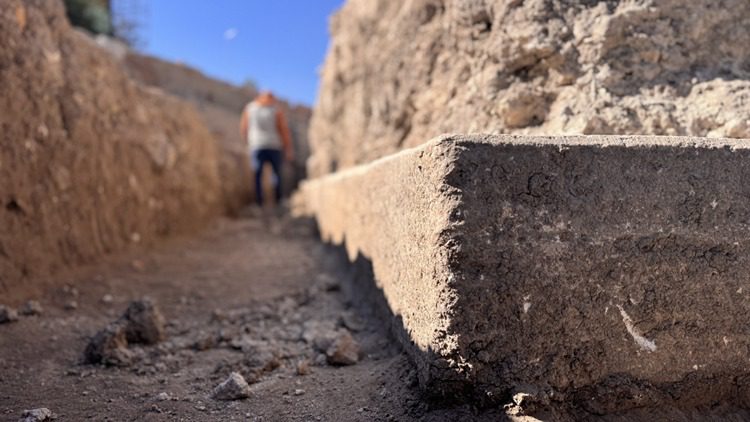
Beneath the busy streets of modern Konya, archaeologists have uncovered the foundations of a monumental gate once built to shield the Seljuk capital from Mongol invasions. The find confirms the existence of the long-debated outer fortifications constructed under Sultan Alaaddin Keykubat in the early 13th century — a discovery that rewrites the defensive map of medieval Anatolia.
A Forgotten Wall Beneath the City
Excavations led by the Konya Museum Directorate, supported by the Ministry of Culture and Tourism and the Konya Metropolitan Municipality, have revealed the remains of the Larende Gate — one of twelve entrances that once punctuated the city’s outer walls.
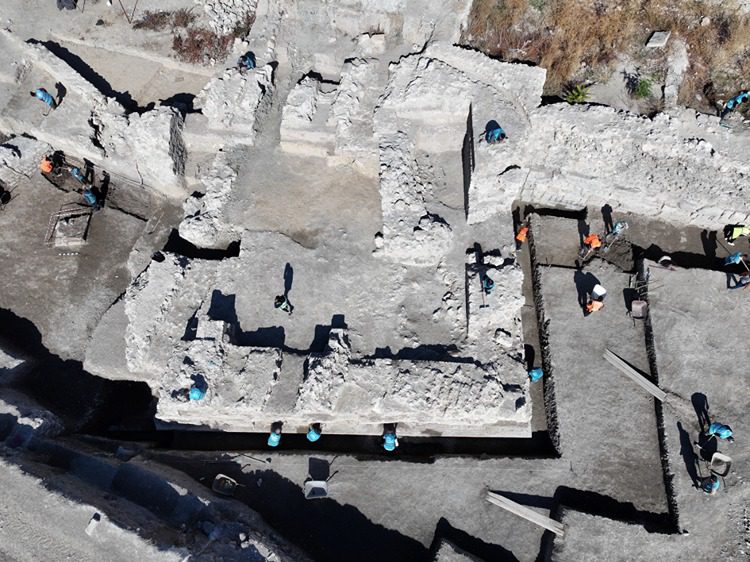
Archaeologists unearthed a 120-meter stretch of fortification and the 11-meter-wide foundations of the gate itself in the Sahipata neighborhood of Meram district. For more than a century, the structure was known only from 19th-century travelers’ sketches and Ottoman-era photographs. Now, its stones have emerged again from the soil of the former Seljuk capital.
“This discovery finally proves that the outer defense wall of Konya really existed,” said excavation director Mehmet Ali Çelebi. “We uncovered the base of the Larende Gate in its entirety — it was one of the four grand gates financed directly from the state treasury by Sultan Alaaddin Keykubat.”
Built Against the Mongol Advance
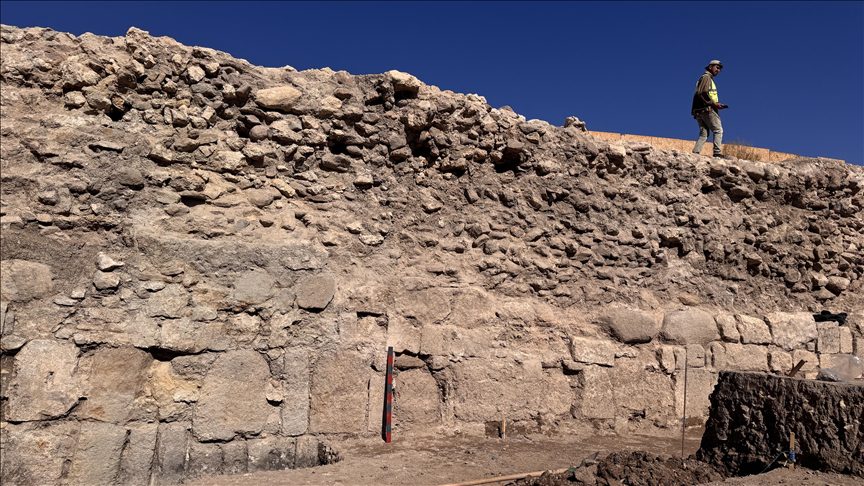
The massive outer walls, three meters thick and constructed using the sandık duvar (double-faced wall with rubble infill) technique, were designed as a robust shield during a turbulent era.
In the early 13th century, the Mongol threat loomed large across Central Asia, and the Seljuks, aware of the devastation it could bring, fortified Konya — their political and cultural heart — with an elaborate ring of walls stretching up to five kilometers.
Çelebi explains that these fortifications stood as a bulwark until 1255, when large sections were destroyed, only to be partially repaired under the reign of Fatih Sultan Mehmet centuries later. Over time, however, urban expansion consumed the stones; by the mid-19th century, the once-mighty walls had nearly vanished.
From Travelers’ Drawings to Archaeological Proof
For decades, historians debated whether Konya’s outer fortifications were real or merely symbolic representations from early travelogues.
Nineteenth-century European travelers like Charles Texier and Carl Humann had drawn the Larende Gate in their sketches, describing its ornate carvings and commanding presence at the southern entrance to the city. Those depictions, long treated as romanticized impressions, now find material confirmation.
“The Larende Gate was not just an entryway,” said Çelebi. “It was a statement of power — a gateway to the Seljuk capital facing the route to Karaman, known in the past as Larende. Its architectural design and scale tell us it was built to impress as much as to defend.”
The Angel Reliefs of the Larende Gate
The gate once featured carved angel figures and an inscription plaque, both of which are now preserved and displayed in the Karatay Tile Works Museum in Konya.
These carvings reflect the high craftsmanship of Seljuk stonemasons, whose blend of geometric precision and symbolic motifs became a hallmark of medieval Anatolian architecture.
Archaeologists also unearthed traces of the moat and the bridge piers that once spanned it, further confirming the city’s complex defense infrastructure. These findings help reconstruct how medieval Konya’s outer defenses operated — from layered walls to engineered water barriers.
Reframing Konya’s Medieval Landscape
The rediscovery of the Larende Gate adds a crucial piece to the puzzle of Konya’s medieval urban fabric. For years, the city’s outer defenses were believed lost to urbanization. This excavation not only locates one of its monumental gates but also redefines how the Seljuk capital interacted with its hinterland and trade routes.
The research team plans to continue excavations along the wall line, aiming to uncover additional segments of the fortification system. Once stabilized and conserved, the site is expected to become part of an open-air archaeological park that will allow visitors to walk the perimeter of what was once a city fortified against the steppe storms of the Mongol age.
A Capital at the Crossroads of History
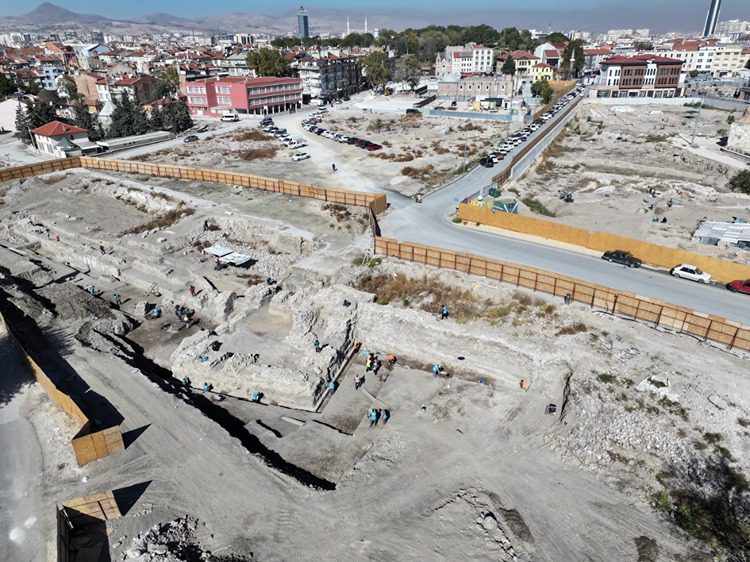
Under Sultan Alaaddin Keykubat I (r. 1220–1237), Konya reached its zenith as the capital of the Seljuk Sultanate of Rum, bridging Persian, Byzantine, and Turkic traditions. The rediscovery of the Larende Gate — the southern face of that imperial city — offers a tangible link to a moment when Konya stood as both a cultural beacon and a fortress on the frontier of history.
Cover Image: Detail of the Seljuk fortification wall discovered in central Konya — part of the lost outer defenses built under Sultan Alaaddin Keykubat to protect the city against Mongol incursions.