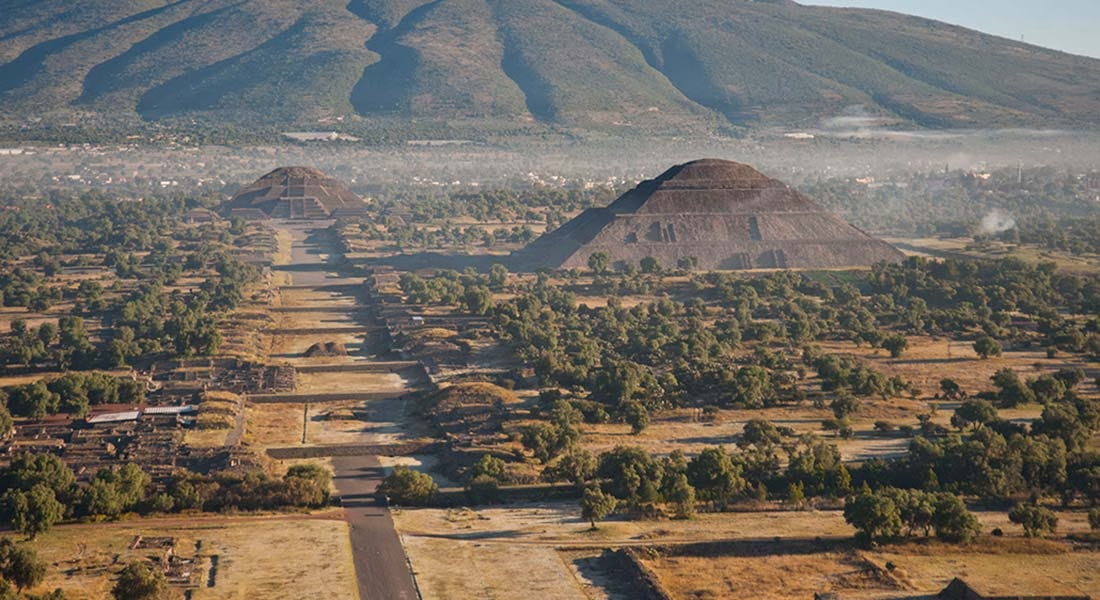
For centuries, one of Mesoamerica’s greatest enigmas has remained unsolved: the language of Teotihuacan. Now, two researchers from the University of Copenhagen — Dr. Christophe Helmke and Dr. Magnus Pharao Hansen — may have cracked the code behind the mysterious symbols covering the city’s ancient murals and pottery.
Their study, published in Current Anthropology, proposes that the signs found across Teotihuacan’s walls represent an actual writing system — and, more remarkably, that it records an early form of Uto-Aztecan, the language family that would later give rise to Nahuatl, the tongue of the Aztecs.
A “Rome of the Americas”
Founded around 100 BC in the Valley of Mexico, Teotihuacan flourished for more than six centuries. At its height, the metropolis boasted a population of over 100,000 and monumental structures such as the Pyramids of the Sun and the Moon. To ancient Mesoamerica, the city held a cultural and political influence comparable to that of Rome in the Mediterranean world.
Yet despite its grandeur, the identity of Teotihuacan’s people — and the language they spoke — remained a mystery.
“There are many distinct cultures in Mexico, but Teotihuacan has always been the most enigmatic,” says Hansen. “Until now, we didn’t know what they spoke or which later peoples they were connected to.”
The Signs Speak
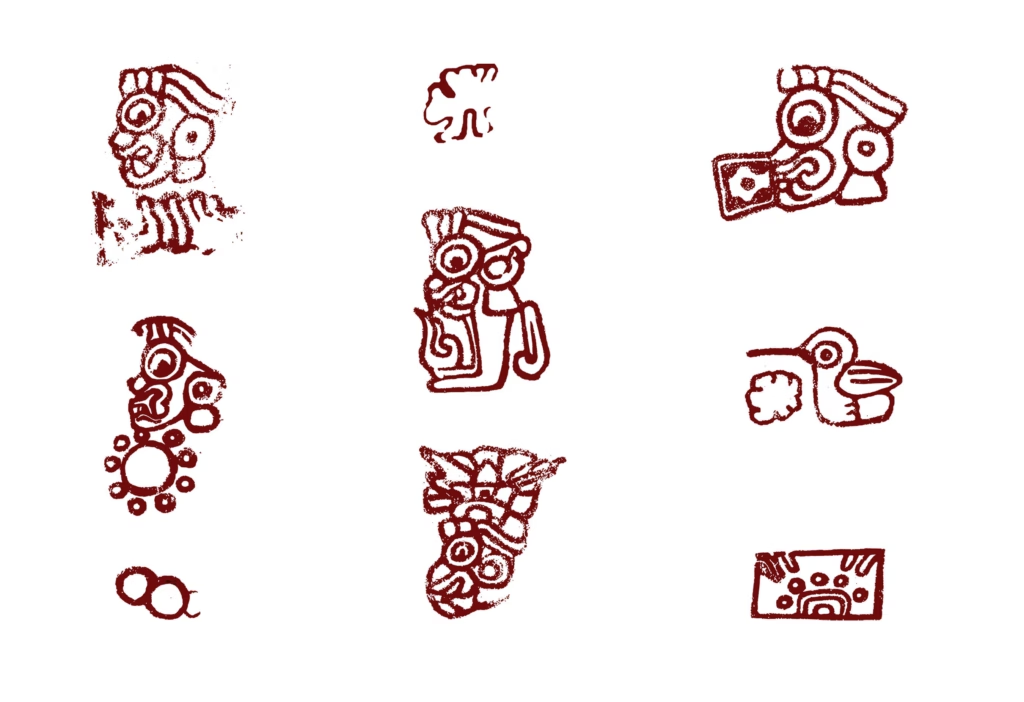
By closely examining more than a hundred symbols painted on murals and carved into ceramics, the Danish researchers argue that these are not mere decorations but a structured system of writing.
Their linguistic analysis suggests that the inscriptions preserve an early stage of Proto-Uto-Aztecan, a distant ancestor of today’s Cora, Huichol, and Nahuatl languages. This discovery challenges the long-held belief that Nahuatl speakers arrived in central Mexico long after Teotihuacan’s collapse.
“If we are right,” says Helmke, “then Nahuatl-speaking peoples may have been present in the region far earlier — possibly as direct descendants of Teotihuacan’s inhabitants.”
Reading the Walls
The decipherment relies on what the researchers call the rebus method, where images stand not only for ideas but also for sounds.
A coyote figure, for instance, might mean “coyote” in one context, but elsewhere serve as a phonetic syllable to form more abstract words. Understanding such puzzles requires reconstructing how Uto-Aztecan words may have sounded 2,000 years ago.
“It would be like trying to read Viking runes using modern Danish — you need a linguistic bridge from the same era,” Helmke explains.
Toward a Linguistic Renaissance
The discovery marks the first systematic attempt to align Teotihuacan’s visual language with a known linguistic family. The researchers hope that further murals and inscribed artifacts will confirm their hypothesis and help expand the decipherment.
“No one before us has used a language contemporary with Teotihuacan to interpret its writing,” says Hansen. “We’ve built a baseline that future scholars can test and refine. If confirmed, it could reshape our entire understanding of Mesoamerican civilization.”
For now, Teotihuacan’s murals continue to whisper from the walls — but perhaps, after two millennia, we are finally learning to listen.
Cover Image: The Mesoamerican city of Teotihuacan in central Mexico. Credit: Christophe Helmke, University of Copenhagen