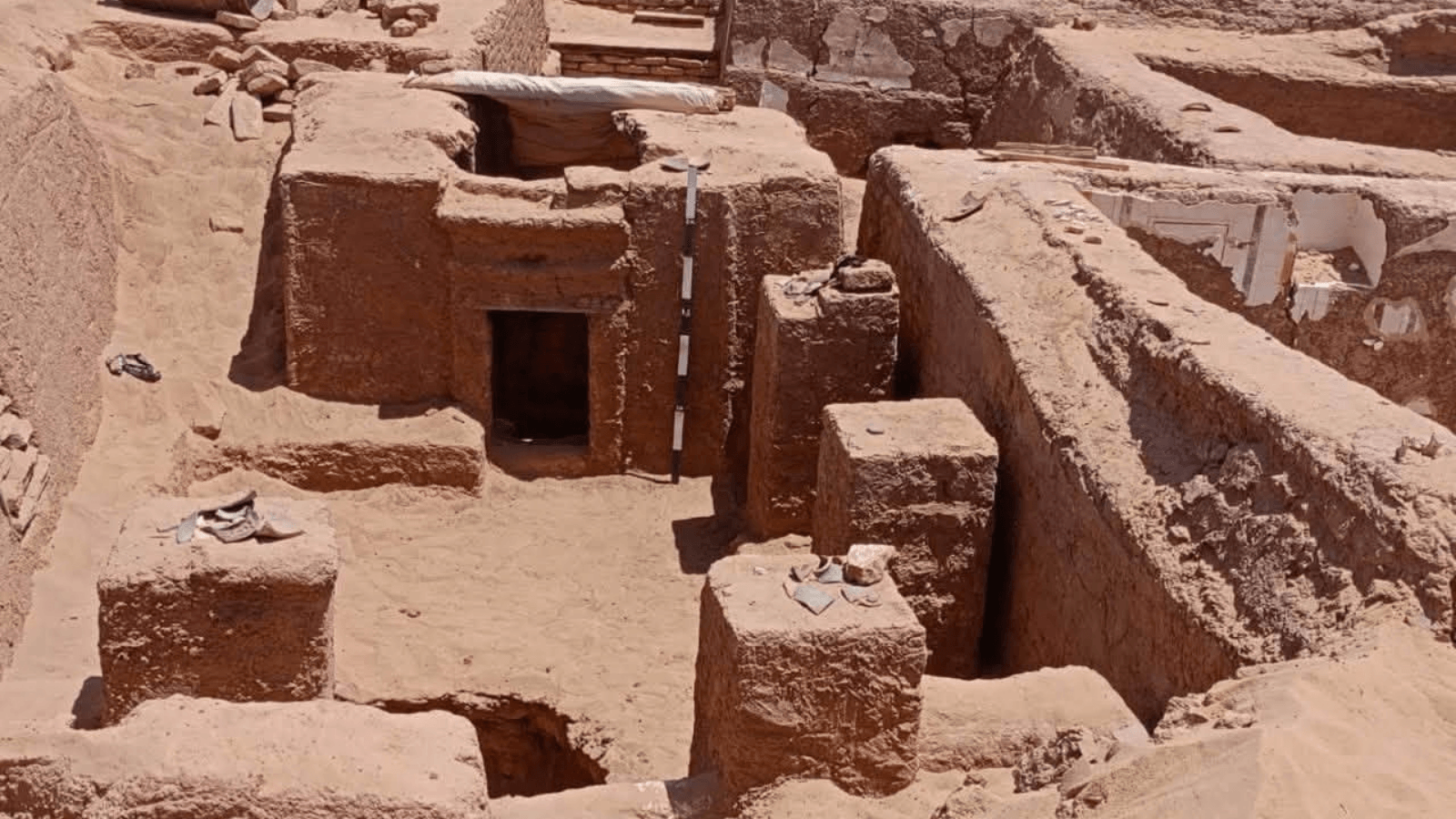
Fourteen steps descend to a stone doorway in Egypt’s Dakhla Oasis. Its carvings draw on ancient Egyptian beliefs about protection after death. Deeper inside the newly discovered tomb, archaeologists found a farewell written in another language: a 19-line funerary poem in Greek.
An Egyptian team from the Supreme Council of Antiquities uncovered the Roman-era tomb at Bir al-Shaghala, a cemetery near the ancient city of Mothis. The monument was built for a man and his wife. Its pyramidal upper structure is made of mud brick, while a carved stone entrance forms one of its most distinctive features.
An Egyptian vision of the afterlife
A cornice decorated with a winged sun and cobras crowns the entrance. Hieroglyphic texts and protective spells frame the doorway, while a scene depicting the seventh hour of the Amduat appears above it. This ancient Egyptian funerary text follows the sun god’s journey through the underworld during the night. According to the excavation team, the scene is a first among the tombs so far found at Bir al-Shaghala.
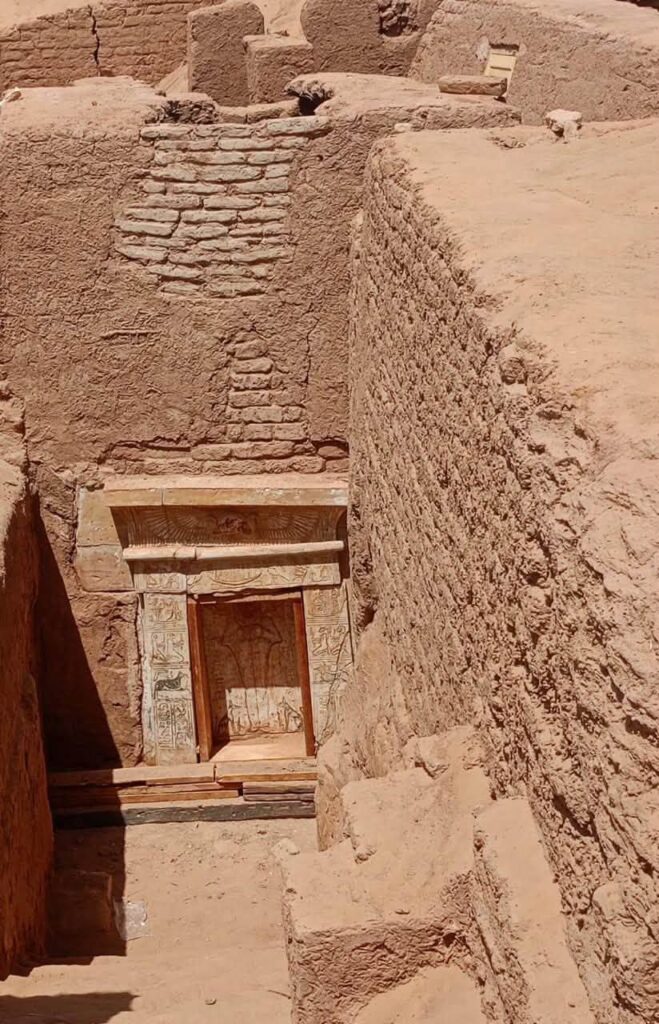
The entrance was sealed with a decorated stone slab. Beyond it, the steps lead to a hall with a sloping roof and two burial spaces. Part of the hall has collapsed, but enough survives to show how the builders arranged the rooms beneath the pyramidal structure.
The tomb also contained a sandstone offering table and purification basin, pottery vessels and a bronze coin depicting the Roman emperor Constantine. Archaeologists have raised the possibility that people reused the monument after its original construction. The coin therefore belongs to the tomb’s history, but does not by itself establish when the first burials took place.
A farewell written in Greek
The most personal find is a stone funerary stele bearing a poem written in red ink. Its 19 lines commemorate a man named Bisichthes. Researchers tentatively suggest that he may have served as a judge, although the full inscription and the evidence for that interpretation have yet to be published. They date the elegy to the late third or early fourth century CE.
Egyptian protective imagery and Greek verse meet in this one monument, but neither was out of place in the oasis. Scholars studying other tombs at Bir al-Shaghala have documented Greek and Demotic inscriptions side by side. In one previously excavated tomb, a short Greek farewell names a man called Apollonios; a Demotic inscription at the same doorway records his Egyptian name, Petophois, and his family. That is a separate burial, yet it offers a glimpse of the multilingual world in which the newly found poem was composed.
A cemetery outside Mothis
Bir al-Shaghala served Mothis, the capital of Dakhla Oasis in the Roman period. Excavations that began in 2002 have exposed tombs with different plans, including burial rooms below and chapels or pyramidal structures above. A previously studied tomb at the site had an upper chapel and spaces associated with funerary gatherings. Such monuments could remain places for the living to visit as well as places to bury the dead.
The new tomb preserves both sides of that relationship. Offerings and purification belonged to rituals carried out at the monument; the doorway’s spells addressed the dangers imagined beyond it. The Greek poem, meanwhile, asked visitors to remember a particular person. Its full reading may reveal more about Bisichthes and the family who chose these words for him.
Cover Image: Excavations at Bir al-Shaghala in Egypt’s Dakhla Oasis, where archaeologists uncovered a Roman-era tomb with a pyramidal mud-brick structure. Credit: Ministry of Tourism and Antiquities