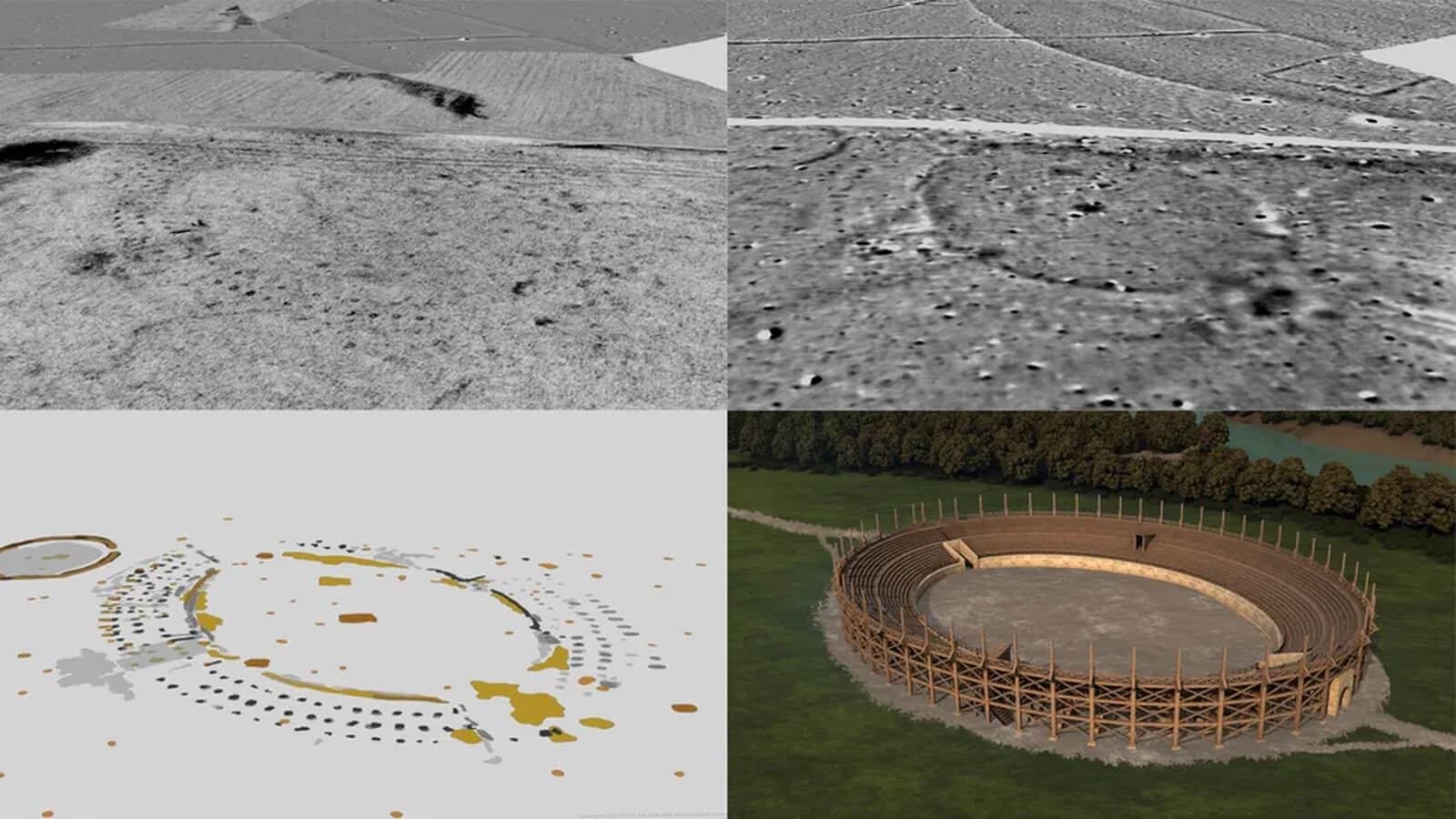
Archaeologists have identified a Roman city beneath fields near the Danube in Austria. Its planned streets cover 25 to 30 hectares, and a newly detected amphitheater could have seated around 8,000 spectators—an unexpected find beside a fort built for only about 500 soldiers.
The city lies at Stein, in the municipality of St. Pantaleon-Erla. Researchers believe it may be Claudivium, a settlement recorded by the second-century geographer Ptolemy, though its ancient name has yet to be confirmed.
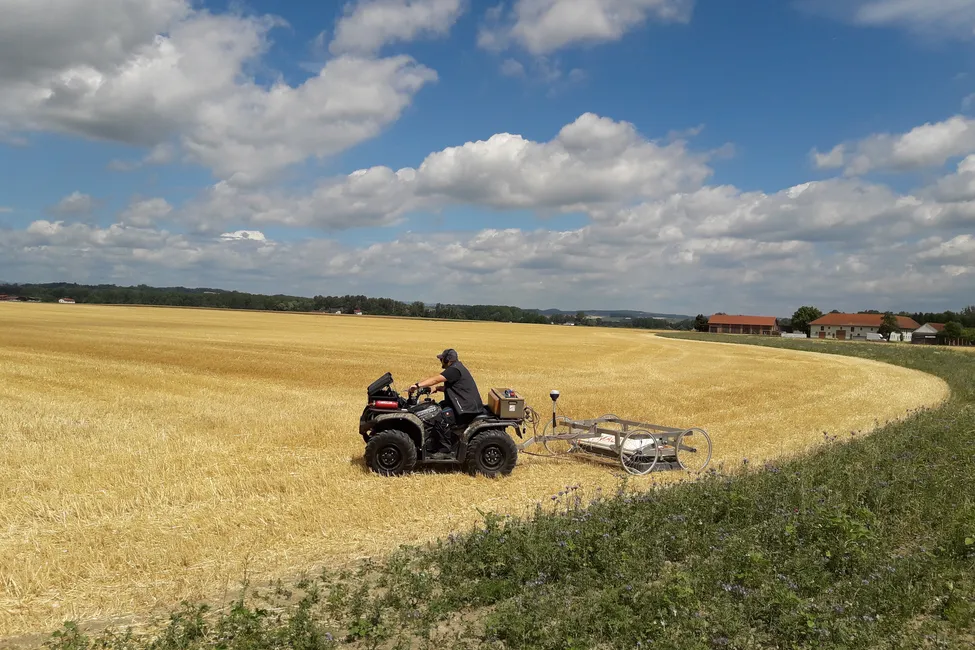
The discovery emerged from a project investigating roughly ten kilometers of the Roman Danube frontier around Enns. Since 2015, the team has combined geophysical surveys with excavations at selected locations, gradually revealing a network of settlements and military sites on both sides of the river.
More than a settlement beside a fort
Roman soldiers were already known to have occupied Stein. In 2017, University of Innsbruck archaeologist Gerald Grabherr discovered a second-century stone fort there. Later surveys revealed an earlier timber-and-earth camp dating to the first century.
The position mattered. Stein stood near a Danube crossing and the mouth of the Aist, whose valley offered a route north toward the Vltava and trading networks beyond Roman territory. A fort here could watch movement along both the river and the route into lands outside the empire.
Civilian communities often developed beside Roman forts to supply soldiers with goods and services. But Stein appears to have grown far beyond an ordinary fort settlement. Its regular street grid extends across 25 to 30 hectares, a scale Grabherr says has no known parallel beside an auxiliary fort housing approximately 500 troops.
The amphitheater strengthens the case that Stein was an important urban center. Geophysical measurements revealed its outline, and researchers estimate that it could have accommodated around 8,000 spectators—a capacity comparable to the amphitheater at Carnuntum, one of the best-known Roman centers on the Danube.
Roads leaving Stein passed burial grounds. To the northwest, researchers identified a large cemetery containing graves, funerary structures and mounds. Some are substantial, suggesting that people of considerable means may have been buried there. Excavations at the settlement’s southern edge also uncovered three Roman drying installations that the team thinks may have formed part of a brewery.
A city abandoned without destruction
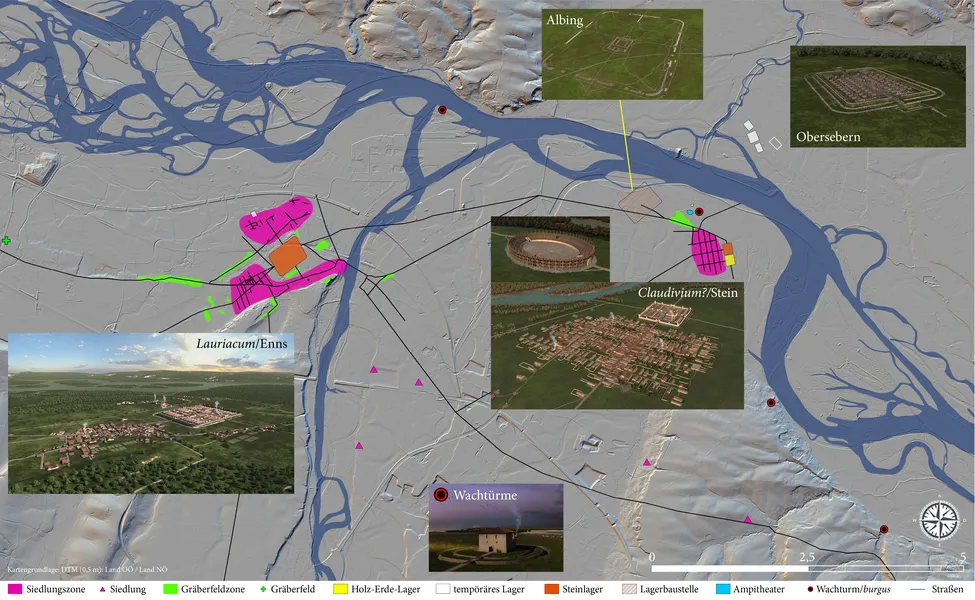
Stein was part of a wider Roman landscape whose plans appear to have changed. At nearby Albing, investigators found a legionary fortress that builders started but never finished. They dug foundation trenches and laid substantial foundations for its defenses and headquarters, yet never raised the walls. Several Roman camps north of the Danube also point to a concentration of troops in the area.
The city appears to have been occupied from around 80 to 180 CE. Archaeologist Barbara Kainrath of Research Archaeology says the finds suggest an organized withdrawal: the team has found no evidence that an attack destroyed the settlement.
Coin finds place its abandonment near the transition from Marcus Aurelius to his son Commodus. After becoming emperor in 180 CE, Commodus brought the Marcomannic Wars to an end. The researchers propose that a change in Roman frontier strategy led to Stein’s abandonment while Lauriacum, at modern Enns, remained in use.
Some of Stein’s residents may have moved there. Archaeologists at Lauriacum have found bronze-casting tools and types of dress brooch also known from Stein, which the team interprets as clues that some craftspeople relocated. The similar finds suggest a connection between the two places, though they cannot trace the journeys of individuals.
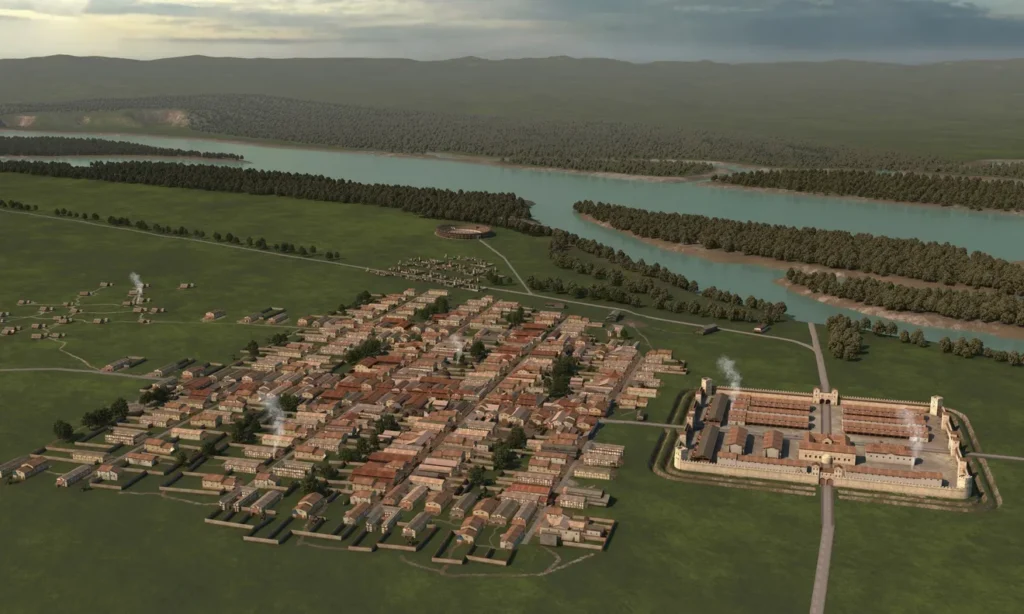
The question of the city’s name remains open. Ptolemy recorded Claudivium and gave coordinates for a nearby river entering from the north; researchers say these appear to fit Stein and the Aist. Further excavation may test that identification and explain why a substantial Roman city beside the Danube was given up after roughly a century.
Cover Image: Geophysical survey images, an archaeological plan and a reconstruction of the Roman amphitheater at Stein. Survey data: GeoSphere Austria; reconstruction: 7Reasons.