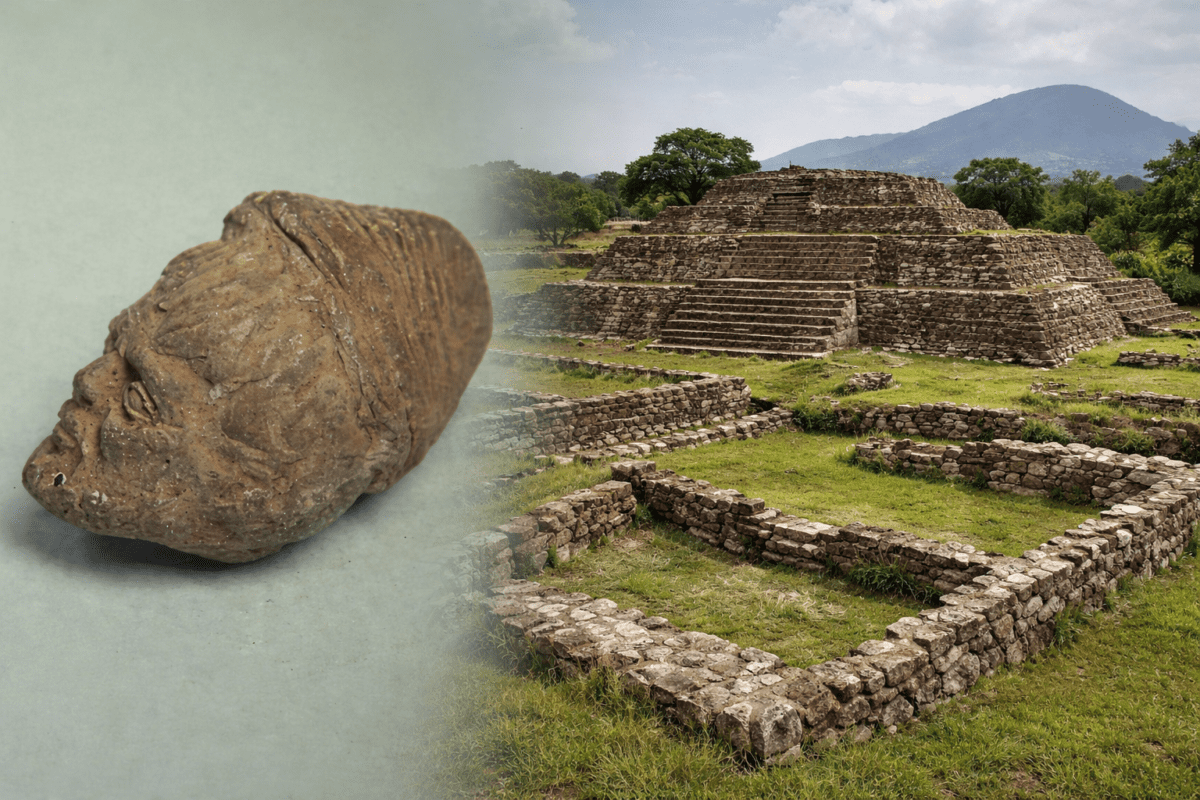
In central Mexico, at an ancient site long associated with pre-Hispanic civilization, a small terracotta head continues to unsettle one of history’s most accepted timelines. Known as the Tecaxic-Calixtlahuaca Head, the artifact was discovered inside a sealed burial—and yet its features appear unmistakably foreign, even Roman.
Nearly a century after its discovery, the object remains one of archaeology’s most debated anomalies.
A Discovery That Didn’t Fit
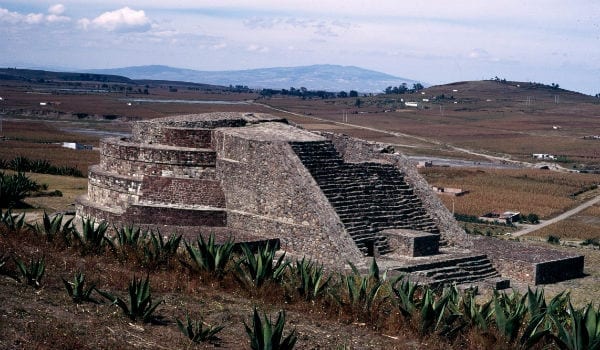
The story begins in 1933, when Mexican archaeologist José García Payón led excavations at Tecaxic-Calixtlahuaca, an important pre-Columbian site located about 65 kilometers west of modern Mexico City.
Beneath a pyramidal structure, his team uncovered a carefully sealed burial. The context was clear and undisturbed: three intact floor layers covered a funerary deposit containing ceramics, gold ornaments, bone artifacts, and fragments of rock crystal—materials entirely consistent with Mesoamerican traditions.
Then came the anomaly.
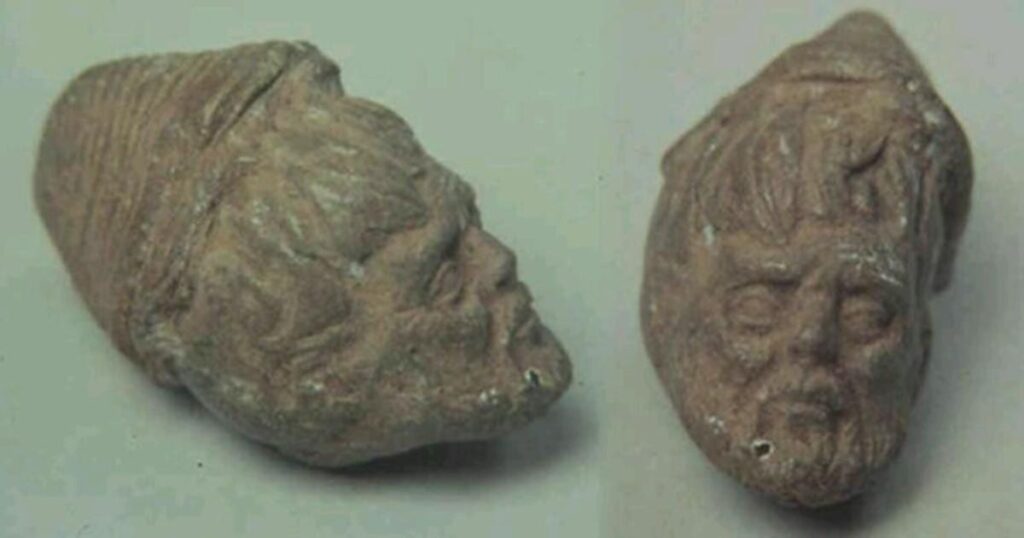
Among the offerings lay a small terracotta head depicting a bearded man. Its proportions, facial features, and sculptural style did not resemble known indigenous forms. Instead, the object carried a visual language more familiar to the ancient Mediterranean world.
Even at first glance, something felt off.
A “Roman” Object in an Unexpected Place
The mystery deepened decades later as specialists began to examine the artifact more closely.
In 1961, Austrian anthropologist Robert Heine-Geldern suggested the piece could date as early as 200 BCE. Later, in the 1990s, German archaeologist Bernard Andreae, former director of the German Archaeological Institute in Rome, offered a more striking interpretation.
According to Andreae, the head was “without any doubt Roman.”
He linked its stylistic features—particularly the beard and hairstyle—to the Severan period (193–235 CE), an era marked by distinct imperial portrait traditions. If correct, this would place the object’s origin firmly within the Roman Empire.
Scientific testing added weight, but not clarity. Thermoluminescence analysis conducted in Germany suggested the artifact could date anywhere between the 9th century BCE and the 13th century CE. Crucially, this range supports the possibility that the object predates European contact with the Americas.
A Timeline That Refuses to Align
The burial itself has been dated to between 1476 and 1510 CE, just years before Hernán Cortés arrived in Mexico in 1519.
That is where the problem becomes unavoidable.
If the head is genuinely Roman—or even broadly Old World in origin—how did it end up in a sealed pre-Hispanic grave? The context appears intact, the layers undisturbed. There is no obvious intrusion.
This contradiction has fueled decades of debate, with no clear resolution.
Competing Theories, No Consensus
Several explanations have been proposed over the years, each attempting to reconcile the artifact with established history.
One of the simplest possibilities is also the most controversial: that the object was planted during excavation. Some researchers have suggested that a member of Payón’s team may have introduced the head as a prank. The claim is difficult to verify. Documentation from the excavation is incomplete, and no direct evidence of tampering has ever been found.
Another theory places the object within the earliest phase of European exploration. The burial slightly overlaps with the decades preceding the Spanish conquest, raising the possibility—however slim—that a European artifact traveled inland before widespread contact.
Others have looked further back.
Some researchers, including Romeo Hristov, have proposed that an ancient ship—Roman, Phoenician, or Berber—could have drifted across the Atlantic, carried by currents. In such a scenario, objects might have reached the American coastline accidentally and later entered local exchange networks.
It is a compelling idea, though one that rests on possibility rather than evidence.
More speculative hypotheses suggest long-distance transmission through Eurasian trade networks or even indirect routes via Asia. These remain difficult to test and widely debated.
An Object That Refuses to Settle
What keeps the Tecaxic-Calixtlahuaca Head at the center of archaeological discussion is not just its appearance, but its context. The burial was sealed. The materials were consistent. And yet one object stands apart.
Archaeologist David Grove has noted that even if the artifact arrived through accidental means, it would not necessarily prove sustained contact between civilizations. At most, it would point to a rare and isolated event.
Still, the presence of such an object—however it arrived—raises questions that are not easily dismissed.
A Quiet Challenge to Established Narratives
The Tecaxic-Calixtlahuaca Head does not rewrite history. At least, not yet.
But it does something perhaps more important. It exposes the limits of certainty.
Archaeology is built on patterns, contexts, and probabilities. Occasionally, an object emerges that refuses to fit any of them. This is one of those cases.
Was it a hoax, an accident, or a trace of a forgotten encounter?
For now, the answer remains unresolved.
And the small terracotta face—buried for centuries beneath layers of earth—continues to look outward, carrying a story that no one has yet been able to fully explain.
Hristov R, Genovés S. MESOAMERICAN EVIDENCE OF PRE-COLUMBIAN TRANSOCEANIC CONTACTS. Ancient Mesoamerica. 1999;10(2):207-213. doi:10.1017/S0956536199102013
Cover Image Credit: AI-generated composite image representing the mysterious Roman terracotta head discovered at Tecaxic-Calixtlahuaca, juxtaposed with the ancient Mesoamerican pyramid where it was found.