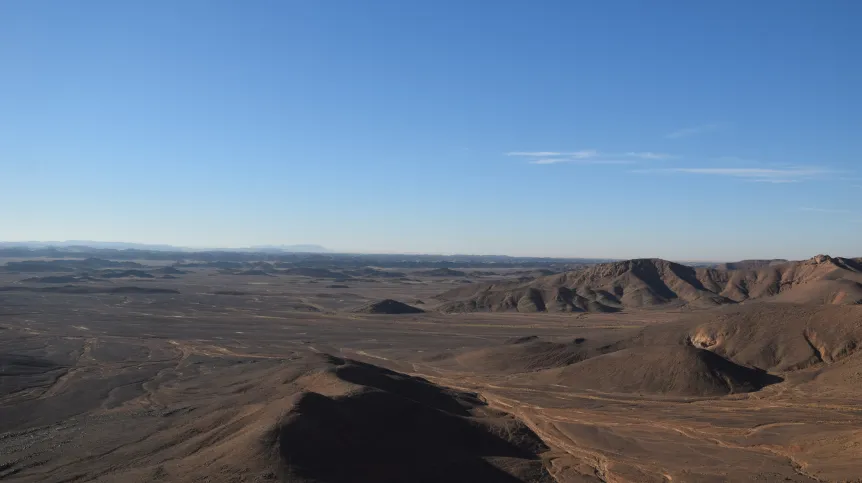
Between the Nile Valley and the Red Sea, hundreds of monumental tombs in the Atbai Desert have endured for millennia in a landscape often treated as empty space on the map.
A new archaeological study has identified 260 previously unknown monumental burial structures across the Atbai Desert, a vast arid region stretching through northeastern Africa from southern Egypt and eastern Sudan toward the Eritrean borderlands. The findings, published in African Archaeological Review, were made through the Atbai Survey Project, which used satellite imagery to trace a burial tradition far larger than archaeologists had previously recognized.
Researchers documented 280 Atbai Enclosure Burials in total. Most had never appeared in archaeological records before. Their distribution across such a broad area shows that ancient herding communities did not leave only scattered graves behind. They shaped parts of this desert with stone monuments, animal burials, routes, memory and ritual.
Stone Monuments Across a Difficult Desert
The Atbai Desert lies between Egypt and Nubia, two of the best-studied regions of the ancient world. Its own archaeology, however, remained less visible for a long time. The terrain is dry, wide and difficult to cross. Many areas sit far from modern roads and settlements.
Several thousand years ago, parts of this landscape offered more water, vegetation and seasonal pasture than they do today. During the later phases of the African Humid Period and the environmental shifts that followed, cattle, sheep and goats could still support a mobile pastoral life in places that now appear almost uninhabitable.

The most visible traces of those communities are the large stone burial enclosures now known as Atbai Enclosure Burials. From above, many look like circular or oval rings pressed into the desert floor. Some are only a few meters wide. Others reach more than 80 meters in diameter.
Inside them, archaeologists have recorded human graves, animal burials, smaller stone mounds and internal stone arrangements. These were not simple grave markers. They were planned mortuary spaces, built to be seen, used and remembered.
Satellite Archaeology Changed the Picture
A small number of these structures had been known before. For decades, they seemed rare. The new survey changed that view by moving the search from the ground to the sky.
As part of the Atbai Survey Project, an international team examined satellite and aerial imagery, including images available through Google Earth and Bing Maps. That method made it possible to scan huge areas that would be slow, costly and often impractical to cover only through fieldwork.
Across a long corridor from Upper Egypt through Sudan toward the Eritrean borderlands, the team recorded 280 monumental burial structures. Only about 20 were previously known. The other 260 were identified through remote sensing.
For Dr. Maria Carmela Gatto of the Polish Academy of Sciences, the pattern is too large to treat as a set of isolated monuments. It points instead to a cultural tradition spread across thousands of square kilometers. In Egypt, few undiscovered examples may remain. In Sudan, where the desert is larger and less fully mapped, more structures may still be waiting. The team plans to use machine learning to help complete the search.
Human and Animal Burials Shared the Same Space
The Atbai tombs stand out not only for their size. What they contained is just as important.
Cattle, sheep and goats appear repeatedly in the burial record. For pastoral societies, these animals were never only food or property. They represented wealth, movement, identity and social standing. In some communities, they also carried religious or symbolic value.
Several enclosures appear to have been arranged around a central human burial, with animal graves or other burials placed nearby. Such layouts may point to hierarchy inside these herding groups. The person at the center may have been a leader, a ritual figure or someone whose authority was tied to the control of herds.
These tombs preserve a rare trace of how ancient herders connected animals, authority and the dead.
Wadi Khashab Gives the Clearest Example
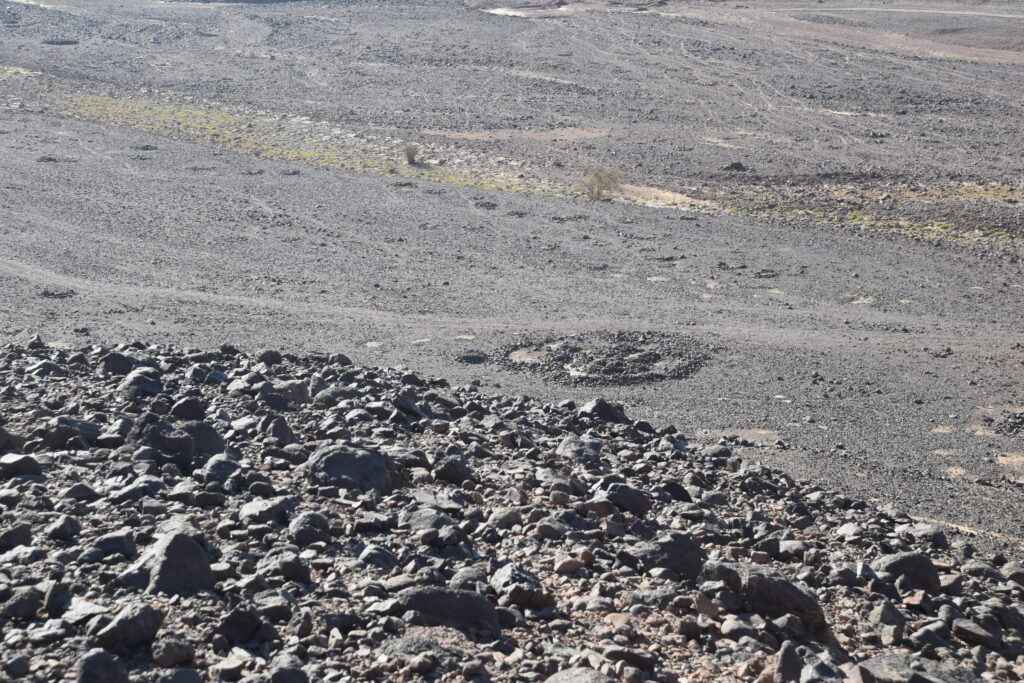
The best-excavated example comes from Wadi Khashab, in the northern Atbai. Polish archaeologists working there identified 25 burials inside a monumental enclosure.
At the center lay a human grave. Around it were burials of cattle, sheep and a child. The arrangement gives ground-level detail to what satellite images can only outline from above: a burial place where people and animals were placed according to a deliberate order.
Radiocarbon dating added another important detail. Roughly two thousand years after the monument was first built, its interior was altered and new burials were added.
That long use changes the meaning of the site. Wadi Khashab was not a grave visited for one generation and then forgotten. It remained a landmark, remembered and reused by later communities moving through the same desert.
Tombs Beside Water, Pasture and Old Routes
The burial enclosures were not placed at random. Many stand near ancient water sources, dry river valleys, grazing zones and natural corridors used for movement across the desert.
That pattern fits the logic of pastoral life. The builders chose places tied to survival: water, pasture and routes for people and animals. In some areas, satellite images also preserve old tracks, faint lines left by repeated movement across the desert surface.
The tombs belonged to that same network. A well, a grazing zone, a route and a burial monument could all form part of one lived landscape.
A Wider Pastoral World Written in Stone
Comparable monumental burial traditions are known from parts of the Sahara, East Africa and the Arabian Peninsula, including Libya, Niger, Chad, Kenya, Djibouti and Saudi Arabia. The Atbai discoveries add a major northeastern African chapter to that wider story.
The scale of the monuments also says something about the communities that built them. Even a single large enclosure required serious communal effort. Researchers estimate that building an average monument may have taken more than 161 days of one person’s labor, or several days for a group of 50 people.
It is harder, after this survey, to imagine these herding groups as small communities moving unnoticed across the desert. They built in stone. They buried animals alongside people. They returned to some places long after the first burials had been made.
The Atbai Desert may look empty at ground level. From above, it tells another story. Its newly recorded stone rings mark an ancient pastoral world of herds, routes, status and burial across one of Africa’s most demanding landscapes.
Cover Image: A wide view of the desert landscape in the Atbai region. Credit: The Atbai Survey Project