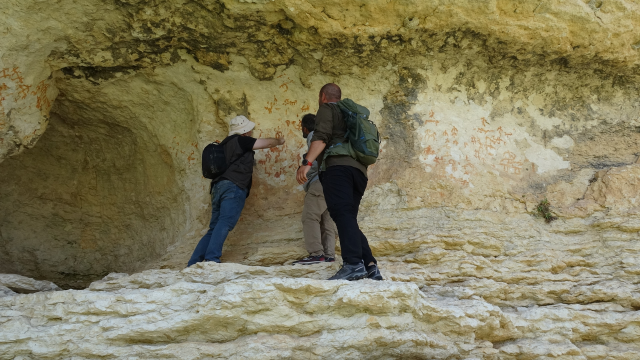
A prehistoric cave discovered in Tohma Canyon in Malatya, eastern Türkiye, may rank among the oldest and richest painted caves known in Anatolia.
Initial surveys identified nearly 100 human and animal figures on the cave walls, along with numerous geometric symbols. The paintings, made in red and reddish-brown tones, appear to belong to a symbolic visual tradition rather than a naturalistic one.
A prehistoric discovery in eastern Türkiye
The discovery was made during fieldwork led by Dr. Levent İskenderoğlu of İnönü University’s Faculty of Fine Arts and Design. The research team includes academics from İnönü University, Istanbul University and Fırat University.
While surveying the Tohma Canyon area, the team noticed painted surfaces inside the cave. Early observations revealed human figures, animal depictions and geometric signs spread across different wall panels.
The density of the images immediately set the site apart. This was not a cave with a few isolated marks. The walls appear to preserve a complex prehistoric visual record, one that may help researchers understand how early communities in Anatolia used line, image and symbol to express meaning.
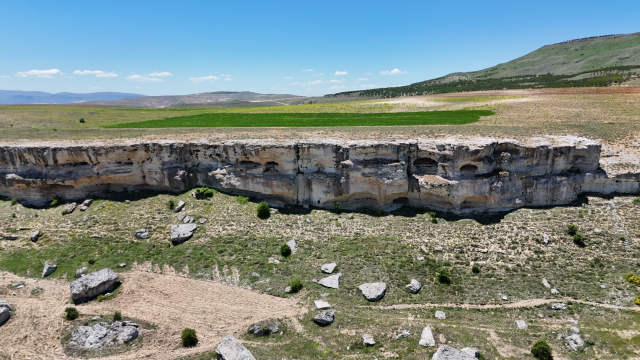
Human figures, animals and geometric symbols
According to Dr. İskenderoğlu, the paintings are not simply individual figures placed at random. In some areas, human forms, animals and geometric motifs appear together. Some lines intersect. Some figures overlap. Other parts of the cave show differences in style.
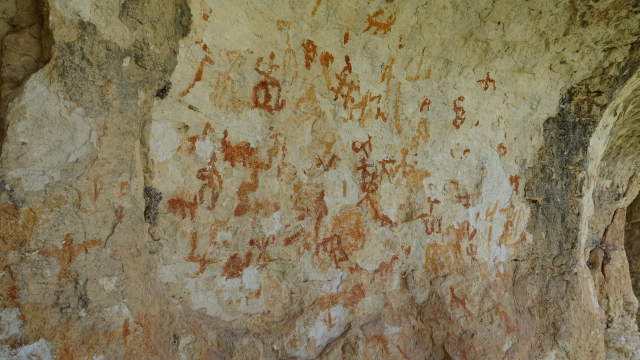
That layered structure may be one of the most important clues. It suggests that the cave was not used once and then abandoned. Instead, the same surfaces may have been revisited, altered and reinterpreted over a long period, possibly across generations.
The paintings also differ from the more naturalistic cave art traditions known from parts of Europe. The figures in Tohma Canyon are more schematic and symbolic, with a visual language that seems to emphasize signs, relationships and repeated forms.
A cautious link to the Neolithic period
The cave has not yet been definitively dated. Based on the first assessment, researchers suggest that it may cautiously be placed within the Neolithic period. The wider region, however, also contains traces of human presence from earlier prehistoric periods, which makes the site especially important for future study.
A firm chronology will require detailed surface documentation, laboratory analyses and pigment studies. The team plans to record the painted panels in detail, classify the figures, create inventory records and examine the technical features of the pigments.
Only after those studies will it be possible to understand when the paintings were made, whether the cave was used in different phases and how its visual program developed through time.
Among Anatolia’s major painted cave sites
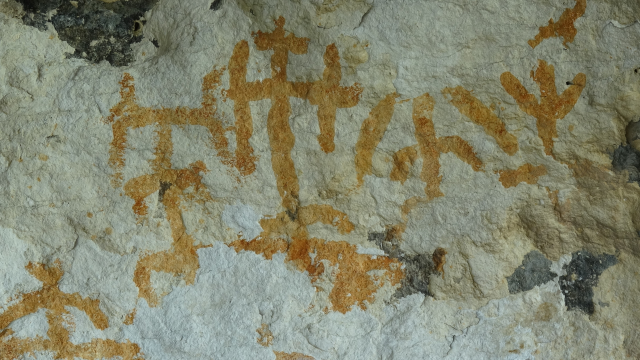
Dr. İskenderoğlu said the cave may become one of the most important painted cave sites yet documented in Türkiye.
The site is already being compared with major examples of prehistoric cave and rock art in Anatolia, including Beldibi in Antalya, Latmos near the Aydın-Muğla border and Doğu Sandal Cave in Mersin. What makes the Tohma Canyon cave stand out is the combination of figure density, subject variety and symbolic richness.
Nearly 100 figures, together with numerous geometric symbols, point to a visual world that was not merely decorative. The arrangement of humans, animals and signs may indicate a symbolic or ritual use of the cave, although researchers stress that this question can only be addressed after further study.
For Anatolian prehistory, the discovery is important because it adds a new painted site to a region already known for deep cultural continuity. For a wider audience, it offers rare evidence of how early communities used images not just to record what they saw, but to organize meaning on stone surfaces.
Recent damage raises concern
The discovery also comes with an urgent warning. Researchers observed traces of recent damage inside the cave, possibly linked to treasure hunting or unauthorized activity.
Dr. İskenderoğlu called for the site to be protected as soon as possible and warned against further damage.
“You cannot find gold or valuables here. What exists here are traces of human history,” he said. “Unfortunately, we encountered damage that appears to have taken place recently. Such interventions cause irreversible losses. Please do not harm this cultural heritage.”
The team will submit its first assessment reports to the relevant conservation board. The next stage will focus on documentation, protection and scientific analysis.